


Last updated: October 2026 Written by the LiftKitGuide Team, truck suspension installers and editors
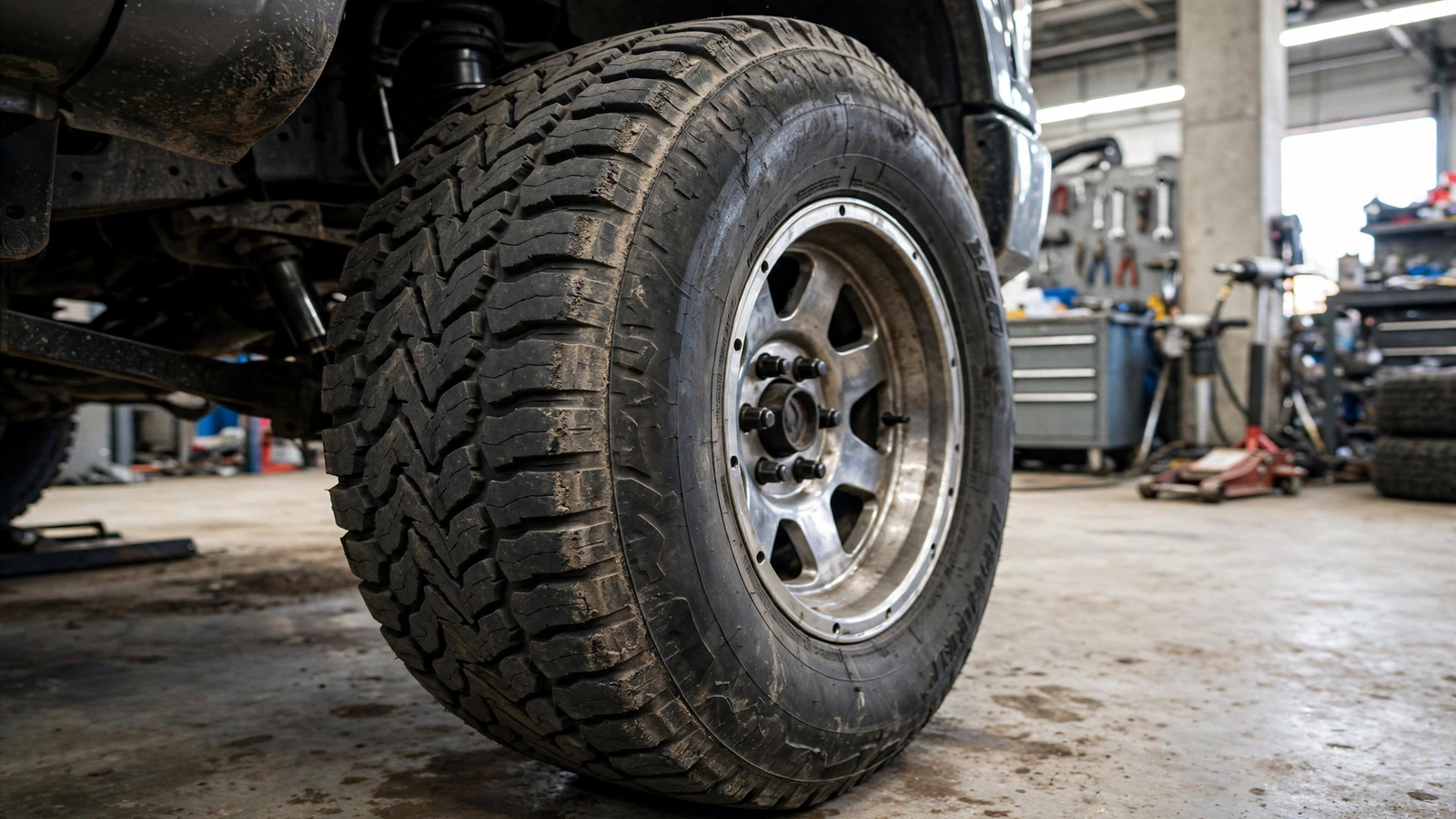
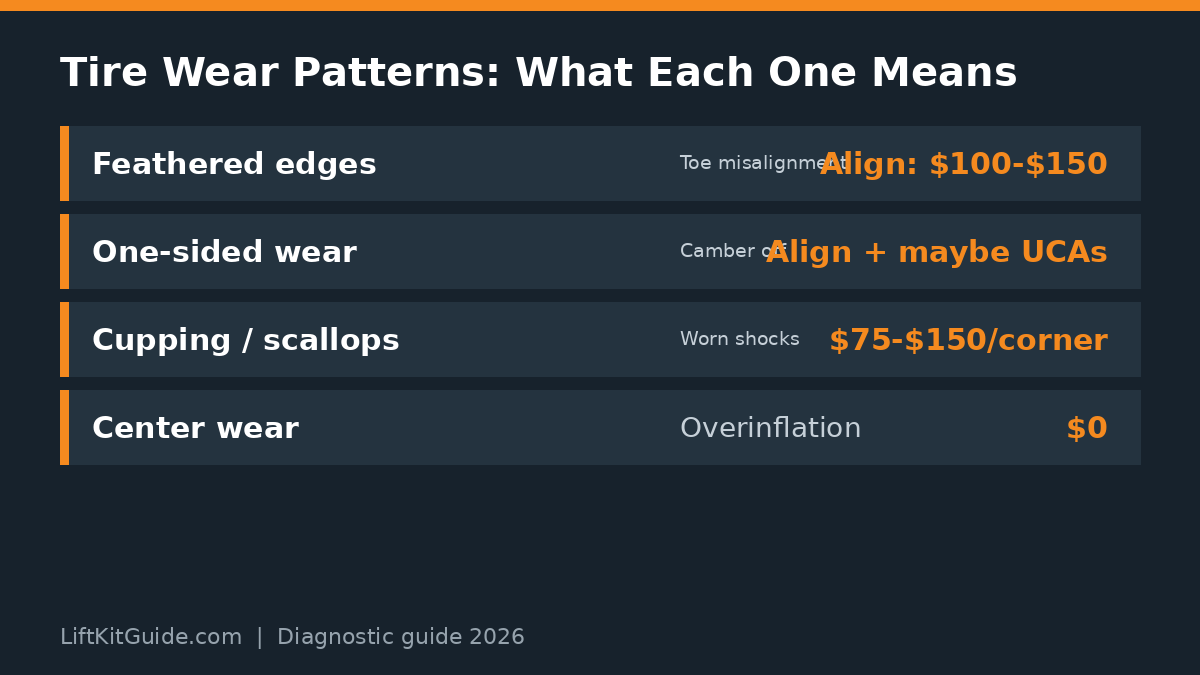
Why do my tires wear unevenly after a lift? Because lifting changes the alignment angles the tires were designed to run on: toe shifts as the tie rods swing through a new arc, camber goes positive as the suspension geometry changes, and many owners skip the alignment or the tire rotations the new setup demands. The pattern tells the story — feathered edges mean toe, one-sided wear means camber, cupping means worn shocks. A proper post-lift alignment plus rotations every 5,000 miles prevents most of it.
Key takeaways
- Feathered tread edges = toe problem; one-sided wear = camber problem; cupping = worn shocks or bushings.
- Lifting typically pushes camber positive — the top of the tire leans out and the outer edge wears.
- Rotate every 5,000 miles on a lifted truck; big tires punish skipped rotations fast.
- A post-lift alignment must correct caster, camber, AND toe — ‘toe and go’ is not enough.
- Catching a wear pattern early can save a $1,200+ set of 35s.
On this page
Why do my tires wear unevenly after a lift?
Tires wear evenly when three angles — toe, camber, and caster — hold the tread flat on the road. A lift kit changes all three at once: the tie rods swing through a different arc (changing toe), the control arms sit at new angles (pushing camber positive), and the steering axis tilts (reducing caster). The tires did not get worse; the geometry they roll on did. That is the fundamental answer to why do my tires wear unevenly after a lift, and it is why the wear often starts within the first few thousand miles after the install.
The second half of the answer is maintenance. Bigger, heavier tires amplify every alignment error — a tenth of a degree of toe that a stock tire would shrug off will feather a 35-inch mud tire visibly. And many owners keep rotating on the stock schedule (or not at all) while running tires that demand rotation every 5,000 miles. Combine shifted angles with skipped rotations and you get the classic post-lift complaint. The fix is unglamorous but effective: align it right, rotate it often, and the MPG penalty will be the only thing your tires cost you.
There is a settling factor that catches owners off guard when why do my tires wear unevenly after a lift shows up a month after a perfect alignment. A brand-new lift settles as the springs take a set and the bushings break in — typically a quarter to half inch over the first few hundred miles — and the alignment angles move with it. A truck aligned on day one can be measurably out by day thirty. Smart shops either align after a short break-in or offer a free re-check; if yours did neither, that 500-mile re-check is on you. This settling window is also when the most common lift regrets get locked in, so treat the re-check as part of the install, not an optional extra.
What wear pattern does bad toe create?
Bad toe creates feathering — the tread blocks develop a sharp edge on one side and a rounded edge on the other, like a saw blade. Run your hand across the tread (carefully, with the truck parked): if it feels smooth one way and catches your skin the other way, that is feathering, and it means the tires are being dragged sideways as they roll. Toe-in feathers the outside edges; toe-out feathers the inside edges. Either way, the tire is scrubbing rubber off every mile.
Toe wear is the fastest killer of the common patterns because the scrubbing is constant — a badly toed tire can go from new to noisy and feathered in under 5,000 miles. After a lift, toe changes because the tie rods operate at a new angle, and it changes again as the suspension settles over the first few hundred miles. That is why the alignment should happen after the lift, and why a re-check after the suspension settles is smart money. If you catch feathering early, correcting the toe stops it; the existing feathering will not reverse, but rotation can even out the noise and extend the tire’s life.
Why do my tires wear unevenly after a lift on the inside edge?
Inside-edge wear after a lift usually means too much negative camber or toe-out — but here is the twist: most lifted trucks actually wear the OUTSIDE edge first, because the lift pushes camber positive (top of the tire leaning out). If yours is wearing the inside edge, the alignment shop may have overcorrected, dialing in negative camber to compensate, or the toe is out at the same time. Either way, the answer to why do my tires wear unevenly after a lift on the inside edge is on the alignment printout, not in the tire. When that question is why do my tires wear unevenly after a lift, the printout is the first place to look.
The fix is camber back near zero. On IFS trucks that means the alignment cams; on trucks where the stock cams max out before camber reaches spec — common at 3 inches of lift and up — it means aftermarket upper control arms with more adjustment range. Do not let a shop tell you visible positive camber is ‘the best they can do’ without mentioning UCAs; that visible lean-out is exactly what eats the outer shoulder off a $300 tire. Owners in this Tundra owners thread ran into precisely this wall, where the stock adjustments were maxed and only aftermarket arms could bring camber home.
| Wear pattern | What it looks like | Root cause |
|---|---|---|
| Feathering | Sharp edge one way, smooth the other | Toe misalignment |
| Inside-edge wear | Inner shoulder bald, rest fine | Too much negative camber or toe-out |
| Outside-edge wear | Outer shoulder bald, rest fine | Too much positive camber (common after lift) |
| Cupping / scalloping | Dips around the tread | Worn shocks, bushings, or balance |
| Center wear | Middle bald, edges fine | Overinflation |
Can worn shocks cup your tires?
Cupping — also called scalloping — looks like a series of dips scooped out around the tread, and it is the signature of a tire that is bouncing instead of rolling. Worn shocks cannot control the wheel’s up-and-down motion, so the tire leaves the pavement and slams back down thousands of times per mile, hammering the same spots. Bad wheel balance and worn bushings do the same thing. If your tread looks like a washboard, the tires are telling you the suspension is not controlling them.
After a lift, cupping often traces back to shocks that are wrong for the new setup: stock-length shocks topped out on a taller lift, or cheap shocks that faded within a year. The bounce test is crude but useful — push down hard on each corner and let go; the truck should rise and settle, not keep bouncing. Any corner that pogos needs shocks. Quality replacements run $75 to $150 per corner for monotubes, and they are the difference between tires that last 40,000 miles and tires that cup themselves to death in 15,000. This is also why buying a complete quality kit beats piecing together spacers and stock shocks.
A practical tip for anyone asking why do my tires wear unevenly after a lift while staring at cupped tires: do the bounce test before you blame the alignment. Push down hard on each corner of the truck and release — the corner should rise and settle once, not keep bouncing. A corner that pogos has a dead shock, and no alignment on earth will stop that tire from cupping. This test takes two minutes, costs nothing, and has saved countless owners from paying for a second alignment that could never fix a damping problem. Replace the dead corners in pairs (both fronts or both rears) so the damping stays balanced side to side.
How does tire pressure change wear after upsizing?
Tire pressure is the most neglected variable in the whole why do my tires wear unevenly after a lift discussion. The door-jamb sticker pressure was calculated for the stock tires; your 35s or 37s almost certainly want a different number. Underinflation wears both outer edges (the tire’s shoulders carry the load while the center lifts), overinflation wears the center (the tire balloons and only the middle touches). Either mistake is invisible until the wear pattern is already set.
The right method is the chalk test: draw a chalk line across the tread, drive 100 feet straight, and read the wear. Chalk gone from the center only means overinflated; gone from the edges only means underinflated; even wear means the pressure is right for your truck’s weight. Most 35-inch all-terrains on a half-ton land between 32 and 38 psi for daily driving — but verify with the chalk, not with a forum guess. Check pressures monthly, because a slow leak on one corner creates a one-tire wear pattern that looks exactly like an alignment fault.
It is worth running the numbers on pressure when why do my tires wear unevenly after a lift keeps coming up despite a good alignment. Dropping from 35 psi to 28 psi on a 35-inch tire can cut its load capacity by hundreds of pounds per corner, letting the sidewalls flex and the shoulders scrub — and the wear looks identical to a camber problem. Conversely, the 40+ psi some shops default to on big tires balloons the center. The chalk test described above is the only honest way to set pressure for YOUR truck’s weight; the number on the forum is for someone else’s truck. Recheck seasonally, because a 30-degree temperature swing moves pressures several psi.
How often should you rotate tires on a lifted truck?
Every 5,000 miles — no exceptions, no ‘I’ll do it next oil change.’ Big tires on a lifted truck wear faster and less evenly than stock, so the rotation interval that was fine before is not fine now. Front tires take the steering and most of the braking load, which is why the fronts always wear faster; regular rotation spreads that punishment across all four (or five, if you run a full-size spare in the rotation, which you should).
Use the right pattern: for non-directional tires, the rearward-cross (rears straight forward, fronts cross to the rear) is the standard. For directional tires, keep them on the same side and just move front to back. Mark each tire’s position with chalk so you can verify the shop actually rotated them — it happens more than you would think. Skipped rotations are the number one reason a $1,200 set of 35s dies at 25,000 miles instead of 45,000, and no alignment can compensate for rubber that was never moved. Pair the habit with the rest of your 35s setup and the tires will finally pay for themselves.
One more rotation detail that matters when why do my tires wear unevenly after a lift is the worry: include the full-size spare in the rotation and you turn four-tire wear into five-tire wear, stretching the set’s life by roughly 20 percent. The pattern is simple — rotate the spare in with every 5,000-mile service so all five wear evenly. This only works if the spare matches (same size, same model); a mismatched spare belongs on the truck only long enough to reach a tire shop. Given what a set of 35s costs, the ‘free’ extra tire life from a five-tire rotation is the best value in truck maintenance, right up there with keeping the rest of the setup affordable.
What alignment specs protect tires on a lifted truck?
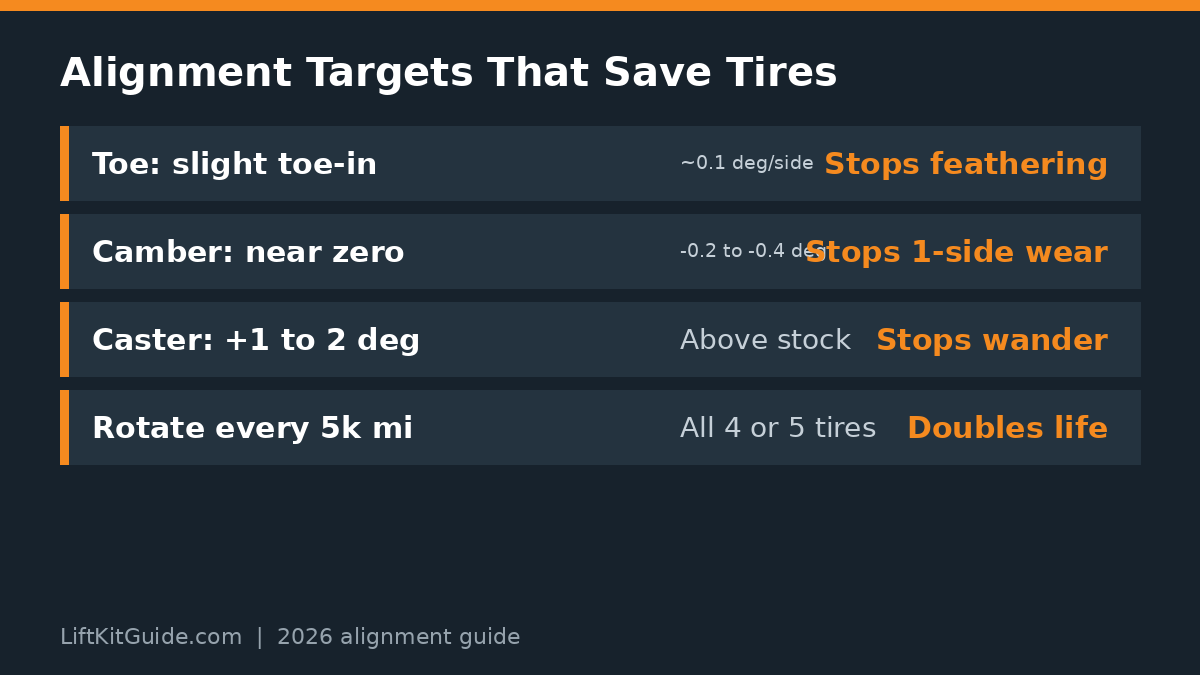
Ask for these numbers by name when you book the alignment, because a generic ‘set it to spec’ often means the shop aims for the middle of the factory range — which was written for stock ride height. Toe should be a slight toe-in, roughly 0.1 degree per side, set evenly left to right. Camber should sit near zero, with a touch of negative (around -0.2 to -0.4 degrees) ideal for even wear since cornering forces roll the tire onto its outer edge. Caster 1 to 2 degrees above stock keeps the truck tracking straight, which prevents the constant corrections that scrub tires.
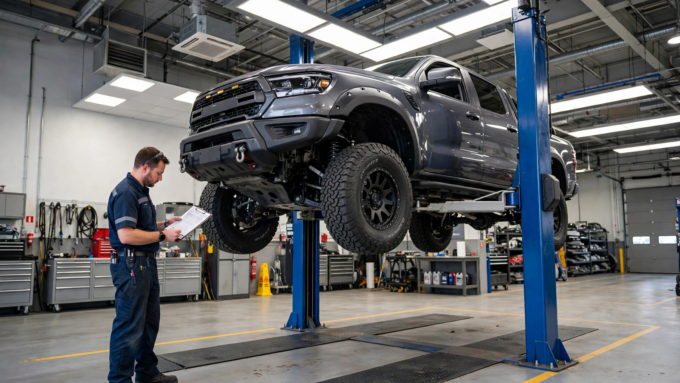
Get the printout and read it. If camber or caster cannot reach these targets with the stock adjustments maxed out, that is the shop telling you — in numbers — that you need aftermarket upper control arms, not that ‘this is the best we can do.’ And always align AFTER the suspension has settled (a few hundred miles) or re-check then; a fresh lift settles and the angles move with it. The $100 to $150 alignment is the cheapest tire insurance in the truck world, far cheaper than the total cost of lifting lesson owners learn when they skip it.
| Angle | Target on a lifted truck | What it prevents |
|---|---|---|
| Toe | Slight toe-in, ~0.1 deg per side | Feathering and edge scrub |
| Camber | Near zero (-0.2 to -0.4 deg ideal) | One-sided shoulder wear |
| Caster | 1-2 deg above stock spec | Wander (indirectly saves tires) |
| Thrust angle | Near zero | Rear tire scrub and ‘crabbing’ |
When is uneven wear a sign of a bigger problem?
Most uneven wear is gradual and alignment-related, but sudden or one-sided-on-one-tire wear is a distress signal. A wheel bearing going bad lets the tire wobble microscopically, which cups the tread fast; a sticking brake caliper overheats one tire and wears it rapidly; a bent rim from a pothole creates a permanent hop. When why do my tires wear unevenly after a lift shows up on a single tire while the other three look fine, stop thinking alignment and start thinking component failure on that corner. And when why do my tires wear unevenly after a lift is the symptom, that discipline pays for itself in rubber.
The timeline matters too. Wear that appears within weeks of a lift install points at the install — usually a skipped or botched alignment. Wear that appears a year later on a truck that was fine points at worn parts: ball joints, tie rod ends, bushings, or shocks that have given up. Either way, read the pattern, check the dates, and fix the cause before buying new rubber — because new tires on an unfixed problem just become expensive new victims. That discipline is what separates owners who get 45,000 miles from a set of 35s from owners who get 20,000.
- Sudden onset: a tire that was fine and starts wearing fast points to a new failure — check ball joints, wheel bearings, and tie rod ends.
- One tire only: single-tire wear is rarely alignment; suspect that wheel’s bearing, a bent rim, or a sticking brake.
- Wear plus noise: humming or roaring that changes with speed alongside cupping means bearings or severe cupping — inspect immediately.
- Wear plus pull: the truck drifting and wearing at once suggests toe or thrust angle is significantly off.
- Wear after new parts: fresh wear right after a lift install means the install skipped the alignment — go back before the tires pay for it.
Frequently asked questions
How long do 35-inch tires last on a lifted truck?
40,000–50,000 miles for all-terrains with proper alignment and rotations; 30,000–40,000 for mud-terrains.
Will an alignment fix already-uneven tires?
It stops further uneven wear but cannot restore lost rubber. Rotate and align immediately.
Do I need upper control arms to stop tire wear?
Yes, if stock adjustments max out before reaching spec, which is common at 3+ inches of lift.
Can overinflation cause center wear on 35s?
Yes — overinflation balloons the tire onto its center tread. Use the chalk test to set pressure.
Why are my front tires wearing faster than the rears?
Fronts handle steering and braking, so faster front wear is normal — which is why rotations matter.
The bottom line
Uneven tire wear after a lift is the truck telling you, in rubber, that the geometry changed and the maintenance did not keep up. Read the wear pattern — feathering means toe, one-sided wear means camber, cupping means the shocks or bushings are done — then fix the angle and the habit behind it. Alignment plus 5,000-mile rotations solves the overwhelming majority of cases.
Do not buy new tires until the cause is fixed. A fresh set of 35s on an unaligned truck is just a $1,200 donation to the same wear pattern. Align it, rotate it, check pressures monthly, and your tires will last the way the mileage warranty says they should.



Leave a comment