


Last updated: October 2026 Written by the LiftKitGuide Team, truck suspension installers and editors
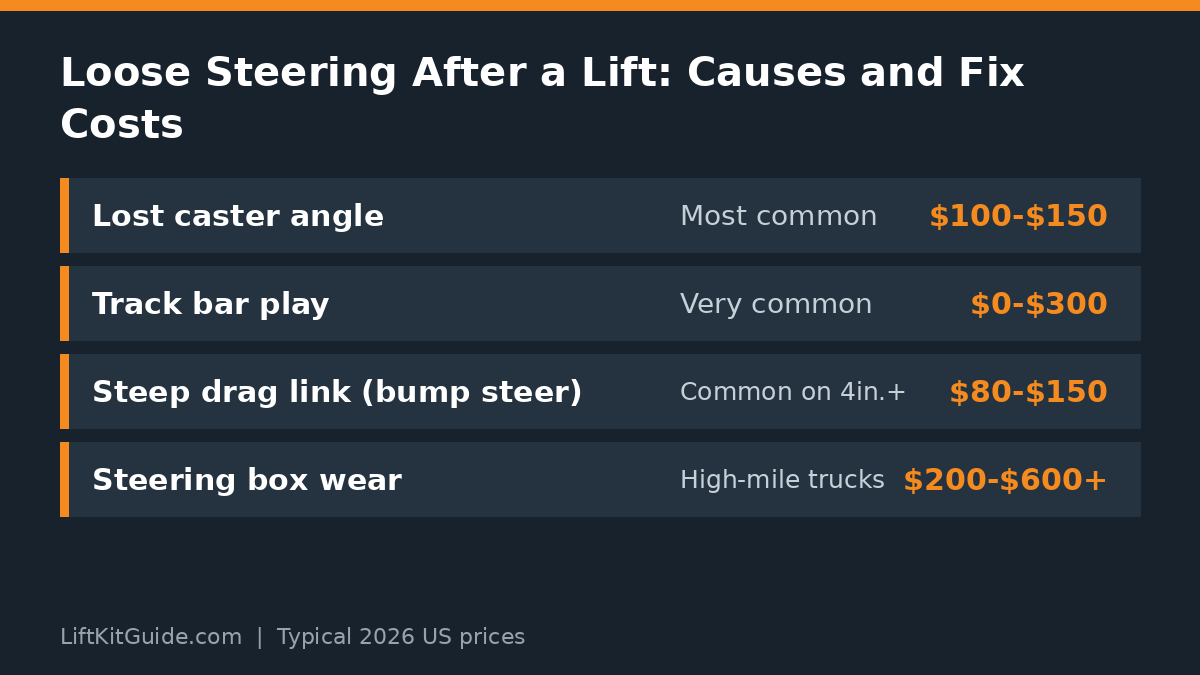
Why does my steering feel loose after a lift kit? The most common cause is lost caster: lifting rotates the front axle and reduces the caster angle that gives steering its self-centering stability, leaving the wheel light and vague. Other suspects include a worn track bar, loose tie rod ends, steering box play, and steep drag link angles causing bump steer. The fix is an alignment with caster restored to spec (often 1–2 degrees above stock), plus a torque check of every steering bolt.
Key takeaways
- Lifting typically costs 2–3 degrees of caster — the main reason steering feels loose and vague.
- Adding 1–2 degrees of caster above factory spec restores straight-line stability and return-to-center.
- Check the track bar, tie rod ends, and steering box for play before buying any parts.
- A steep drag link angle causes bump steer; a drop pitman arm or raised steering arm fixes it.
- Always align after a lift and re-torque steering hardware after 50 miles.
On this page
Why does my steering feel loose after a lift kit?
Steering feel comes from geometry, and a lift kit rearranges that geometry. The single biggest change is caster: the fore-aft tilt of the steering axis that makes the wheels want to track straight and the wheel want to return to center. Lifting rotates the front axle housing, which tilts the steering axis back toward vertical and steals 2 to 3 degrees of caster. The result is steering that feels light, vague, and unwilling to center itself — the classic answer to why does my steering feel loose after a lift kit on trucks and Jeeps that drove perfectly before the install.
The good news is that this kind of looseness is a setup problem, not a broken-parts problem. Nothing has to be worn out for the steering to feel wrong; the angles are just no longer what the truck was designed around. That is why the fix is usually an alignment with corrected caster rather than a parts cannon. If the looseness appeared the day the lift went on and nothing was worn before, suspect geometry first, and read our guide to common post-lift mistakes to see what else the install may have skipped.
How does lost caster make steering feel vague?
Think of caster like the front wheels of a shopping cart: the tilt of the pivot is what makes the wheels trail behind and track straight. Positive caster puts the tire’s contact patch behind the steering axis, so the tire naturally wants to roll straight and the steering wheel naturally returns to center after a turn. Reduce that tilt and the self-centering force fades — the truck wanders, needs constant correction, and feels disconnected, especially on the highway.
On a lifted truck the fix is to put the caster back. On solid-axle rigs that means adjustable control arms dialed to 5 to 6.5 degrees; on IFS trucks it means an alignment shop that knows to push caster 1 to 2 degrees above the factory spec rather than just setting toe and calling it done. Owners on truck forums consistently report that this single change transforms the truck from darty to planted. It costs the price of an alignment ($100 to $150) plus control arms ($300 to $800) if your stock arms cannot reach the needed numbers.
There is a useful before-and-after test that confirms caster is your problem when why does my steering feel loose after a lift kit is the complaint. Drive a familiar highway on-ramp before the alignment, noting how much correction the truck needs and whether the wheel returns to center on its own. After the caster-corrected alignment, drive the same ramp again — owners consistently describe the difference as night and day, with the truck tracking straight and the wheel snapping back to center. If the alignment did not change the feel, your problem is mechanical play, not geometry, and the track bar and tie rod tests in the next sections are your next stop.
Why does my steering feel loose after a lift kit even with new parts?
When everything is new and the steering still feels wrong, the answer to why does my steering feel loose after a lift kit is usually one of three things: the alignment shop set toe without correcting caster, the track bar has play, or the steering box itself is worn. ‘Toe and go’ alignments are epidemic — the printout shows green toe numbers while caster sits at half its needed value, and the truck still wanders. Always read the caster line on your alignment printout; if it is at the bottom of the spec range or below, the alignment did not fix your problem.
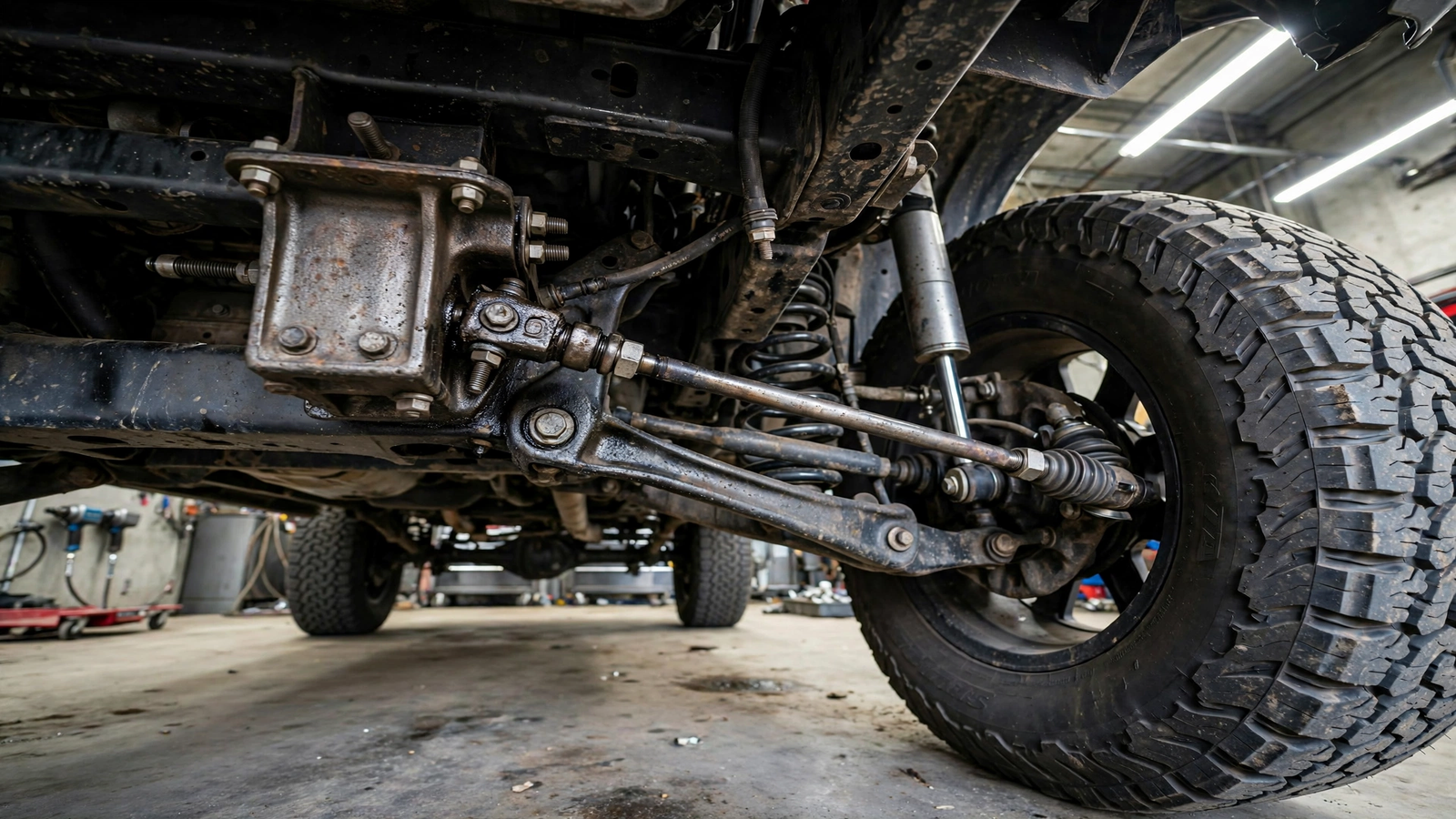
The track bar is the next suspect because it is the only link keeping a solid front axle centered. Even a small amount of bushing wear lets the axle shift side to side over bumps, which feels exactly like loose steering. Have a helper rock the steering wheel while you watch both track bar ends for movement. And do not overlook the steering box: sector shaft play is common on high-mileage trucks, and a lift’s bigger tires multiply the load on it. A box with internal wear can feel fine at parking-lot speeds and sloppy everywhere else — the same play that feeds death wobble starts as vague steering long before it becomes a shake.
What is bump steer and does your lift cause it?
Bump steer is what happens when the drag link — the bar connecting the pitman arm to the steering knuckle — sits at a steep angle after a lift. As the suspension cycles over bumps, the angled drag link pushes and pulls the steering left and right without any input from you. The wheel tugs in your hands over every bump, the truck darts on rough roads, and the whole thing feels loose even though nothing is actually worn. If your truck drives fine on smooth pavement but gets darty on rough roads, bump steer is the prime suspect.
The cure is to get the drag link level again. On most lifted trucks that means a drop pitman arm ($80 to $150) that lowers the steering box end of the link, or a raised steering arm at the knuckle on older solid-axle trucks. The drag link should sit as close to horizontal as possible at ride height, and it should stay roughly parallel to the track bar — when those two bars swing in different arcs, the steering and the axle fight each other. This is one of the geometry details that separates a complete lift kit from a budget spacer setup that leaves the steering to fend for itself.
A quick visual check settles the bump steer question for anyone asking why does my steering feel loose after a lift kit after a taller lift. Park on level ground and sight along the drag link from the side: it should run nearly horizontal from the pitman arm to the steering knuckle. If it dives steeply downward toward the axle, every bump is steering your truck. Also compare it to the track bar — the two should be roughly parallel. When they form a wide V, the axle and the steering are swinging in different arcs, and the fight between them is exactly the darty, loose feeling you are chasing. This visual takes thirty seconds and has diagnosed more bump steer than any alignment machine.
| Steering symptom | Likely cause | Fix |
|---|---|---|
| Vague, wandering, won’t center | Lost caster | Alignment with corrected caster |
| Darty over bumps, wheel tugs | Bump steer from drag link angle | Drop pitman arm / raised arm |
| Clunk or play when rocking wheel | Track bar or tie rod play | Replace worn parts, torque to spec |
| Dead spot in the middle | Steering box wear | Adjust or replace steering box |
Can the track bar make steering feel loose?
Absolutely — on any solid-axle truck or Jeep, the track bar is the steering-feel linchpin. Its job is holding the axle centered under the frame, and any bushing wear or loose bolt lets the axle shuffle sideways a fraction of an inch. You feel that shuffle as vagueness: the truck seems to take a beat to respond to steering input, and it wanders over bumps and road crowns. Because the movement is small, it rarely shows up as a clunk — it just feels like the steering went soft after the lift. Even small play here answers why does my steering feel loose after a lift kit on trucks where the alignment numbers look perfect.
Testing is a two-person job and takes five minutes. With the truck on the ground and the engine off, have a helper turn the steering wheel back and forth through its free play while you lie underneath watching the track bar ends. Any visible shifting between the bar and its bracket means the bushing or bolt is done. On lifted trucks an adjustable heavy-duty track bar ($150 to $300) is the lasting fix: it re-centers an axle the lift pushed sideways and its firmer bushings sharpen response. Torque the bolts at ride height and re-torque after 50 miles — the same discipline that prevents other post-lift handling complaints.
Do you need a drop pitman arm after lifting?
For lifts around 4 inches and taller on trucks with steering boxes, usually yes. The pitman arm drops the drag link’s frame-side mounting point to compensate for the added ride height, bringing the link back toward horizontal. Without it, the steep drag link angle creates the bump steer described above, and no amount of alignment will fix a geometry problem — which is a frustrating lesson for owners asking why does my steering feel loose after a lift kit after paying for two alignments.
There are limits, though. Dropping the pitman arm too far can over-correct and cause its own binding, and on some IFS trucks a drop pitman arm is not even an option — the fix there is different (often a differential drop or corrected tie rod geometry). Match the pitman arm drop to your lift height using the kit manufacturer’s guidance, keep the drag link parallel to the track bar, and verify full steering sweep without binding before driving. When in doubt, the kit maker that engineered your lift knows the right combination better than a generic parts counter.
It is worth knowing that pitman arm swaps have a failure mode of their own, which matters when why does my steering feel loose after a lift kit persists after the ‘fix.’ An incorrect drop length — too much or too little for your lift height — leaves the drag link angled the other way or creates binding at full steering lock. Always cycle the steering lock to lock on jack stands after installing a drop arm, feeling for any notch or hard stop before the knuckles reach their limits. And torque the pitman arm nut to the factory spec (often 185 ft-lbs on full-size trucks) — a loose pitman arm is rare but catastrophic, so this is not a bolt to guess on.
How do you tighten up loose steering step by step?
Work in this order because it runs from free to expensive and from most-likely to least-likely. Start with the alignment printout — if caster is low, that is your answer and the fix is an alignment done right, not new parts. Then torque-check every steering and track bar bolt at ride height; loose hardware after an install is embarrassingly common. Then do the helper test on the track bar and the jacked-up play tests on tie rod ends and ball joints. That sequence is the difference between solving why does my steering feel loose after a lift kit in an afternoon and chasing it for months.
Only after the mechanical inspection should you evaluate the drag link angle and the steering box. If the drag link is steep, the drop pitman arm is the fix; if the box has internal play, adjustment or replacement ($200 to $600+ in parts) is the fix. Finish with a proper alignment and the 50-mile re-torque. Owners who follow this sequence usually find the problem in the first three steps — which beats the all-too-common approach of buying a steering stabilizer and hoping, a shortcut this IH8MUD steering thread shows rarely satisfies anyone.
- Read your alignment printout: check the caster numbers, not just toe — push for 1–2 degrees above stock spec.
- Torque-check everything: track bar bolts, tie rod jam nuts, and control arm bolts at ride height.
- Helper test the track bar: watch both ends for movement while someone rocks the wheel.
- Check tie rod ends and ball joints: jack up each side and feel for play.
- Evaluate the drag link angle: if it is steep, add the correct drop pitman arm.
- Assess the steering box: look for sector shaft play and leaks; adjust or replace if worn.
- Re-align and re-torque: full alignment, then re-torque all hardware after 50 miles.
When is loose steering a safety problem?
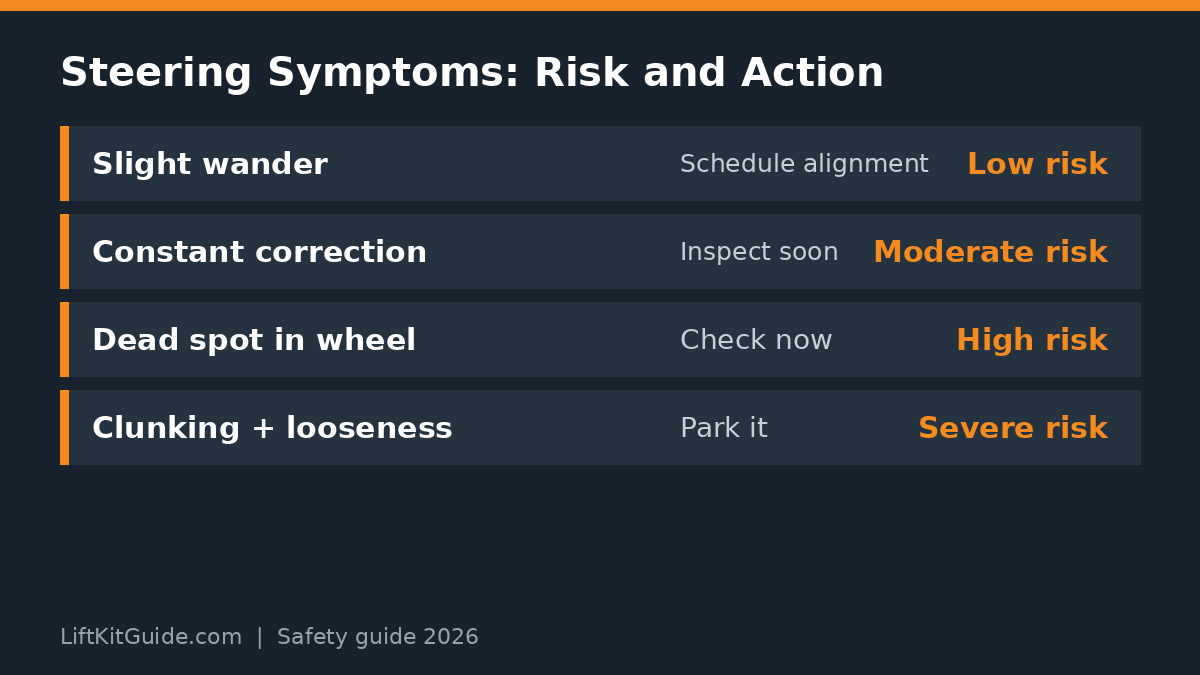
Vague steering becomes dangerous when it stops being predictable. A truck that wanders mildly but responds consistently is an annoyance; a truck with a dead spot in the middle of the steering, sudden darts over bumps, or clunking from the front end is a truck that can surprise you at the worst moment. The line between the two is play: any looseness you can feel as free movement in the wheel before the tires respond deserves immediate inspection, because that play is worn metal, not bad geometry.
Do not keep driving on clunking or on steering that changes behavior day to day — those are failing joints or a dying steering box, and failure at highway speed is catastrophic. For everything short of that, drive gently to a shop and get the caster-corrected alignment and full steering inspection. And keep your paperwork: if a dealer ever questions a steering warranty claim, knowing how lifts affect warranty coverage helps you argue from facts instead of guesses.
One more safety note for anyone living with the question of why does my steering feel loose after a lift kit while saving up for the fix: increase your following distance and slow down earlier than you think you need to. Vague steering lengthens your effective reaction time because every correction takes a beat longer to register at the tires. That margin matters most in crosswinds and around semi trucks, where a lifted truck’s tall profile already catches more air. It is also smart to avoid sudden lane changes until the steering is sorted — the combination of body roll and delayed response is what turns a minor wander into a scary moment, a dynamic covered further in our daily-driver lift guide.
| Symptom | Risk | Action |
|---|---|---|
| Slight wander, centers slowly | Low | Schedule alignment with caster correction |
| Needs constant correction | Moderate | Inspect track bar and tie rods soon |
| Dead spot / play in wheel | High | Check steering box and linkage now |
| Darts hard over bumps | High | Fix bump steer before highway driving |
| Clunking plus looseness | Severe | Park it; inspect for failed joints |
Frequently asked questions
Will an alignment fix loose steering after a lift?
Only if the shop corrects caster. Ask for 1–2 degrees above factory spec and verify on the printout.
Can a steering stabilizer tighten loose steering?
No — it only masks symptoms. Fix caster, track bar play, and worn joints first.
How much caster do I need after a lift?
Usually 5–6.5 degrees, or 1–2 above factory spec; follow your lift manufacturer's recommendation.
Why is my steering wheel off-center after a lift?
The lift changed drag link geometry. It is fixed by adjusting drag link length during alignment.
Do I need adjustable control arms?
Yes, if stock arms cannot reach the caster spec your lift needs, which is common at 2.5+ inches.
The bottom line
Loose steering after a lift kit is almost always a geometry story: lost caster first, then track bar play, drag link angles, and steering box wear in supporting roles. The diagnostic order matters — read the alignment printout, torque-check the hardware, test the track bar with a helper, and only then consider parts. Most trucks are transformed by a caster-corrected alignment alone.
Do not accept vague steering as the price of a lift. A properly set up lifted truck should track straight, center itself out of turns, and stay predictable over bumps. Get the geometry right once, re-torque after 50 miles, and the truck will drive like it should have from day one.



Leave a comment