


Last updated: October 2026 Written by the LiftKitGuide Team, truck suspension installers and editors
Is long travel suspension worth it daily driver duty? For most daily drivers, no — a long travel kit typically costs $4,000 to $8,000 installed, needs fiberglass fenders, increases body roll on pavement, and demands regular uniball and shock maintenance that a commuter truck simply does not need. Long travel shines at high-speed desert running, where double the wheel travel keeps tires planted. If your truck spends 90 percent of its miles on pavement, a quality mid-travel coilover setup delivers a better ride for far less money.
Key takeaways
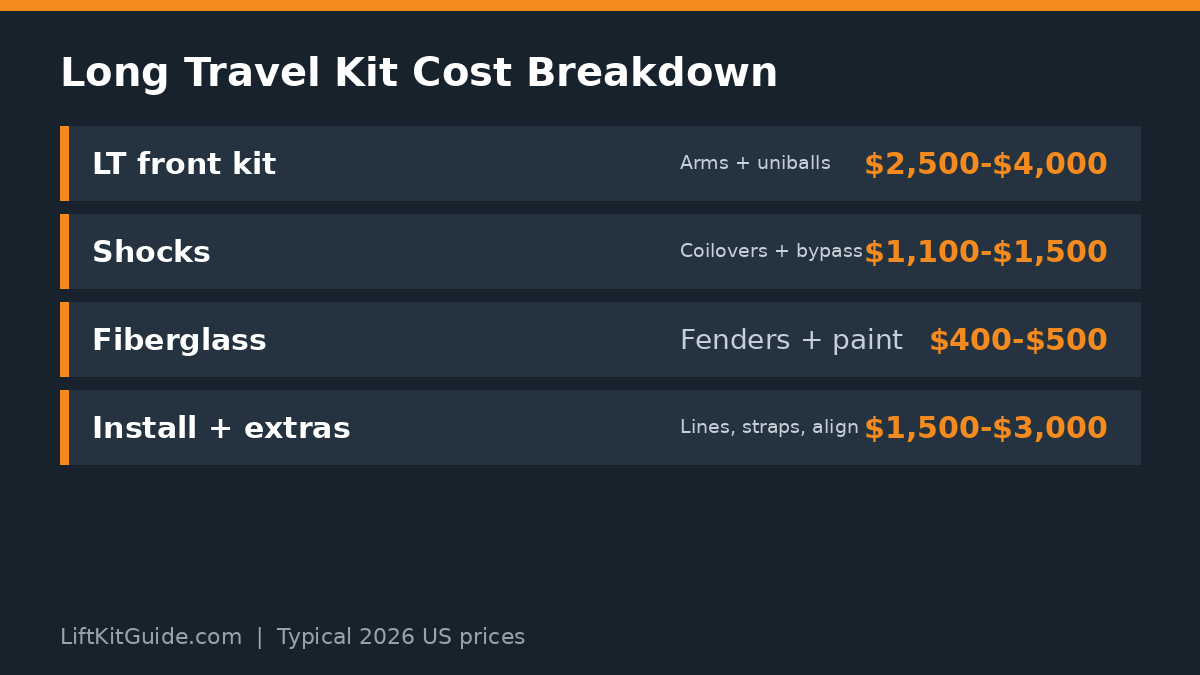
- A basic long travel front kit runs $2,500-$4,000, plus $1,100-$1,500 for shocks and $400-$500 for fiberglass fenders — $4,000-$8,000 installed all-in.
- Long travel roughly doubles wheel travel (about 12-13 inches vs 7-8 stock), which pays off at speed off-road but adds body roll on the street.
- Uniballs, heims, and bypass shocks need cleaning, inspection, and rebuilds far more often than sealed ball joints and monotube shocks.
- Nearly every long travel kit is wider than stock, so fiberglass fenders are required for full bump travel without tire damage.
- Daily drivers that rarely leave pavement get a better return from a $1,500-$3,000 mid-travel coilover kit with UCAs.
On this page
What is a long travel suspension kit and what does it change?
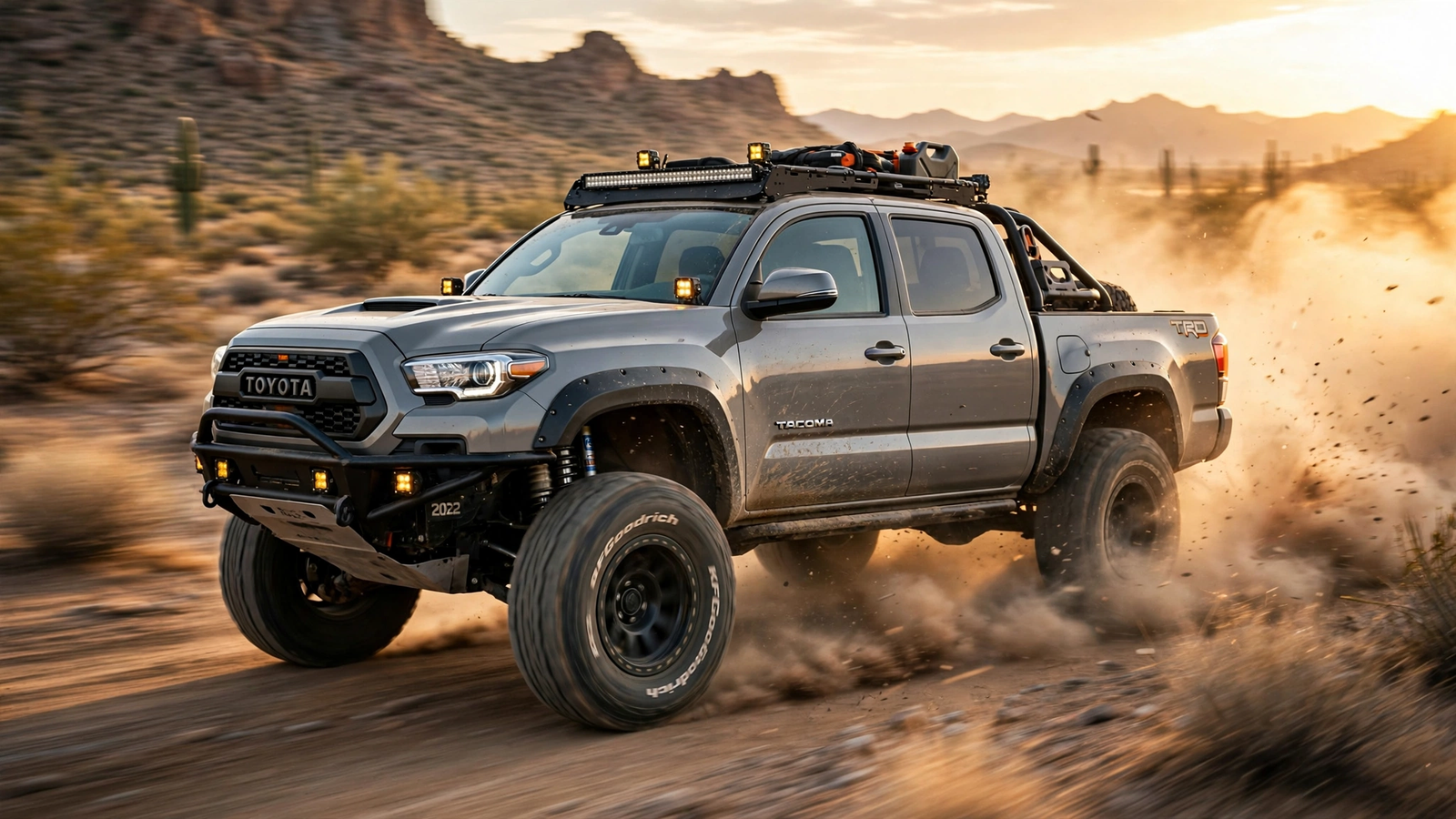
A long travel suspension kit replaces your truck’s front control arms with longer, wider arms and relocates the shock mounts so each wheel can cycle through far more travel than stock. Where a factory Tacoma or 4Runner might offer 7 to 8 inches of front wheel travel, a basic long travel kit delivers 12 to 13 inches, and race-oriented setups go further. The extra width — typically 3 to 3.5 inches per side — is what makes the geometry work, and it is also why fiberglass fenders become mandatory rather than optional.
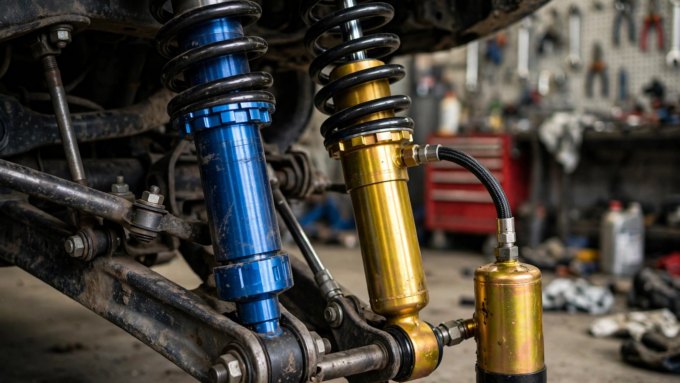
The rear gets a matching treatment on serious builds: spring-under-axle leaf conversions, 14 to 16 inch travel bypass shocks, a bed cage or shock hoops to mount them higher than stock, hydraulic bump stops, and limit straps. This is a fundamentally different animal from a lift kit, which mostly raises ride height — and that difference is central to the is long travel suspension worth it daily driver discussion. Long travel keeps the center of gravity relatively low while letting the wheels move dramatically more, which is exactly what high-speed desert terrain demands.
Shopping for long travel starts with admitting what the kit cannot do for a commuter. It will not improve fuel economy, it will not make parking easier, and it will not reduce the number of shop visits — in fact it increases all three costs. That reality check sits at the heart of the is long travel suspension worth it daily driver debate, because the same dollars buy a transformative mid-travel setup with money left over for tires. Before falling in love with bypass shocks, price the alternative and drive a truck that has it.
Is long travel suspension worth it daily driver cost-wise?
Start with honest math, because the sticker price of the kit is only the down payment. A basic front long travel kit runs $2,500 to $4,000, quality coilovers and bypass shocks add $1,100 to $1,500 or much more, and fiberglass fenders cost another $400 to $500 before paint. Professional installation, alignment, extended brake lines, limit straps, and gusseting can push a complete build to $6,000 to $8,000, and that is before the rear suspension gets touched. Ask the is long travel suspension worth it daily driver question honestly: a $2,000 mid-travel setup rides better on the highway for most owners.
Then consider what the money buys you on your actual commute. The wider track improves stability at speed off-road, but on pavement the same width makes parking garages tighter and the increased body roll from soft, long-travel valving makes the truck feel less composed in corners. If you are financing the build, the monthly payment for capability you use twice a year is hard to justify against a coilover kit that improves every single mile you drive. For a deeper look at what height costs, see our guide to suspension lift kits and typical cost to lift a truck by kit type.
| Build item | Typical cost | Notes |
|---|---|---|
| Front long travel kit | $2,500-$4,000 | Arms, uniballs, hardware; brands like Total Chaos, Camburg |
| Front shocks (coilovers + bypass) | $1,100-$1,500+ | Race series cost more; rebuildable |
| Fiberglass fenders | $400-$500 | Plus paint and install |
| Install, alignment, extras | $1,500-$3,000 | Brake lines, straps, gusseting |
| Complete front, installed | $4,000-$8,000 | Rear long travel adds $3,000+ more |
How does long travel affect daily driving comfort and handling?
On the highway, a well-tuned long travel truck can ride beautifully — the long shock stroke soaks up expansion joints and potholes with ease. The catch is body roll: soft valving and tall, compliant springs that shine at 60 mph through whoops also let the body lean in freeway interchanges. Owners consistently report more roll than stock, and while sway bars help, disconnecting or removing them for articulation makes street manners worse. Tire choice matters too; the wide stance usually pairs with aggressive all-terrains that hum at 70 mph.
There are also practical daily annoyances. The wider track kicks up more road spray onto the doors, fiberglass fenders can crack in parking-lot taps that steel would shrug off, and finding replacement uniballs or custom-length axles on a road trip is nothing like sourcing a stock ball joint. None of this disqualifies long travel, but it reframes the question: the ride is plush in a straight line and compromised everywhere a commuter actually notices.
Tire noise deserves its own warning for anyone commuting on long travel. The wide stance practically begs for 35-inch mud or aggressive all-terrains, and those tires drone at highway speed in a way stock-size all-terrains never do. Add the wind noise around fiberglass fenders and the occasional uniball squeak, and the cabin is simply louder than a stock or mid-travel truck. When owners weigh is long travel suspension worth it daily driver comfort, noise is the complaint that surprises them most after the first month.
Is long travel suspension worth it daily driver maintenance schedule?
Maintenance is where the daily-driver case for long travel usually falls apart. Uniballs and heim joints are exposed, precision components — they need regular cleaning and lubrication, and they wear faster than sealed factory ball joints, especially in road salt or dusty daily use. Rebuildable race shocks are a feature, not a convenience: expect to service or rebuild them every 20,000 to 30,000 hard miles, at $135 or more per shock plus weeks of downtime if you cannot do it yourself. Compare that to a sealed monotube shock that runs 60,000-plus miles with zero attention.
The wider stance also accelerates wear on everything it touches: wheel bearings, tie rods, and CV axles all work harder with the added leverage. Extended CV axles on 4WD trucks are a known pain point to install and replace. If you daily drive 15,000 miles a year, you will be servicing the front end far more often than any stock or mid-travel truck. That service burden is why the is long travel suspension worth it daily driver debate keeps resurfacing — the maintenance calendar looks more like a race program than a commuter.
- Uniballs and heims: clean and inspect every oil change; replace when play develops, typically 20,000-40,000 street miles.
- Coilovers and bypasses: rebuild every 20,000-30,000 hard miles; budget $135+ per shock plus downtime.
- Wheel bearings and CVs: wider track adds leverage — expect shorter life than stock, especially with heavy wheels.
- Alignment: check more often; long travel geometry is sensitive to small changes and curb hits.
- Fiberglass: inspect for stress cracks after any contact; repairs need bodywork, not a hammer.
Long travel vs a standard 6-inch lift: which is the better buy?
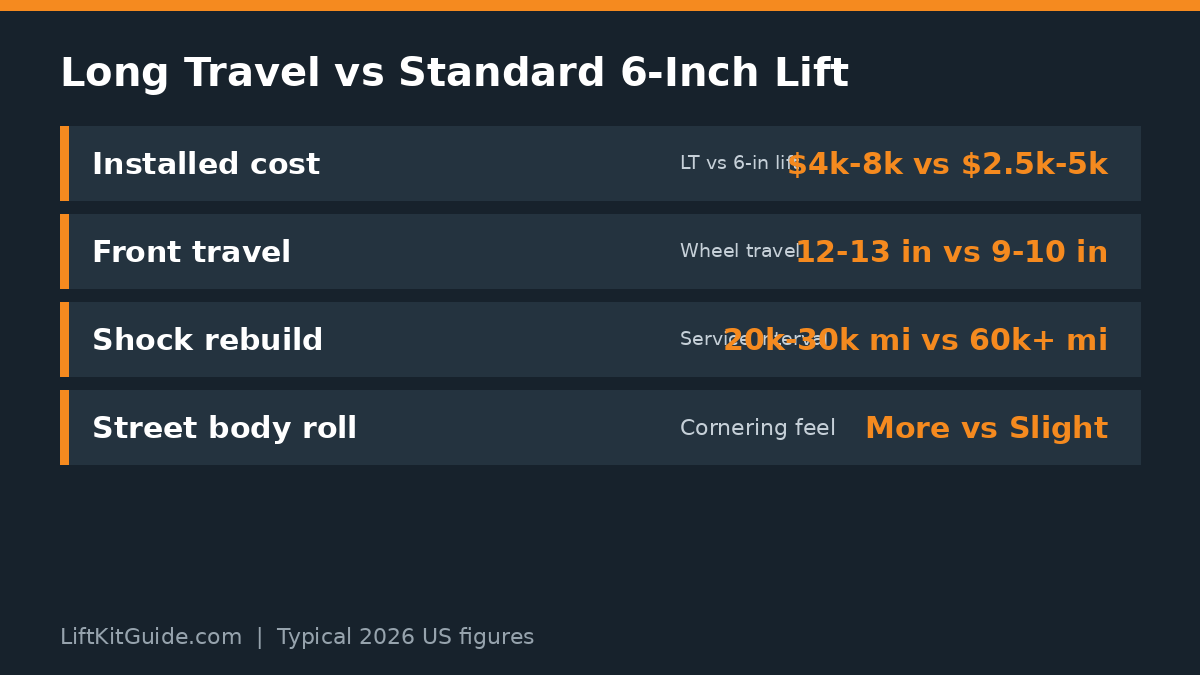
A standard 6-inch suspension lift and a long travel kit solve different problems, and confusing them is expensive. The 6-inch lift is about stance and tire clearance: it raises the truck, fits 35s or 37s, and keeps mostly stock-width geometry with drop brackets. It costs $2,500 to $5,000 installed, rides acceptably, and any shop can align and service it. Long travel is about wheel travel and high-speed control: it keeps the truck lower, cycles twice the travel, and demands fiberglass, custom parts, and specialist knowledge.
For a daily driver that occasionally hits forest roads, the 6-inch lift — or better yet a 2 to 3 inch mid-travel coilover kit — wins on every practical metric: cost, maintenance, parts availability, and street manners. Long travel wins only when the use case includes sustained high-speed off-road driving, where the extra travel is the difference between control and chaos. Our best lift kit brands ranking covers which mainstream kits suit daily drivers, and our lift kit mistakes owners regret guide shows what goes wrong when the build does not match the mission.
Insurance and registration add quiet friction too. Some insurers classify heavily modified suspension as a material change and may adjust premiums or require disclosure, and a few states scrutinize track width and fender coverage at inspection. None of this is a dealbreaker, but it is paperwork a stock truck never generates. These small hassles accumulate in the is long travel suspension worth it daily driver calculation, especially for owners who assumed the only costs were parts and install.
| Factor | Long travel kit | Standard 6-inch lift |
|---|---|---|
| Installed cost | $4,000-$8,000+ | $2,500-$5,000 |
| Front wheel travel | 12-13 in. | 9-10 in. |
| Track width | +6-7 in. total | Near stock |
| Fenders | Fiberglass required | Stock or trimmed |
| Shock service interval | 20,000-30,000 mi | 50,000-70,000 mi |
| Street body roll | More than stock | Slightly more |
| Best use | High-speed desert | Stance, tires, light trails |
What does a complete long travel build really cost over five years?
Purchase price is only chapter one. Over five years and 75,000 daily-driven miles, budget for at least two shock rebuild cycles ($1,000 to $1,600), one set of uniballs and heims ($400 to $800), accelerated tire wear from the wide, aggressive setup ($1,200 to $1,800 for a set of 35s), and more frequent alignments ($400 to $600). Add the initial $4,000 to $8,000 build, and five-year ownership lands between $7,000 and $12,000 above a stock truck — roughly double the running cost of a quality mid-travel setup.
Resale is the other hidden cost. A tasteful mid-travel truck with name-brand coilovers sells easily; a long travel truck with fiberglass fenders appeals to a tiny buyer pool and can actually reduce trade-in value at dealers who see custom fabrication as a liability. If you might sell within five years, the depreciation math alone can erase any joy the kit brought. Total cost of ownership is the number that should drive the decision, not the hero shots.
Shop labor is another line item buyers underestimate. Long travel installs take significantly longer than bolt-on lift kits because of the fiberglass work, custom brake lines, limit strap setup, and iterative alignment. At $120 to $150 per hour, labor alone can add $1,500 to $2,500, and few general repair shops will touch the job — you need a 4×4 specialty shop. That labor premium belongs in every is long travel suspension worth it daily driver spreadsheet, because it is money a simpler kit would never demand.
Who should actually buy long travel — and who should skip it?
Buy long travel if your weekends genuinely involve high-speed desert running, pre-running, or chase-truck duty, and you have a second vehicle for the weeks the truck is on jack stands. The performance envelope is real: nothing else lets a 5,000-pound truck absorb whoops at speed while staying composed. Owners who use the travel as designed — regularly, hard — consistently say it was worth every dollar and every rebuild.
Skip it if your off-roading is forest roads, camping trails, or the occasional mud hole, and especially if this is your only vehicle. A $1,500 to $3,000 mid-travel kit with quality coilovers, aftermarket upper control arms, and good all-terrains will ride better on Monday morning, cost half as much to own, and still embarrass stock trucks on Saturday. Be honest about the 90 percent use case, not the 10 percent fantasy — that is the entire decision.
Consider the opportunity cost in concrete terms. Eight thousand dollars buys the long travel front end, or it buys a $2,500 mid-travel coilover kit, a $1,800 set of 35s, a $600 regear contribution, and still leaves nearly $3,000 for fuel and trips. One path gives you internet-famous suspension; the other gives you a truck that is better everywhere you actually drive it. Framed that way, the is long travel suspension worth it daily driver question usually answers itself for anyone honest about their mileage split.
What should you buy instead for a daily driver that still wheels?
The sweet spot for a daily-driven truck that sees real trails is a mid-travel setup: 2 to 3 inches of lift from quality coilovers (Bilstein 6112, Fox 2.0, or Eibach Stage 2), aftermarket upper control arms to correct geometry, and a matching rear shock and spring package. Total installed cost runs $1,500 to $3,000, maintenance is essentially zero beyond normal service, and the truck rides better than stock every single day while handling moderate trails with confidence.
Pair that suspension with the right tire — a 33-inch all-terrain on most half-tons needs no trimming and no regear — and you have a truck that commutes quietly, tows safely, and still gets you to the campsite. Check whether 35s will rub before sizing up, so the tire choice does not surprise you at the pump. Capability you actually use beats capability you photograph.
If you do pull the trigger, buy quality once. The price gap between a reputable kit with good geometry and a bargain kit is a few hundred dollars, but the difference in alignment stability, uniball life, and resale is enormous. Budget the full supporting cast from day one — fiberglass, brake lines, straps, alignment — rather than discovering each need as a surprise. And keep asking is long travel suspension worth it daily driver money at every step, because scope creep is how $5,000 builds become $9,000 builds.
Frequently asked questions
How much does a long travel suspension kit cost installed?
A basic front long travel kit costs $2,500 to $4,000 for parts, plus $1,100 to $1,500 for shocks and $400 to $500 for fiberglass fenders. With professional installation, alignment, brake lines, and extras, expect $4,000 to $8,000 all-in for the front; a matching rear long travel setup adds $3,000 or more.
Can you daily drive a truck with long travel suspension?
Yes, but it comes with compromises: more body roll in corners, a wider track that complicates parking, louder aggressive tires, and a maintenance schedule closer to a race program — uniball service and shock rebuilds every 20,000 to 30,000 hard miles. Most owners who daily drive long travel trucks also accept higher running costs.
Do you need fiberglass fenders for long travel?
Nearly every long travel kit is 3 to 3.5 inches wider per side than stock, so fiberglass fenders are required to use full bump travel without destroying tires and fenders. You can temporarily limit up-travel with bump stop spacers, but that defeats much of the kit's purpose.
How often do long travel shocks need rebuilding?
Rebuildable race-series coilovers and bypass shocks typically need service every 20,000 to 30,000 hard miles, or about once a year for a truck driven hard off-road. Rebuilds run roughly $135 or more per shock plus shipping and downtime, which is why many daily drivers prefer sealed shocks.
Is long travel better than a 6-inch lift kit?
They solve different problems. Long travel delivers roughly double the wheel travel for high-speed off-road control but costs more and needs more maintenance. A 6-inch lift delivers stance and big-tire clearance with near-stock service needs. For daily drivers, the 6-inch lift — or a mid-travel coilover kit — is the more practical buy.
Does long travel suspension hurt resale value?
Often, yes. Fiberglass fenders and custom fabrication narrow the buyer pool significantly, and dealers may appraise a long travel truck below a comparable stock or mildly lifted truck. A tasteful mid-travel build with name-brand bolt-on parts typically resells much easier.
The bottom line
Long travel suspension is the ultimate tool for high-speed desert driving, and nothing else comes close at speed through rough terrain. But the $4,000 to $8,000 build cost, fiberglass requirement, increased body roll, and race-program maintenance schedule make it a poor value for a truck that spends its life commuting.
For the daily driver that still wheels on weekends, a $1,500 to $3,000 mid-travel coilover setup with upper control arms delivers 90 percent of the real-world benefit at half the cost and a fraction of the upkeep. Match the build to the miles you actually drive.



Leave a comment