


Last updated: October 2026 Written by the LiftKitGuide Team, truck suspension installers and editors
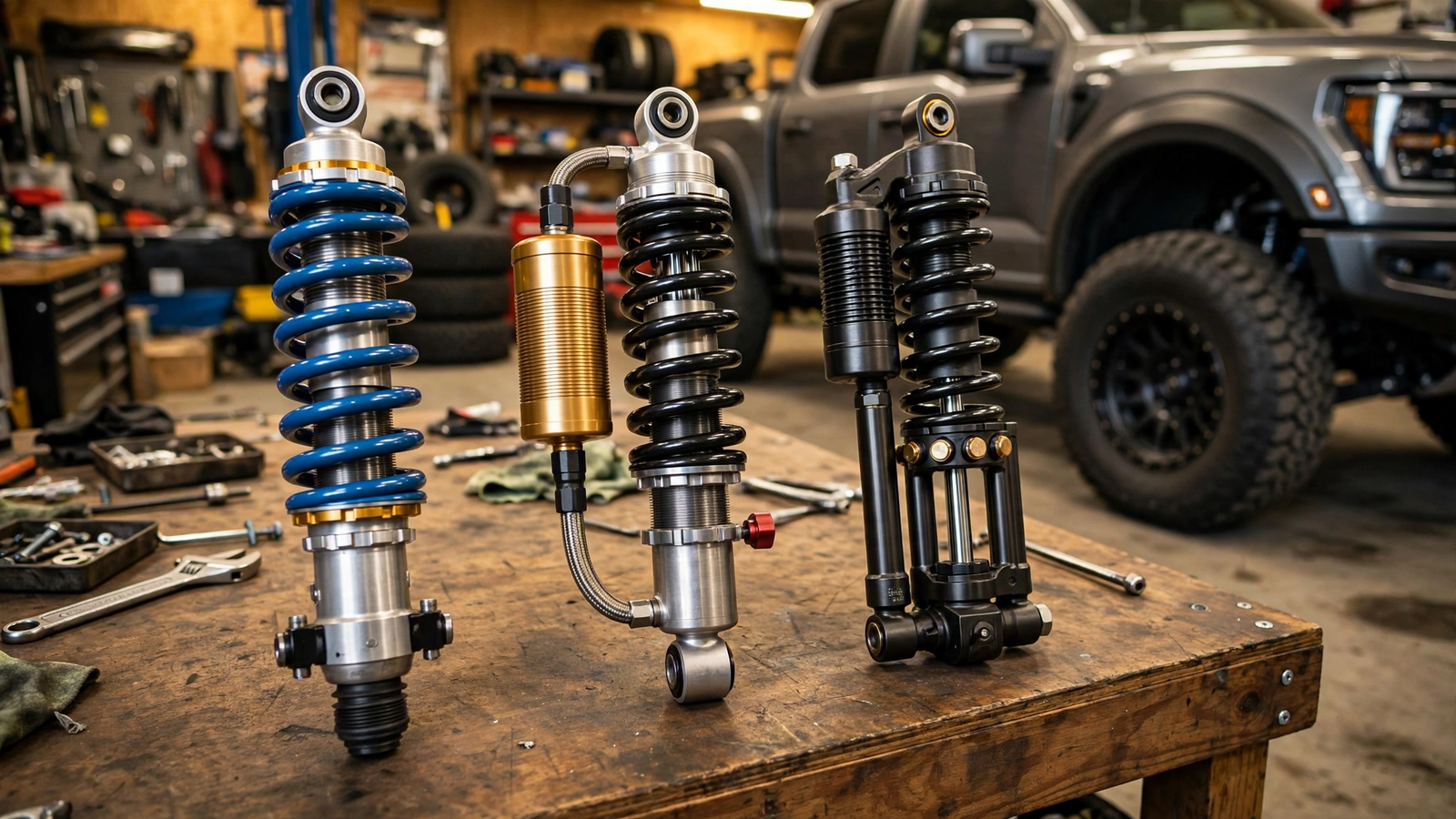
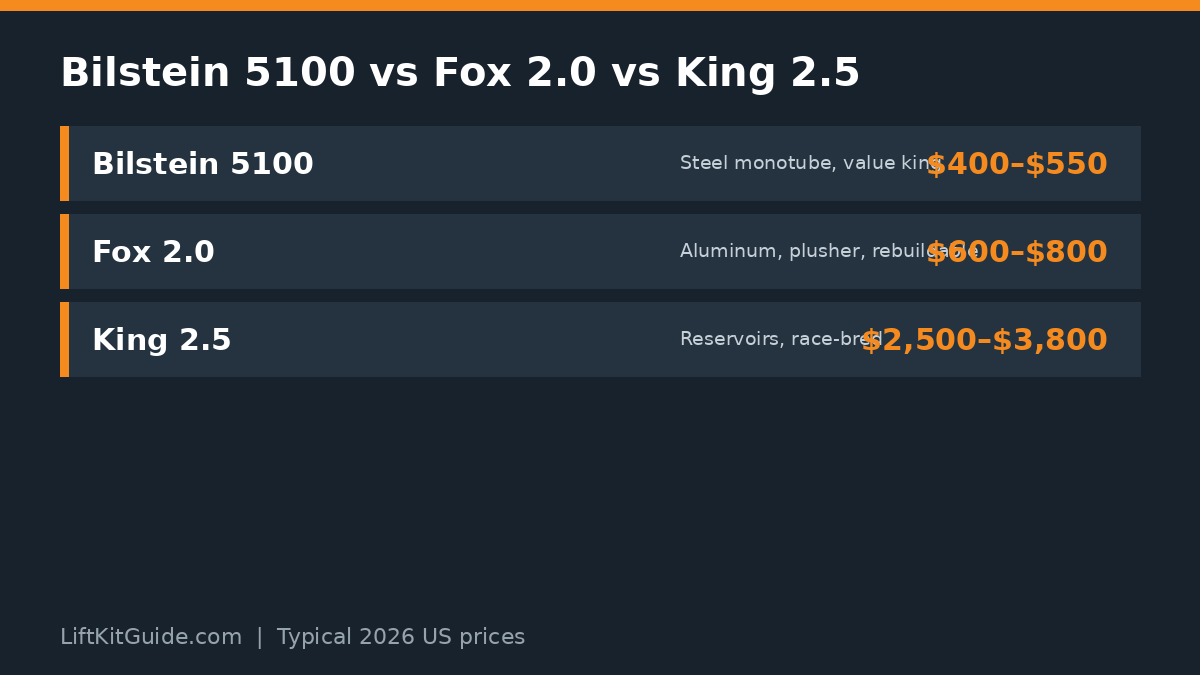
Should you upgrade shocks when installing a lift kit? In most cases, yes — especially if your kit came with basic twin-tube shocks. Upgrading to Bilstein 5100s ($400–$550 for four) is the sweet spot for daily drivers, Fox 2.0s ($600–$800) add a plusher ride and rebuildability for long ownership, and King 2.5s ($2,500–$3,800) are the top tier for serious off-road use. The shocks determine your ride quality more than any other lift component.
Key takeaways
- Upgrading shocks is one of the highest-satisfaction purchases in lifting — cheap kit shocks are the most common lift regret.
- Bilstein 5100s ($400–$550/set) are the value sweet spot: monotube, sized for lifts, ideal for daily drivers.
- Fox 2.0s cost ~$45 more per shock than 5100s and add aluminum bodies, plusher ride, and rebuildability.
- King 2.5s ($2,500–$3,800/set) are unmatched off-road but need $150–$300/corner rebuilds every 30,000–40,000 miles.
- Install upgraded shocks during the lift — the marginal labor is near zero versus paying twice later.
On this page
Should you upgrade shocks when installing a lift kit?
Should you upgrade shocks when installing a lift kit? If your kit did not include them, the answer is usually yes — and the upgrade is one of the highest-satisfaction purchases in the truck world. The shocks are the components that translate your lift’s new geometry into actual ride quality, and the difference between basic kit shocks and a quality upgrade is something you feel every single day you drive. Owners who cheap out on shocks almost universally describe it as their biggest lift regret.
That said, upgrade does not have to mean the most expensive option. The question should you upgrade shocks when installing a lift kit is really three questions: do you need longer shocks for the lift height (often yes), do you need better damping than the kit includes (usually yes), and how far up the price ladder should you climb (depends on use). A $500 set of Bilstein 5100s is an upgrade over most kit-included twin-tubes; a $3,000 King setup is an upgrade over everything. Matching the tier to your driving is the whole game.
One more framing point: shocks are wear items, not lifetime parts. Even the best shocks need replacement or rebuilds eventually, so money spent on quality now pays back in years of better driving. When owners ask should you upgrade shocks when installing a lift kit, experienced builders answer with a question of their own: do you want to enjoy driving your truck, or just look at it? If the answer is driving, upgrade the shocks.
What do you gain by upgrading shocks with a lift kit?
The most immediate gain is ride quality. Kit-included shocks — especially the generic twin-tubes bundled with budget lifts — are built to a price point, with basic valving that controls neither small chatter nor big hits particularly well. Upgrading to Bilstein 5100s or Fox 2.0s replaces that compromise with monotube construction, better oil capacity, and valving developed specifically for lifted trucks. The truck stops crashing over expansion joints and starts absorbing them.
Heat management is the second gain, and it matters more than most street drivers realize. Every bump converts motion into heat inside the shock body, and small twin-tube shocks fade — lose damping — as they heat up on rough roads. Larger-diameter monotubes and aluminum bodies (Fox’s signature) shed heat far faster, so the tenth mile of washboard feels like the first. For towing, the gain is control: properly valved shocks keep a loaded truck stable instead of wallowing through every dip.
Finally, premium shocks buy adjustability and serviceability. Fox and King units can be rebuilt and revalved rather than thrown away, and many offer compression adjusters that let you soften the ride for the street and firm it up for the trail. Over a 100,000-mile ownership, a rebuildable $3,000 King setup with $200-per-corner rebuilds can actually cost less per mile than replacing $500 Bilsteins twice — while riding better the entire time.
That long-term math is worth running before you decide. When owners ask should you upgrade shocks when installing a lift kit, they usually compare purchase prices and stop there — but purchase price is only chapter one. A $500 set replaced twice costs $1,000 over 100,000 miles; a $3,000 King set rebuilt twice costs $3,800 but delivers a meaningfully better ride for every one of those miles. Owner threads on the best lift kit brands are full of real-world cost-per-mile breakdowns that make the premium tiers look more rational than the sticker suggests.
- Harsh ride over small bumps: basic kit shocks transmit expansion joints and gravel directly into the cabin.
- Fade on long rough roads: damping disappears after miles of washboard because small shocks overheat.
- Wallowing when loaded: soft generic valving cannot control a lifted truck with a trailer or bed full of gear.
- No adjustability: you get one compromise setting instead of dialing the ride to your use.
- Throwaway lifespan: non-rebuildable shocks become landfill at 50,000 miles; premium units get serviced.
Bilstein 5100 vs Fox 2.0 vs King: how do they compare?
The Bilstein 5100 is the default answer for a reason: at roughly $90 to $130 per shock ($400 to $550 for a set of four), it delivers monotube construction, zinc plating, and valving tuned for lifted trucks at a price most owners can stomach. The ride is firmer than stock — owners describe it as controlled rather than plush — and the 5100 is not rebuildable, so plan on replacement every 50,000 to 80,000 miles. For a daily driver that occasionally tows, it is the sweet spot of the entire market.
The Fox 2.0 Performance Series costs about $45 more per shock than the 5100 (roughly $600 to $800 for a set), and that premium buys an aluminum body that runs cooler, an internal floating piston design that resists aeration, and a generally plusher ride that owners consistently prefer on-road. Fox units are rebuildable and revalvable, which matters for long-term ownership. The long-running Fox versus Bilstein debate among owners usually concludes that the Fox rides better but the Bilstein wins on value.
King 2.5 coilovers sit at the top at $2,500 to $3,800 for a full set, with 2.5-inch bodies, remote reservoirs on many applications, and a single compression adjuster. The ride is superb both on-road and off — testers call it the best-riding truck suspension they have driven — but Kings demand maintenance: rebuilds every 30,000 to 40,000 miles at $150 to $300 per corner. For a truck that actually goes off-road hard, nothing else compares; for a mall crawler, it is glorious overkill.
One more consideration when weighing should you upgrade shocks when installing a lift kit: the shocks must match the kit, not just the truck. A 6-inch drop-bracket kit and a 3-inch spacer kit need completely different shock lengths, and buying premium shocks in the wrong length is worse than running correct-length budget units. Always shop by your suspension lift kit application — year, model, drivetrain, and lift height — before falling in love with a brand.
| Shock | Set of 4 cost | Body / design | Rebuildable | Best for |
|---|---|---|---|---|
| Bilstein 5100 | $400–$550 | Steel monotube | No | Daily drivers, value builds |
| Fox 2.0 Performance | $600–$800 | Aluminum IFP monotube | Yes | Better ride, long ownership |
| King 2.5 | $2,500–$3,800 | 2.5 in. remote reservoir | Yes | Serious off-road use |
Should you upgrade shocks when installing a lift kit on a daily driver?
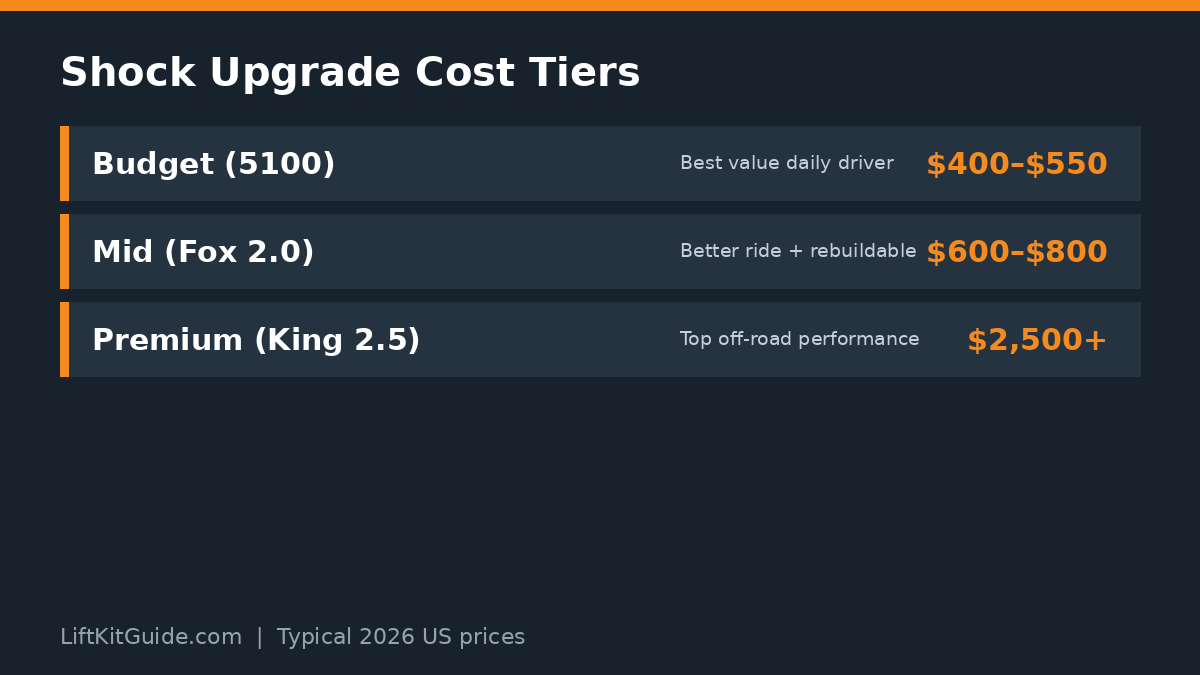
For a daily driver, the Bilstein 5100 is almost always the right answer to should you upgrade shocks when installing a lift kit. It fixes the two real problems — correct length for the lift and better damping than kit twin-tubes — at a price that makes sense for a truck whose hardest duty is the morning commute. Owners consistently report that 5100s transform a budget lift from harsh to pleasant without any downside except a slightly firmer ride than stock.
Fox 2.0s make sense for the daily driver who plans to keep the truck a decade: the rebuildability and cooler running pay off over very long ownership, and the plusher ride is genuinely nicer. Kings on a pure street truck are money spent on capability you will never use — enjoyable, but impossible to justify rationally. Match the shock to the mission, and for most daily drivers the mission says 5100.
One caveat: if your lift kit already includes decent shocks (BDS includes Fox 2.0s, for example), there may be nothing to upgrade. The upgrade question matters most for budget kits with generic twin-tubes. Before spending, identify what is actually in the box — you might already have the answer installed.
Are Fox 2.0 shocks worth the extra money over Bilstein 5100s?
About $45 per shock — roughly $180 for a set of four — separates the Fox 2.0 from the Bilstein 5100, and owners debate this endlessly. What the money buys: an aluminum body that dissipates heat better, IFP monotube internals that resist shock fade on long rough stretches, a ride most owners describe as plusher and more controlled, and full rebuildability. What it does not buy: dramatically more travel or load capacity — both are sized similarly for the same lift.
The value case for Fox rests on ownership length and use. Keep the truck 3 years and 40,000 miles? The 5100s will serve fine and you will never recoup the Fox premium. Keep it 10 years and 150,000 miles, tow regularly, or drive washboard forest roads? The Fox units’ rebuildability and fade resistance start to look like cheap insurance. Either choice dwarfs the improvement over generic kit shocks, so there is no wrong answer — only a better-matched one.
If you are on the fence, talk to owners of your exact truck. Shock preferences vary by platform more than marketing admits: what rides perfectly on a Silverado can feel harsh on a Tacoma, because spring rates and suspension geometry differ. And if your truck already rides poorly on its current setup, read our guide on why lifted trucks ride rough before buying — sometimes the shocks are not the problem, and the question of should you upgrade shocks when installing a lift kit has a different answer than you expect.
When are King shocks worth it?
Kings are worth it when the truck’s use justifies race-bred hardware: regular high-speed desert running, rock crawling, or overland travel where suspension performance is safety equipment, not luxury. The 2.5-inch bodies and remote reservoirs deliver fade-free damping in conditions that cook smaller shocks, and the compression adjusters let you tune for the terrain. Owners who actually use them describe the difference as transformative, not incremental.
Kings are not worth it as a status purchase for a street truck. The maintenance burden is real — budget $600 to $1,200 every 30,000 to 40,000 miles for rebuilds — and a truck that never leaves pavement will never ask anything of the Kings that 5100s could not answer. There is also the supporting-mod factor: to use extended-travel Kings properly you typically need aftermarket upper control arms, which adds another $600 to $1,000. Go in with eyes open about total cost.
There is also a use-case honesty test worth taking. If your truck is a daily driver that will never see dirt, the rational answer to should you upgrade shocks when installing a lift kit stops at the Fox 2.0 tier — and plenty of owners are perfectly happy never going past the 5100. Our breakdown of whether a 6-inch lift suits daily driving makes the same point about the lift itself: match the hardware to the life the truck actually lives, not the life you imagine on weekends.
What does a shock upgrade cost with a lift kit?
Budget by tier: $400 to $550 for Bilstein 5100s, $600 to $800 for Fox 2.0s, $1,400 to $1,800 for Fox 2.5 reservoir setups, and $2,500 to $3,800 for King 2.5s — all for a set of four before installation. If your kit came with generic shocks, you can often sell the take-offs for $100 to $200 to offset the upgrade. Professional installation runs $200 to $400, though many owners do shocks themselves with basic hand tools since no spring compressor is needed for rear shocks and many front applications.
The total lift budget context matters. A $1,500 lift kit plus $500 in 5100s is a $2,000 suspension that rides well; a $1,500 kit on its included twin-tubes is a $1,500 suspension that rides like it. When owners ask should you upgrade shocks when installing a lift kit from a value perspective, the math almost always favors the upgrade: shocks are the cheapest component that most affects how the truck feels every day. Skimp on brackets or bling before you skimp on shocks.
For context on where shocks sit in the total project budget, a typical leveling kit install runs a few hundred dollars all-in, while a full suspension lift with installation can exceed $3,000 before shocks. Against either total, a $400 to $800 shock upgrade is a modest line item with an outsized effect on satisfaction. When owners revisit the question should you upgrade shocks when installing a lift kit a year later, the ones who said yes almost never regret it — and the ones who said no are usually shopping.
| Upgrade tier | Set of 4 | Install (shop) | Rebuild cost |
|---|---|---|---|
| Bilstein 5100 | $400–$550 | $200–$400 | N/A — replace at 50–80k mi |
| Fox 2.0 Performance | $600–$800 | $200–$400 | $150–$250/corner |
| Fox 2.5 w/ reservoirs | $1,400–$1,800 | $300–$500 | $150–$250/corner |
| King 2.5 | $2,500–$3,800 | $300–$500 | $150–$300/corner every 30–40k mi |
Can you upgrade shocks later instead of during the lift install?
Yes, and many owners do — but it costs more in the long run. Installing shocks during the lift means the suspension is already apart, so the marginal labor is near zero. Coming back later means paying for disassembly twice, or spending another Saturday doing it yourself. If the budget is tight at lift time, running the kit shocks for six months while you save for 5100s is a reasonable plan; just do not stretch it into years of enduring a ride you hate.
There is one strategic reason to wait: if you are unsure which tier you want, driving the kit shocks for a while clarifies what bothers you. Hate the harshness? Fox 2.0s. Notice fade on dirt roads? Larger bodies or reservoirs. Happy enough? Save your money. But if you already know you want the upgrade — and most buyers researching this question do — bundling it with the lift installation is cheaper, faster, and gets you the good ride from day one.
Frequently asked questions
Do I need to upgrade shocks if my lift kit includes them?
Not necessarily. Kits from BDS, Icon, and others include quality Fox or house-brand shocks matched to the kit. The upgrade question matters most for budget kits with generic twin-tube shocks — identify what is in the box before spending.
Are Bilstein 5100s good enough for off-roading?
For light to moderate trail use, yes — the monotube design resists fade far better than stock twin-tubes. For high-speed desert running or rock crawling, step up to 2.5-inch reservoir shocks from Fox, King, or Icon.
How long do Bilstein 5100s last on a lifted truck?
Typically 50,000 to 80,000 miles of daily-driver use. They are not rebuildable, so replacement is the service — at $400–$550 a set, most owners simply buy fresh ones.
Are King shocks worth it for a street truck?
Rationally, no — a street truck never uses their capability, and the rebuild maintenance ($150–$300/corner every 30–40k miles) is real money. They ride beautifully, but Bilstein 5100s or Fox 2.0s deliver 90% of the street experience for a fraction of the cost.
Can I mix shock brands front and rear?
You can, but it is not ideal — different valving philosophies front-to-rear can make handling unpredictable. If budget forces a split, put the better shocks up front where steering feel matters most, and match the rears when funds allow.
Do upgraded shocks change my lift height?
Standard-length replacement shocks do not change ride height — springs and spacers do that. The exception is adjustable-height struts like Bilstein 5100s up front, whose snap-ring grooves can add 0–2.75 inches of lift via spring preload.
The bottom line
Should you upgrade shocks when installing a lift kit? For most owners, yes — and the Bilstein 5100 at $400 to $550 for a set of four is the rational answer for daily drivers, delivering the biggest ride improvement per dollar in the entire lift. Fox 2.0s justify their ~$45-per-shock premium for long-ownership trucks with better ride and rebuildability.
King 2.5s are the undisputed top tier for trucks that work hard off-road, but their purchase price plus ongoing rebuild costs only make sense when the use justifies it. Whatever tier you choose, install the shocks with the lift rather than later — and never let a budget kit’s generic twin-tubes be the thing you feel every day for years.



Leave a comment