


Last updated: October 2026 Written by the LiftKitGuide Team, truck suspension installers and editors
Do you need shock extenders with a leveling kit? Not strictly — but they are a smart $40–$100 stopgap if you are keeping stock shocks. Extenders reposition the factory shock back into its travel range, curing the topping-out clunk, but they do nothing for damping. Proper leveling shocks (Bilstein 5100s, $350–$500 a set) fix both geometry and damping in a single purchase, making extenders completely unnecessary for anyone buying new shocks anyway.
Key takeaways
- Shock extenders ($40–$100) reposition stock shocks into their travel range, curing topping-out clunks on leveled trucks.
- Extenders fix geometry only — damping stays stock-tuned, so ride control does not improve.
- At 2 inches of level they are a worthwhile stopgap; at 2.5 inches+, proper longer shocks are the correct answer.
- Never buy cheap no-name brackets — extenders are load-bearing; stick to reputable brands and check torque.
- If new shocks are in your near-term plans, skip extenders and put the $80 toward Bilstein 5100s instead.
On this page
Do you need shock extenders with a leveling kit?
Do you need shock extenders with a leveling kit? For most leveled trucks, the honest answer is: they help, but they are optional — and proper shocks are better. Shock extenders are small steel brackets that bolt to the lower shock mount and reposition the factory shock downward by an inch or two, putting it back in the middle of its travel range after a leveling kit stretches it toward full extension. They cost $40 to $100, install in minutes, and for many owners they are the first answer to do you need shock extenders with a leveling kit that actually fits the budget.
The reason the question do you need shock extenders with a leveling kit comes up constantly is that extenders sit in an awkward middle ground. They are cheaper than new shocks and more correct than doing nothing, which makes them tempting. But they fix only the geometry half of the problem — the stock shock’s damping stays tuned for a stock-height truck — so experienced builders view them as a stopgap. Understanding exactly what extenders do and do not do is the key to spending wisely.
Think of it this way: extenders answer the question of where the shock sits, while new shocks answer both where it sits and how it behaves. If your budget allows only one purchase right now, extenders buy you time. If you can stretch to proper leveling shocks, skip the extenders entirely — you will end up replacing them anyway, and the correct shocks solve the whole problem in one purchase.
What do shock extenders actually do?
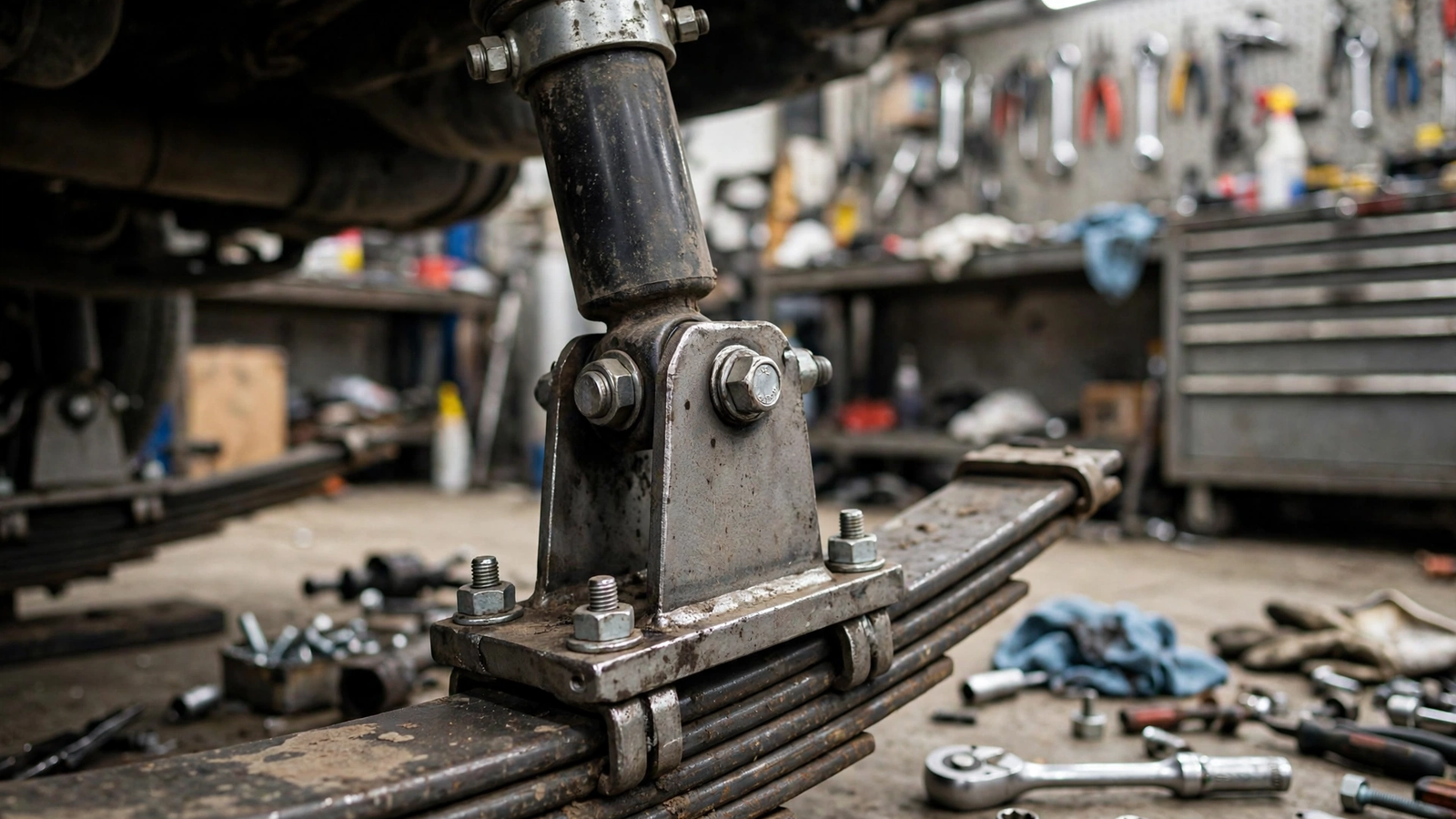
A shock extender is a precisely machined bracket — usually steel, sometimes billet aluminum — that bolts between the shock’s lower mount and the suspension’s shock tab. By dropping the shock’s mounting point by 1 to 2 inches, it restores the droop travel that the leveling kit consumed. The stock shock, which was riding near full extension and topping out over bumps, goes back to operating in the middle of its stroke where it was designed to work.
The effect is immediately noticeable: the harsh topping-out clunk that plagues leveled trucks on stock shocks typically disappears, because the shock regains the travel it needs to absorb sharp impacts. What does not change is anything about damping force. The factory shock’s valving — how stiff it is in compression and rebound — remains exactly as the manufacturer tuned it for a stock-height truck. On a leveled truck with different suspension leverage, that valving is a compromise, and no bracket changes it.
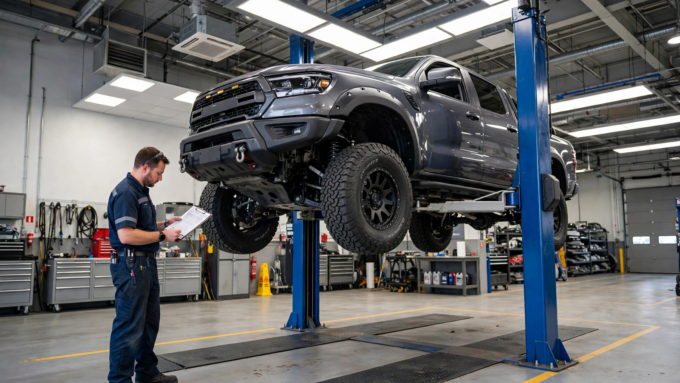
Installation is genuinely simple, which is part of the appeal. With the truck on jack stands and the wheel off, you unbolt the lower shock mount, bolt the extender to the suspension tab, then bolt the shock to the extender. For anyone still weighing do you need shock extenders with a leveling kit against just living with the clunk, the install math helps: the whole job adds perhaps 15 minutes per corner to a leveling kit installation. No spring compressor, no alignment change, no special tools beyond basic sockets.
- Topping-out clunk disappears: the shock regains droop travel, so sharp impacts no longer slam the extension stop.
- Shock life extends: operating mid-stroke instead of maxed out reduces seal and bushing wear significantly.
- Ride stays stock-ish: damping is unchanged, so the truck feels like stock — for better and worse.
- Another failure point: the bracket adds hardware and a joint to a load-bearing suspension component.
- Not a performance upgrade: extenders fix position only; they cannot improve damping, fade resistance, or control.
Do you need shock extenders with a leveling kit at 2 inches?
At 2 inches of level — the most common leveling height — shock extenders fall squarely in the nice-to-have category. Do you need shock extenders with a leveling kit at this height? Strictly speaking, no: thousands of trucks run 2-inch levels on stock shocks with no extenders and survive. But the topping-out clunk is common enough at 2 inches that the $40 to $100 for extenders is money well spent if you are keeping the stock shocks for a while.
The calculus shifts with height. At 1 to 1.5 inches of level, stock shocks stay within their design margin and extenders are unnecessary. At 2.5 inches, the geometry compromise is severe enough that extenders become strongly advisable if you insist on stock shocks — though at that height, proper longer shocks are the genuinely correct answer. The detailed comparison of spacers versus proper leveling struts reaches the same conclusion: extenders mitigate the problem, longer shocks solve it.
There is one more scenario where extenders earn their keep: leveled trucks with rear lift blocks or add-a-leafs. A 2-inch front level plus 1-inch rear lift stretches the rear shocks too, and rear extenders are cheap insurance there. Just remember the rule of thumb — extenders recover 1 to 2 inches of travel, and any lift taller than that needs longer shocks, not longer brackets.
| Leveling height | Extender benefit | Verdict |
|---|---|---|
| 1–1.5 in. | Minimal — shocks within margin | Skip extenders |
| 2 in. | Moderate — cures most topping out | Worth it if keeping stock shocks |
| 2.5 in. | Significant — but shocks still compromised | Better to buy longer shocks |
| 3 in.+ | Insufficient — cannot bridge the gap | Longer shocks required |
What are the downsides of shock extenders?
The biggest downside is that extenders do nothing for damping. Your leveled truck keeps the factory shock’s stock-tuned valving, which was calibrated for different ride height, different suspension angles, and different leverage. Owners often report that the clunk goes away with extenders but the truck still feels floaty or under-controlled — because it is. Geometry fixed, damping unimproved.
Second, extenders add a joint to the suspension. A well-made steel bracket from a reputable brand is plenty strong, but it is still another piece of hardware that can loosen, corrode, or — in the worst case with cheap no-name brackets — crack. This is not a place to buy the $19 special; stick to known brands and check torque specs periodically. A shock extender is a load-bearing component, and failures at speed are dangerous.
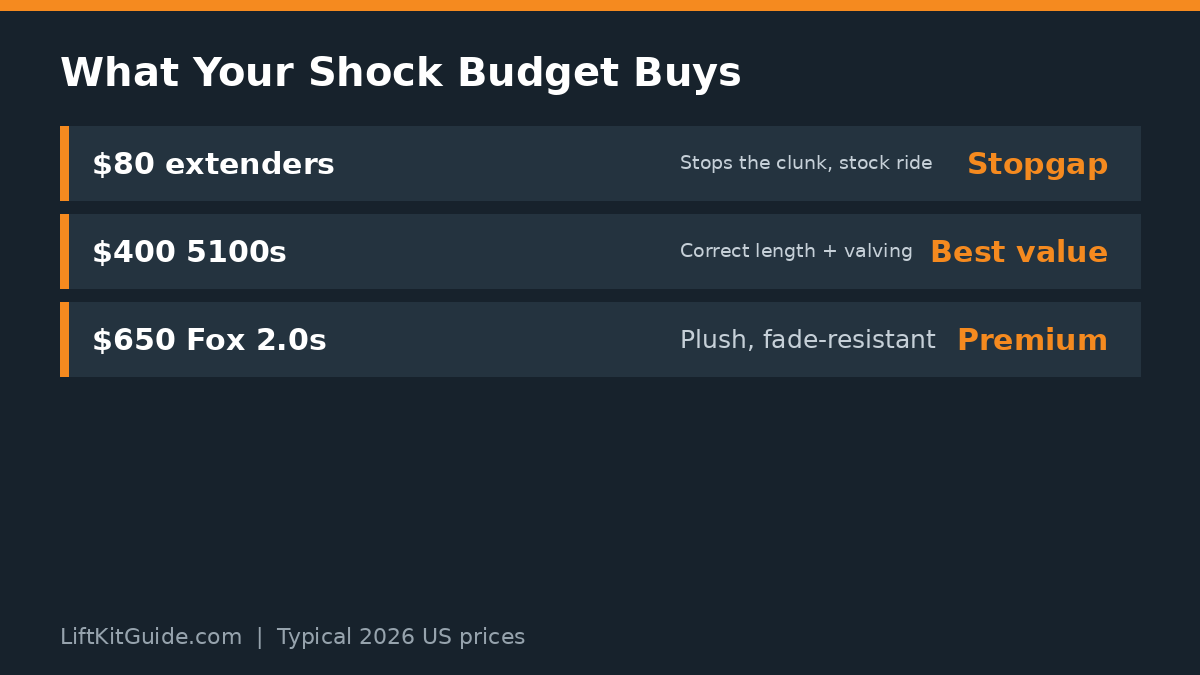
Third, extenders can mask the real solution. Spending $80 on brackets feels like progress, but if you end up buying $400 Bilstein 5100s a year later anyway, the extenders were $80 of delay rather than $80 of value. Be honest about your timeline: if proper shocks are coming within months, skip the extenders and put the money toward them.
There is also a diagnostic angle worth knowing. If your leveled truck already suffers the classic symptoms — harsh topping out, floaty highway manners, vague steering — our guide on why lifted trucks ride rough walks through telling shock problems apart from alignment or tire issues. When owners ask do you need shock extenders with a leveling kit after reading it, the answer often clarifies itself: extenders cure the clunk, but only new shocks cure the ride.” If stock shocks are staying for a year or more, the extenders earn their keep.
Shock extenders vs new shocks: which is better for a leveled truck?
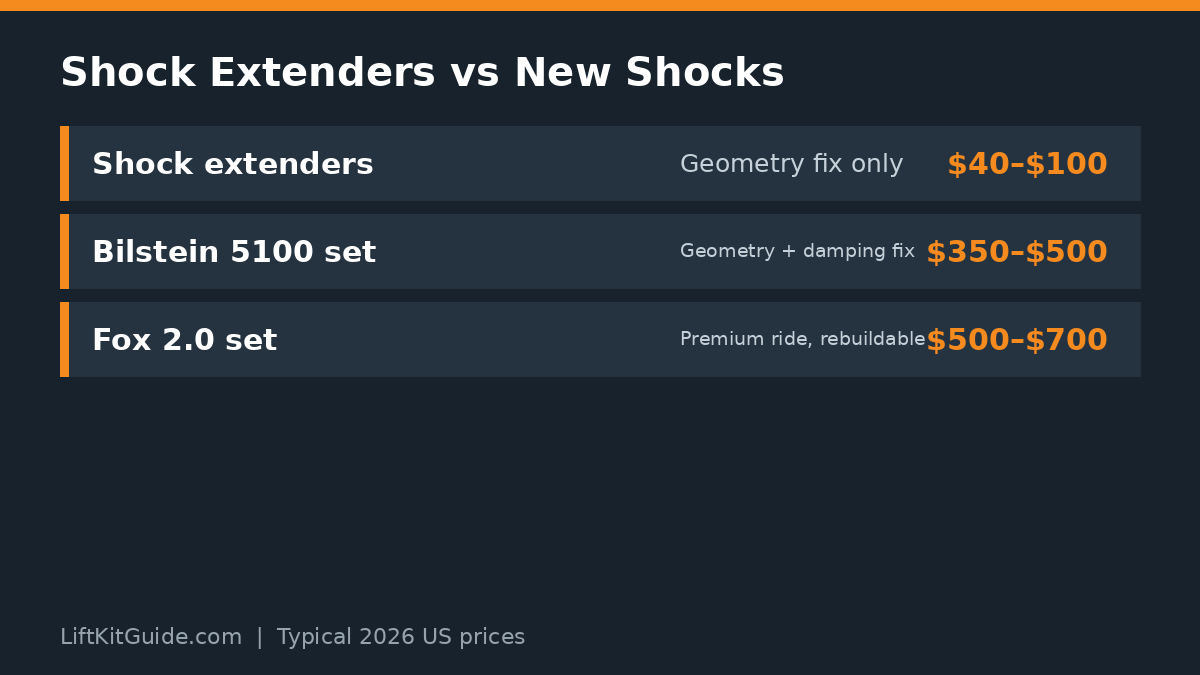
New shocks win on every axis except upfront cost. A set of Bilstein 5100s ($350 to $500 for four) delivers correct extended length AND valving tuned for leveled trucks — the geometry fix plus the damping fix in one purchase. Extenders ($40 to $100) deliver only the geometry fix. For a truck you plan to keep, the 5100s are the better buy by a wide margin, and most owners who try extenders first end up buying the shocks later anyway.
Extenders win only on immediate cash outlay and installation simplicity. If the leveling kit just ate the entire budget and the truck needs to drive to work Monday, $60 in brackets gets you a clunk-free ride this week while you save for shocks. There is no shame in that — it is a rational staging strategy. Just be honest that it is staging, not a final solution, and keep the shock fund growing.
The comparison changes if your stock shocks are already worn. Extenders on 70,000-mile factory shocks are lipstick on a pig: the geometry improves but the dead damping remains dead. In that case skip straight to new shocks — extenders cannot resurrect worn units. New shocks on a fresh truck with a mild level, on the other hand, might be overkill if the stockers have years of life left; that is the one scenario where extenders as a long-term solution make some sense.
| Factor | Shock extenders ($40–$100) | New shocks ($350–$500) |
|---|---|---|
| Fixes topping out | Yes | Yes |
| Improves damping | No | Yes |
| Adds failure points | Yes — extra bracket | No |
| Lifespan | Shocks still wear faster | Full normal service life |
| Best for | Tight budgets, short term | Keepers, towing, off-road |
How much do shock extenders cost?
Front or rear pairs typically run $40 to $100 from reputable brands, with billet aluminum units at the top of the range and basic steel brackets at the bottom. A full set (front and rear) for most trucks lands between $80 and $180. Installation is DIY-friendly — figure 15 to 30 minutes per corner with hand tools during the leveling install, or about $100 in shop labor if you are paying someone.
Compare that with the alternative: $350 to $500 for Bilstein 5100s, $500 to $700 for Fox 2.0s. The extender is roughly one-fifth the cost of proper shocks, which is exactly why the question do you need shock extenders with a leveling kit is really a budget question in disguise. If $400 shocks are not in the cards this month, $80 in brackets is a defensible move — just do not mistake it for the permanent fix.
Shop smart if you go the bracket route. The extender market is full of identical-looking brackets at wildly different prices, and the difference is usually material thickness and hardware quality rather than branding. Stick to established suspension companies — the same best lift kit brands whose kits you trust — and avoid anything without a published torque spec. And remember the question do you need shock extenders with a leveling kit is temporary by nature: every dollar into brackets is a dollar not earning interest in the shock fund.
How do you install shock extenders?
The job is straightforward. Safely lift the truck, support it on jack stands, and remove the wheel for access. Unbolt the shock’s lower mount from the suspension tab, position the extender bracket on the tab, and torque its hardware to the manufacturer’s spec. Then bolt the shock’s lower eye to the extender and torque that too. Repeat on the other side, reinstall the wheels, and lower the truck.
A few tips from experience: use thread locker on the bracket bolts, as suspension hardware loves to vibrate loose; torque everything to spec rather than guessing; and inspect the brackets at every tire rotation for cracks or looseness. If your leveling kit is being installed at a shop, ask them to add the extenders during the same visit — the marginal labor is negligible while everything is already apart.
When should you skip extenders and buy new shocks?
Skip extenders when your stock shocks are worn (50,000-plus miles), when you tow or haul regularly, when the level is 2.5 inches or taller, or when you go off-road with any frequency. In all of these cases the damping deficit matters as much as the geometry, and brackets cannot fix damping. Buying extenders first just delays the inevitable purchase while adding $80 to the total.
Also skip them if you are already buying adjustable-height struts. Bilstein 5100 front struts, for example, are both longer than stock AND height-adjustable via snap-ring grooves — they make extenders completely redundant. And if you are comparing suspension approaches overall, our leveling kit versus lift kit guide covers how shock needs scale with lift height: the taller you go, the faster extenders stop being enough.
One last scenario: owners planning a bigger lift later. If the leveling kit is just step one toward a full suspension lift kit next year, extenders make even less sense — the future lift will need its own longer shocks regardless, so bracket money is doubly wasted. In that case the honest answer to do you need shock extenders with a leveling kit is a firm no: bank the $80, run the level as-is for now, and buy the correct shocks once with the big lift. When in doubt, price the proper shocks first: the answer to do you need shock extenders with a leveling kit is usually no when new shocks are already on the shopping list, and the money is always better spent on the permanent fix than on the temporary bracket.
Frequently asked questions
Do shock extenders change ride height?
No. Extenders only reposition the shock within its travel range; ride height comes from the leveling kit's spacers or springs. Your truck sits exactly as high with or without them.
Can I use shock extenders with a 3-inch lift?
Not effectively. Extenders recover 1–2 inches of travel at most, which cannot bridge a 3-inch gap. A 3-inch lift needs properly longer shocks — extenders are a leveling-kit solution, not a lift-kit one.
Are shock extenders safe?
Quality steel or billet extenders from reputable brands are safe when torqued to spec and inspected periodically. Avoid cheap unbranded brackets — a cracked load-bearing bracket at highway speed is dangerous.
Do I need extenders front and rear?
A front leveling kit primarily stretches the front shocks, so front extenders matter most. If you also lifted the rear (blocks or add-a-leaf), rear extenders are cheap insurance for the same topping-out problem back there.
Will extenders fix my rough ride after leveling?
They fix the topping-out clunk, which is the harshest part — but they do not improve damping, so a floaty or uncontrolled ride will remain. If the ride itself bothers you, only proper valved shocks will fix it.
Can I install extenders myself?
Yes — it is a beginner-friendly job needing only jack stands, sockets, and about 15–30 minutes per corner. Use thread locker on the bracket bolts and torque everything to the manufacturer's specification.
The bottom line
Do you need shock extenders with a leveling kit? They are a sensible $40–$100 investment if you are running stock shocks on a leveled truck and want the topping-out clunk gone today. They do exactly one job — restoring the shock’s travel range — and they do it well for 1 to 2 inches of level.
But understand their limits: extenders never improve damping, they add hardware to the suspension, and they become pointless the moment you buy proper shocks. If Bilstein 5100s or Fox 2.0s are in your future, skip the brackets and put the money toward the real upgrade. The best extender is the one you never needed because you bought the right shocks first.



Leave a comment