


Last updated: October 2026 Written by the LiftKitGuide Team, truck suspension installers and editors
Why is my lifted truck pulling to one side? The most common causes are alignment angles shifted by the lift (toe, camber, caster), a rear thrust angle problem, or simple tire issues like pressure differences and tire pull. Road crown also plays a bigger role on lifted trucks, so a truck that tracks straight on the interstate can drift toward the shoulder on crowned rural roads. Start with the free checks — tire pressure and a tire-rotation test — then get a four-wheel alignment that includes thrust angle.
Key takeaways
- Toe misalignment as small as a fraction of a degree can pull a lifted truck sideways.
- A rear thrust angle problem makes the truck ‘crab’ — the front must steer to compensate.
- Road crown affects lifted trucks more; test on flat interstate before assuming an alignment fault.
- Swap the front tires side to side: if the pull changes direction, it is tire pull.
- A dragging brake caliper pulls constantly and gets worse as the brake heats up.
On this page
Why is my lifted truck pulling to one side after an alignment?
A pull that survives an alignment is frustrating, but it usually means the alignment did not measure the real problem. Most shops perform a front-end alignment — toe and camber up front — while the pull lives in the rear: a thrust angle issue, where the rear axle points slightly left or right of the vehicle centerline. When the rear axle ‘crabs,’ the whole truck drives slightly sideways, and you have to hold the wheel off-center to go straight. No front-end adjustment fixes that, which is why why is my lifted truck pulling to one side after two alignments almost always points rearward.
The other common miss is tire pull. A tire with internal belt shift or uneven wear develops a lateral force that steers the truck on its own, and no alignment machine detects it because the machine measures angles, not tire forces. The classic test is free: swap the two front tires side to side and test-drive. If the pull disappears or switches sides, the tire was the problem — not the alignment. Rotate or replace the offending tire and the ‘alignment problem’ vanishes, a story told over and over in this TacomaWorld thread on post-lift drift.
There is a paperwork angle to this problem that owners discover when why is my lifted truck pulling to one side turns into a shop dispute. If the pull started right after a lift install, the installing shop owns the diagnosis — a reputable shop will re-check its work free, including a full alignment re-check. But if months have passed, wear items like tie rod ends and ball joints enter the picture, and the question becomes whether the lift accelerated the wear or the parts were simply due. Keep your install receipt, the alignment printout, and notes on when the pull started; that paper trail is what separates a warranty conversation from an argument, a point our guide to lift kits and warranties covers in detail.
How does toe misalignment cause a pull?
Toe is the inward or outward pointing of the front tires, and it is the angle most sensitive to lift-related change. Even a tenth of a degree of toe difference side to side creates a constant steering force — the tires are literally fighting each other, and the truck follows the stronger one. Lifting changes toe because the tie rods swing through a new arc at the new ride height, and a truck that was perfectly aligned stock can leave the lift install with toe far enough off to pull noticeably.
The fix is straightforward: a proper alignment sets total toe to a slight toe-in (commonly around 0.1 degree per side on trucks), which gives straight-line stability and helps the steering self-center. Getting this right is part of setting up a suspension lift correctly from day one. But toe must be set at the new ride height with the full weight on the tires, and it must be set evenly side to side — equal toe split matters as much as total toe. If your alignment printout shows toe in spec but the truck still pulls, look at the split: 0.15 degrees on one side and 0.05 on the other is ‘in spec’ on some machines and still enough to cause a drift.
Can the thrust angle make a lifted truck pull?
Yes — and on lifted trucks it is one of the most overlooked causes. Thrust angle is the angle between the rear axle’s direction of travel and the vehicle’s centerline; it should be near zero. Lifting the rear with blocks, add-a-leafs, or new leaf packs can shift the axle on its locating pins, and even a small shift angles the whole truck’s thrust line. The result feels exactly like a front-end pull, but the steering wheel sits off-center going straight because you are constantly compensating for the rear pushing sideways. Asking why is my lifted truck pulling to one side without checking thrust angle is like checking the front door when the back door is open.
Diagnosis requires a four-wheel alignment, not a front-end-only job — insist on it. On leaf-spring trucks there is usually enough play in the spring locating pins to nudge the axle straight; loosen the U-bolts, shift the axle, and re-torque. Some owners find the axle shifted during the lift install itself and never got corrected. A thrust angle under 0.25 degrees is generally acceptable; beyond that, the truck will crab visibly and eat rear tires unevenly. This is a five-minute measurement that too many shops skip, and it is the answer in a large share of ‘aligned twice, still pulls’ cases.
A detail that surprises owners asking why is my lifted truck pulling to one side is how often the rear axle moves during the lift install itself. On leaf-spring trucks, the axle is located by a center pin sitting in the spring perch — and during a block or add-a-leaf install, that pin can seat slightly off-center or the U-bolts can be torqued with the axle shifted a quarter inch. That quarter inch at the axle becomes a visible thrust angle at the wheels. The fix is to loosen the U-bolts, verify the pin is centered in the perch, and re-torque in a star pattern to spec. It is a thirty-minute job that cures pulls no alignment machine can, and it is standard practice in any quality lift kit installation.
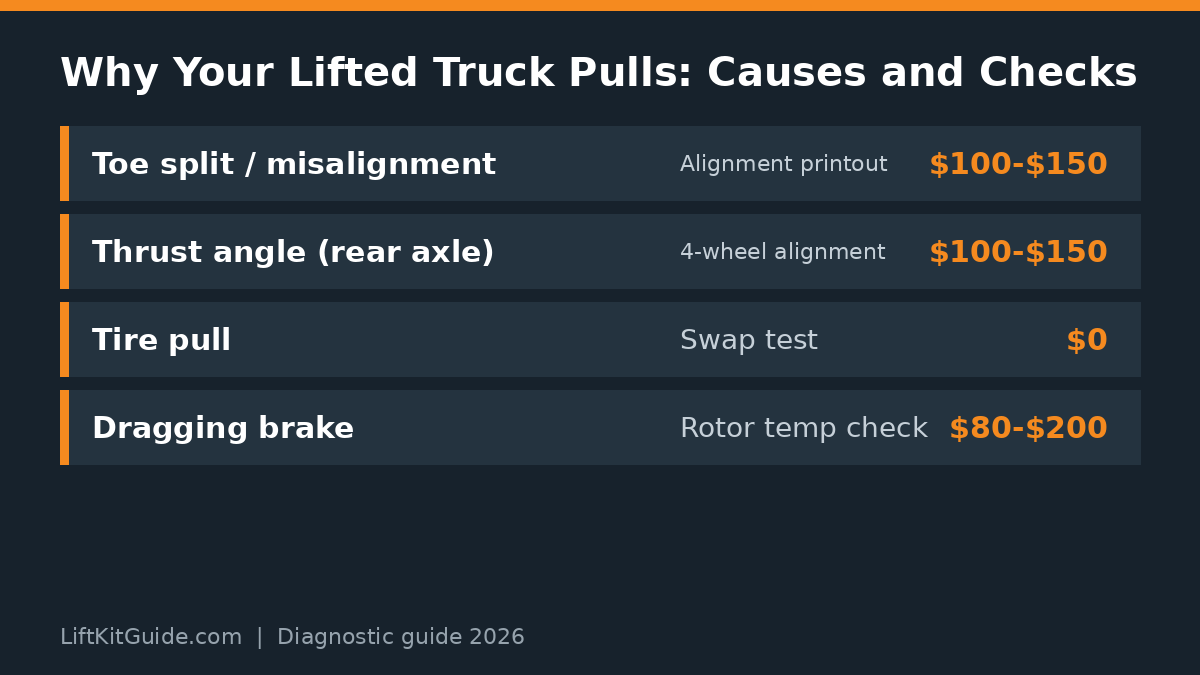
| Cause | How it pulls | How to confirm |
|---|---|---|
| Toe split side to side | Steady drift, worse at speed | Alignment printout: compare left vs right toe |
| Thrust angle (rear axle) | Truck ‘crabs’; wheel off-center | Four-wheel alignment measures rear axle angle |
| Road crown | Drifts toward shoulder on rural roads | Test on flat interstate; compare lanes |
| Tire pull | Pull changes with tire position | Swap front tires side to side |
| Dragging brake | Pull worsens as brakes heat up | Check rotor temps side to side after driving |
Why is my lifted truck pulling to one side only on certain roads?
When the pull comes and goes with the road, the road is the cause — specifically road crown. Rural roads are built with a crowned center so water drains off, which means in the right lane your truck sits tilted toward the shoulder, and gravity pulls it that way. Every vehicle feels this, but a lifted truck feels it more: the higher center of gravity, wider tires, and altered caster all amplify the drift. So why is my lifted truck pulling to one side on back roads but not on the interstate is usually normal road crown, not a mechanical fault.
The test is simple: find a flat, level stretch of interstate and briefly let the wheel go (safely, with hands hovering). If the truck tracks straight there but drifts on crowned two-lanes, the alignment is fine. Wider tires make crown pull more dramatic — owners running 315mm-wide tires report noticeably stronger crown sensitivity than stock. You can also test in the left lane of a divided highway: if the drift reverses direction with the lane change, that is crown behavior, full stop. Do not pay for another alignment to fix a road.
Can a tire itself pull the truck sideways?
Tire pull is real and surprisingly strong. Inside every tire, the steel belts and carcass create lateral forces as the tire rolls; when a belt shifts slightly (from a pothole hit, a manufacturing variance, or uneven wear), that force becomes directional and the tire literally steers the truck. The effect is strong enough to overcome a correct alignment — which is why tire pull is the number one cause of ‘aligned but still pulls’ complaints across all vehicles, lifted or not.
The diagnostic swap is the gold standard and costs nothing. Move the two front tires to opposite sides and test-drive the same road at the same speed. If the pull disappears, one tire was pulling and the rotation changed its influence. If the pull switches direction, you have found the offending tire — mark it and move it to the rear, where its pull is far less noticeable, or replace it. Also check pressures first: a 5-psi difference side to side changes the tire’s rolling diameter enough to cause a drift, and it is the most embarrassing ‘repair’ in the book. Keep a gauge in the truck and check monthly. If you are still deciding on tire size, knowing the biggest tire that fits without a lift helps you avoid the oversized rubber most prone to pull.
Here is a nuance worth knowing when why is my lifted truck pulling to one side is the complaint on a truck with new, aggressive tires. Some mud-terrain tires have a directional tread that must roll a specific way; mounted backwards, the tread’s lateral forces push the truck sideways instead of channeling water and mud outward. Check the rotation arrows on the sidewalls — a tire shop in a hurry can mount a directional tire backwards, and the resulting pull feels exactly like an alignment fault. It is a two-minute visual check that has embarrassed more than one shop, and it costs nothing to verify before you book another alignment.
Could a dragging brake be the real cause?
A sticking brake caliper creates a pull that has a distinctive signature: it is mild when cold and gets stronger as you drive, because the dragging pad heats the rotor and the friction grows. If why is my lifted truck pulling to one side gets worse over a 20-minute drive and the pull eases after the truck sits, suspect the brakes, not the alignment. Lifted trucks are actually prone to this after installs — a brake hose stretched or kinked during the lift can act as a one-way valve, letting pressure in but not fully releasing it. Catching it early is the difference between a caliper job and a warped rotor — and between answering why is my lifted truck pulling to one side in an afternoon versus a month.
Confirm it with an infrared thermometer ($20 to $30, useful for a dozen other diagnostics): after a drive, point it at each front rotor. A dragging brake will read dramatically hotter on one side — hundreds of degrees hotter in bad cases. Also look for a blue-tinted rotor, a burning smell, or the truck pulling harder right after braking. The fix is a caliper rebuild or replacement ($80 to $200 per corner in parts) and inspecting the brake hoses for kinks or internal collapse. Extended stainless brake lines, often needed with taller lifts anyway, eliminate the stretched-hose risk permanently. Since brake work often follows a lift, budgeting the full install cost keeps surprises out of the project.
How do you diagnose a pull step by step?
Run the free tests before spending a dollar. Equalize tire pressures, then do the flat-road test to rule out crown, then the tire swap to rule out tire pull, then the brake-temperature check. These four steps take under an hour and resolve a large fraction of pull complaints without touching an alignment rack. Write down what each test showed — ‘pulls right on flat road, still pulls right after tire swap, rotors equal temp’ is exactly the information a good alignment tech needs.
When you do go in, ask for a four-wheel alignment with a printout, and read it like a detective. Compare left and right toe (the split matters), check that caster is balanced side to side within about half a degree, and look at the thrust angle number. If the shop cannot explain the thrust angle reading, find a shop that can — preferably one that works on lifted trucks regularly. The pattern behind why is my lifted truck pulling to one side is almost always in that printout; you just need a tech willing to look past the green ‘in spec’ lights.
One more diagnostic trick for the stubborn cases where why is my lifted truck pulling to one side refuses to resolve: drive the truck, then immediately jack up the front and spin each tire by hand while watching the tread. A tire with a shifted belt or broken cord will show a visible wobble or hop as it spins — the tread surface rises and falls instead of running true. You can also run your hand carefully over the tread (engine off, truck secure) feeling for feathering or high spots. A tire that looks fine standing still can reveal its damage in rotation, and no alignment will ever fix a structurally compromised tire.
- Check tire pressures: equalize all four to the tire’s recommended range — free and fixes the embarrassing cases.
- Test on flat road: a level interstate run separates road crown from real problems.
- Do the tire swap: front tires side to side; if the pull moves, it is tire pull.
- Check brake heat: infrared thermometer on the rotors after a drive.
- Get a four-wheel alignment: insist on thrust angle measurement, not front-end only.
- Read the printout: compare toe split side to side and check caster balance.
- Inspect for shifted axle: on leaf-spring rears, check U-bolts and locating pins.
What should a post-lift alignment include?
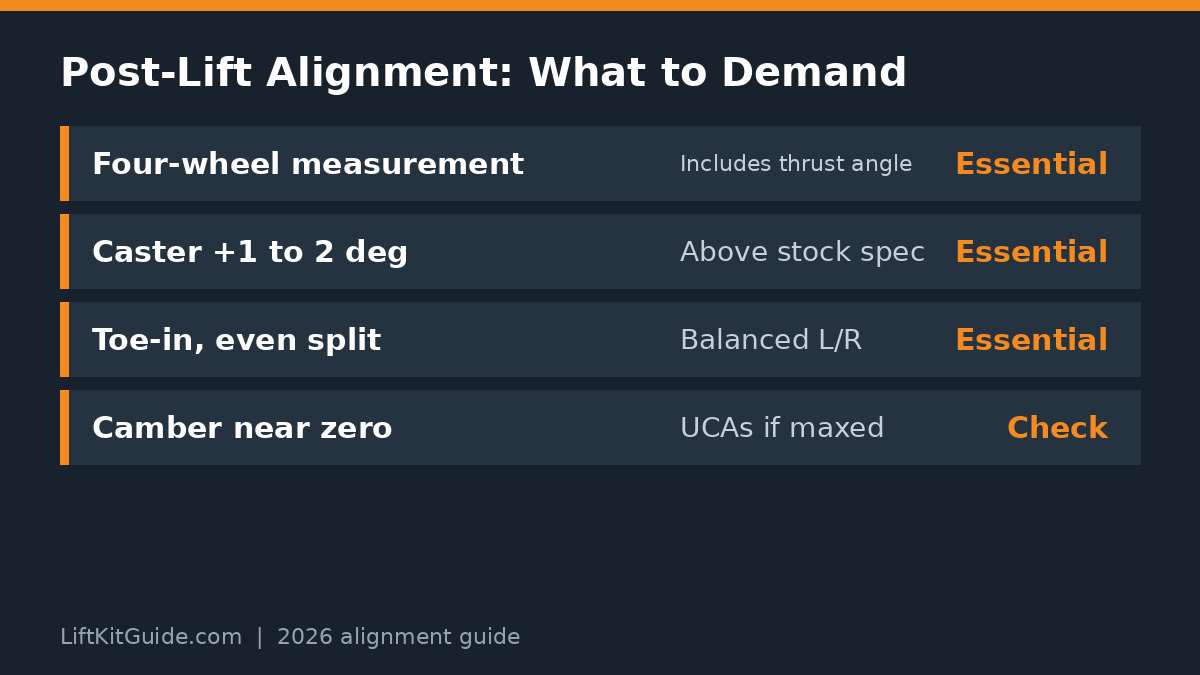
A post-lift alignment is not the same as a routine alignment — it needs to account for everything the lift changed. Insist on a four-wheel alignment (thrust angle included), caster pushed 1 to 2 degrees above stock spec, toe set to a slight toe-in with an even split, and camber brought back near zero. If the stock adjustments max out before camber or caster reach spec — common at 3 inches and up — that is the signal for aftermarket upper control arms, not the signal to accept ‘best we can do.’ That is the standard of care that finally puts why is my lifted truck pulling to one side to rest for good.
Finally, make the shop test-drive the truck before and after, and ask for the before-and-after printout. A tech who drives the truck will catch tire pull and brake drag that the rack cannot see. Expect to pay $100 to $150 for a quality four-wheel alignment, and consider it part of the lift budget rather than an optional extra — it is the cheapest insurance against the uneven tire wear and handling quirks that show up six months later.
| Item | Why it matters after a lift | What to ask for |
|---|---|---|
| Four-wheel measurement | Rear axle shifts during lift installs | Thrust angle on the printout |
| Toe set evenly | Lift changes tie rod geometry | Slight toe-in, balanced split |
| Caster corrected | Lift steals 2-3 degrees | 1-2 degrees above stock spec |
| Camber checked | Lift pushes camber positive | Near zero; UCAs if maxed out |
| Test drive | Numbers do not catch tire pull | Tech drives before and after |
Frequently asked questions
Is it normal for a lifted truck to pull slightly right?
Slight drift on crowned roads is normal; a consistent pull on flat roads needs diagnosis starting with tire pressure and a tire swap test.
Can wide tires cause pulling?
Wide tires amplify crown sensitivity and tire pull, making small alignment issues more noticeable.
How much does a four-wheel alignment cost?
Typically $100 to $150; it is the best money you can spend after a lift.
What is thrust angle?
The angle between the rear axle's travel direction and the vehicle centerline; it should be near zero.
Why does my truck pull worse after new tires?
A new tire with a shifted belt can pull; the swap test confirms whether the tire is the cause.
The bottom line
When a lifted truck pulls to one side, the cause is almost always findable with a logical sequence: free checks first (pressure, flat-road test, tire swap, brake heat), then a four-wheel alignment that actually measures thrust angle. Most ‘mystery pulls’ turn out to be tire pull, road crown, or a rear axle the alignment shop never measured.
Do not keep paying for front-end alignments hoping the pull disappears. Get the full printout, read the toe split and thrust angle yourself, and fix what the numbers show. A lifted truck that tracks straight is not luck — it is measurement.



Leave a comment