


Last updated: October 2026 Written by the LiftKitGuide Team, truck suspension installers and editors
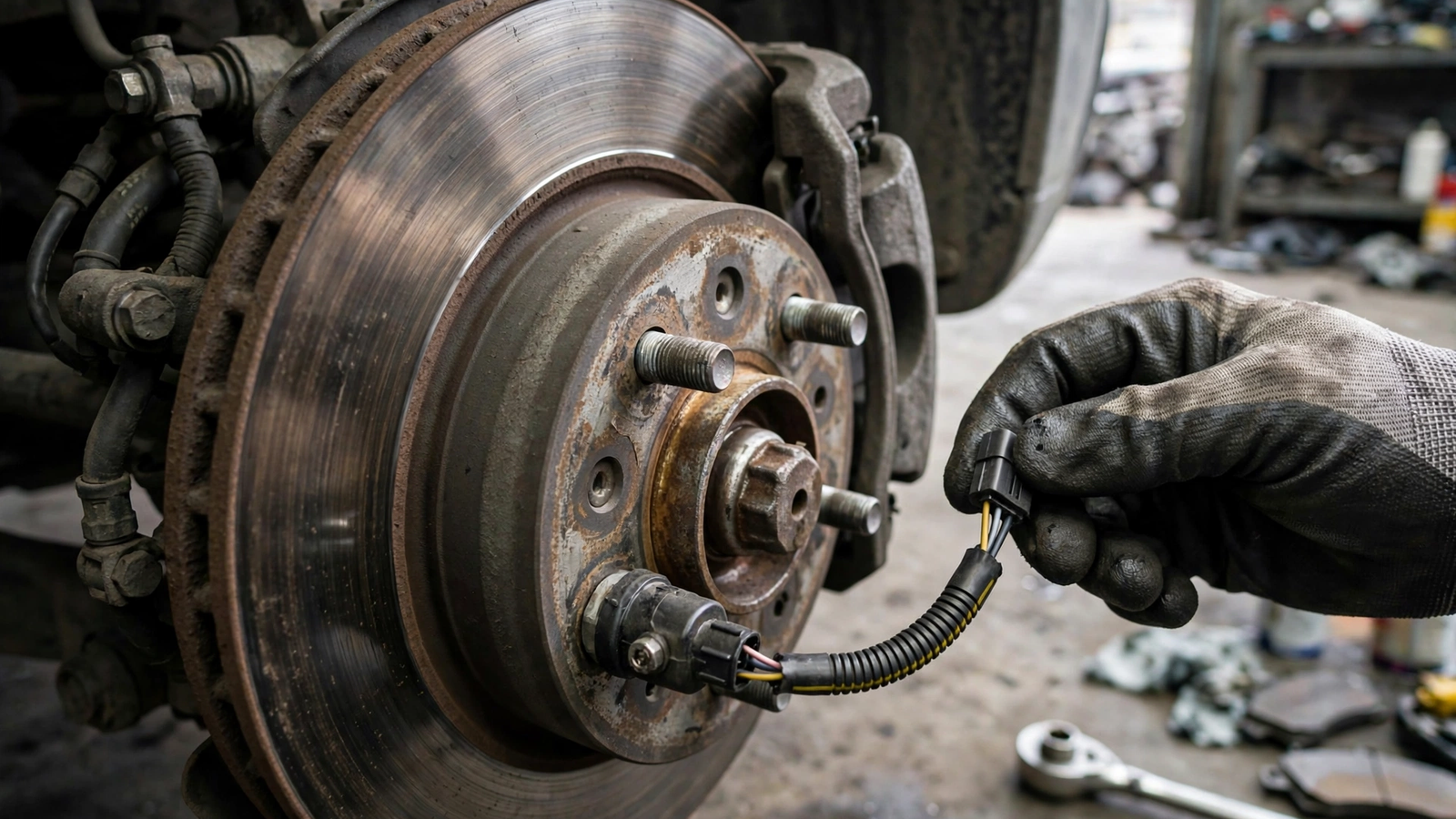
Why is my ABS light on after installing a lift kit? In roughly nine out of ten cases, the install stretched, pinched, or unplugged a wheel-speed sensor wire, and the ABS computer lit the warning because it lost signal from that wheel. The traction control and stability lights often come on too, since they share the same sensors. The fix is usually simple: inspect each sensor harness, repair or reconnect the damaged wire, clear the code, and confirm the steering angle sensor is centered after the alignment.
Key takeaways
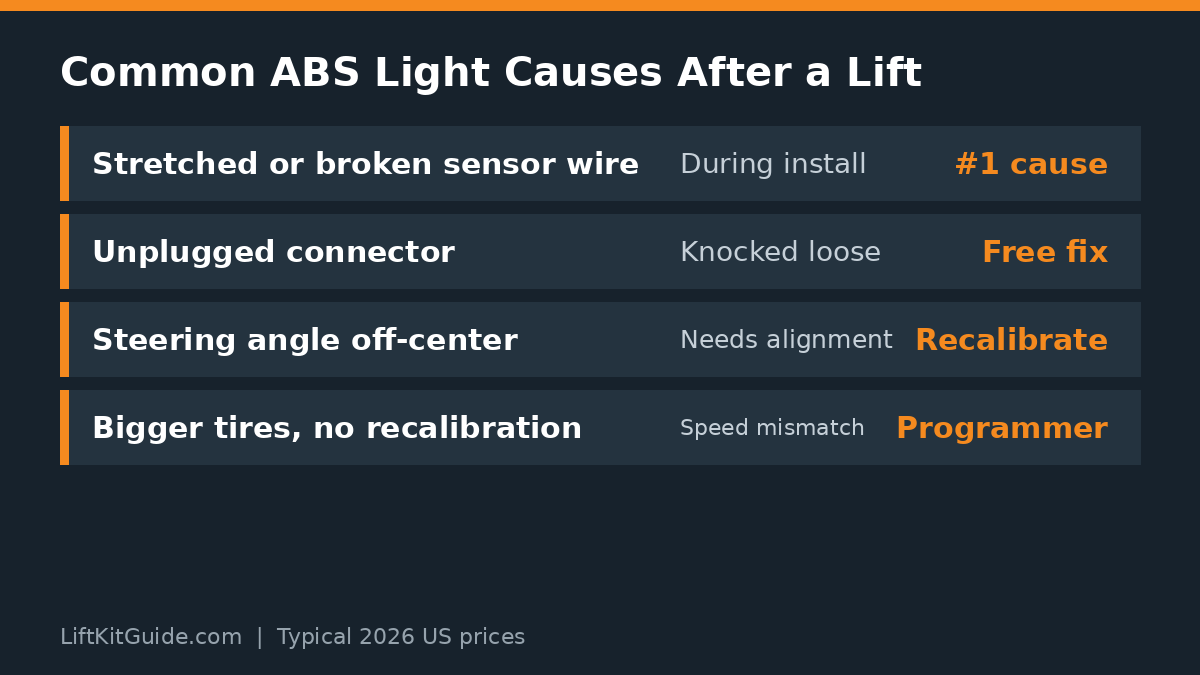
- A stretched or broken wheel-speed sensor wire causes about 90 percent of post-lift ABS lights.
- ABS, traction control, and stability lights usually appear together because they share sensors.
- An off-center steering wheel after the lift can trip the lights even with perfect wiring.
- Bigger tires without speedometer recalibration can confuse the ABS on some trucks.
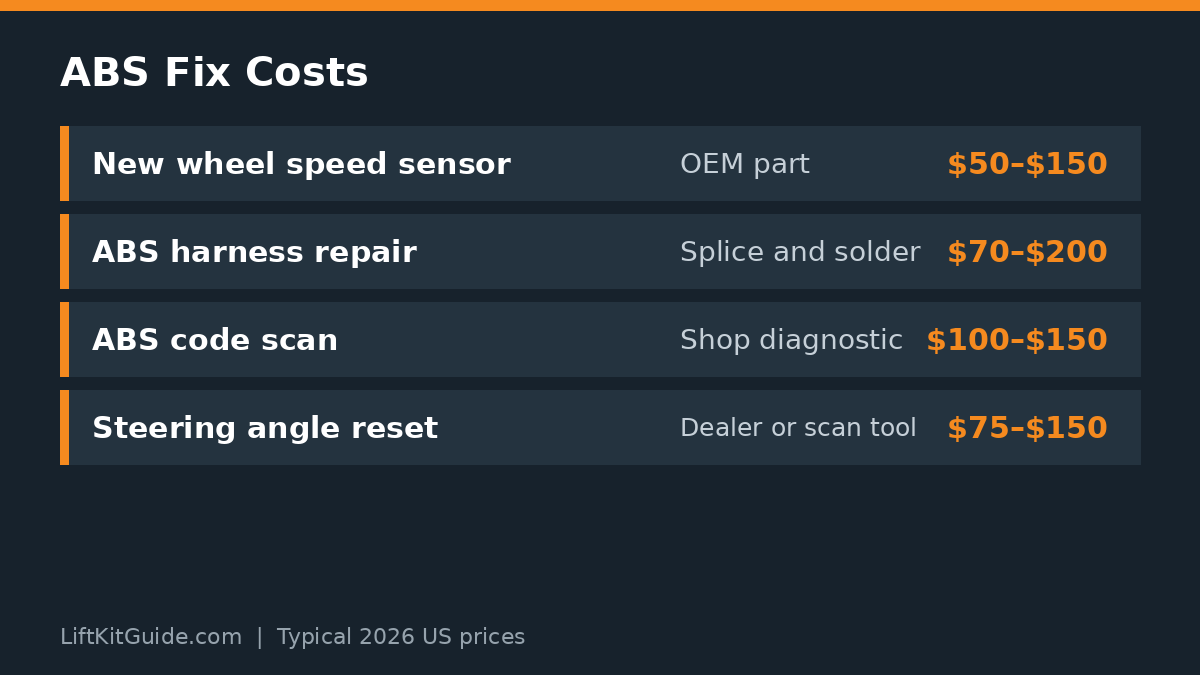
- Diagnosis is a $100-150 scan; most fixes cost $50-200 in parts.
On this page
Why Is My ABS Light On After Installing a Lift Kit?
Why is my ABS light on after installing a lift kit? If the light appeared on the first drive after the install, the answer is almost certainly in the wiring you just disturbed. Each wheel has a speed sensor with a thin harness running to it, and lifting the suspension changes every angle those harnesses route through. A wire that had just enough slack stock can get stretched taut, snagged on a control arm, or yanked from its connector during the work.
The ABS computer is brutally honest: lose signal from one wheel for even a moment and it lights the warning and disables ABS, traction control, and stability control together. That is why the dash often shows three lights, not one. The system is telling you it cannot trust its wheel-speed data, and rather than guess, it shuts the assists down. It feels alarming, but it is the system working as designed.
Before you panic about expensive modules, remember the odds. On owner forums, post-lift ABS lights trace to wiring damage or loose connectors in the overwhelming majority of cases, with failed sensors a distant second and actual ABS module failures extremely rare. So when you ask why is my ABS light on after installing a lift kit, start with your eyes and hands on the harnesses before you spend a dollar on parts, a lesson from our lift kit mistakes and regrets.
Did You Stretch or Break an ABS Sensor Wire?
This is the number one cause, full stop. During a lift install, the knuckle and hub assembly moves through a much bigger range than stock, and the ABS wire clipped along the control arm or knuckle goes along for the ride. If a clip was not released or the harness was routed too tight, the wire stretches, and these thin two-conductor wires do not tolerate stretching. Internal breaks with intact-looking insulation are classic. Treat every inch of that harness as suspect, because asking why is my abs light on after installing a lift kit usually ends at a wire that looked fine.
The telltale sign is a light that appeared immediately after the install with no other symptoms. One Tacoma owner documented exactly this: the shop pulled codes, traced it to the driver-side ABS wire with no continuity, and the owner admitted the wire must have been stretched during his lift install. A $70 replacement harness fixed it. If your story matches, and you are wondering why is my ABS light on after installing a lift kit, you have likely found your answer. This exact failure is documented in a TacomaWorld thread on a stretched ABS wire after a lift.
Inspect systematically. Follow each front sensor wire from the hub to its frame connector, looking for stretched sections, chafing against sharp edges, and clips that popped off. Tug gently at connectors to confirm they are fully seated. A multimeter continuity check from the connector to the sensor takes five minutes and definitively proves a break. Repair means either splicing in new wire with solder and heat shrink or replacing the harness section (factor it into lift kit installation costs).
| What you find | What it means | Fix |
|---|---|---|
| Wire stretched taut | Internal break likely | Replace harness section |
| Chafed insulation | Short to ground | Repair + reroute |
| Connector unseated | Lost signal | Reseat, check lock tab |
| Corroded pins | Intermittent signal | Clean or replace connector |
Can a Disconnected Sensor Connector Trigger the Light?
Absolutely, and it is the happiest outcome because the fix is free. Lift installs involve unbolting shocks, control arms, and knuckles, all in the neighborhood of ABS connectors clipped to the frame rail or inner fender. It is easy to knock a connector loose when wrestling a shock bolt out, and some connectors look seated while the lock tab never engaged. The computer sees an open circuit and lights the dash immediately.
Check every connector you could have touched, not just the obviously disturbed ones. On many trucks the front ABS connectors live on top of the frame rail near the upper shock mount, exactly where hands and tools are flying during a lift. Push each connector until you hear or feel the positive click of the lock. A dab of dielectric grease on reassembly prevents the corrosion that causes repeat offenses.
Rear sensors deserve the same attention. Rear ABS wires often route along the axle and up over the frame, and lifting the rear with blocks or new springs changes that routing. Look for wires pulled tight at full droop; have a helper bounce the rear while you watch the harness. If the wire goes bar-taut before the suspension bottoms, reroute it with more slack and fresh zip ties.
Why Does the Steering Angle Sensor Trip ABS After a Lift?
Modern trucks compare steering angle against actual yaw to decide when stability control should intervene. After a lift and alignment, if the steering wheel sits off-center, the sensor reports a constant steering input that does not match the truck’s straight-line travel. The computer concludes something is wrong with its sensors and lights the ABS and traction warnings. This is extremely common after lifts where the alignment got the toe right but left the wheel crooked.
The fix is a proper alignment with a centered wheel, followed by a steering-angle sensor reset with a capable scan tool. Many alignment shops do the reset as part of the job if you ask, but plenty do not, leaving owners chasing a wiring ghost much like death wobble after a lift kit chasers. If your wheel is visibly off-center and you are asking why is my ABS light on after installing a lift kit, fix the wheel position before touching a single wire.
Note that simply clearing the code will not help here. The sensor immediately reports the same off-center value on the next drive and the light returns within minutes. The sequence matters: center the wheel mechanically through alignment, reset the sensor electronically, then clear codes. Done in that order, the lights stay off. Get this sequence right and the lights stay off for good; get it wrong and why is my abs light on after installing a lift kit becomes a recurring headache.
Can Bigger Tires Alone Turn On the ABS Light?
Sometimes, yes, though it is less common than wiring damage. ABS compares wheel speeds to detect lockup, and it expects all four tires to be the same size. If you mounted a mismatched set, say new 35s on three corners and the stock spare on the fourth, the computer sees one wheel permanently turning at a different speed and flags a fault. Even matched oversized tires can confuse some systems until the tire size is recalibrated.
The recalibration matters because the ABS calculates slip ratios from expected tire circumference. Without updating the programmed tire size, usually via a handheld tuner, the system’s thresholds are all slightly wrong. Most trucks tolerate a one-size increase without complaint, but jumps to 35s and beyond deserve a proper tire-size program, which also fixes your speedometer and shift points as a bonus.
Rule out the simple stuff first: verify all four tires match in size, brand, and wear, and check pressures. A significantly underinflated tire has a smaller effective rolling diameter and can mimic a mismatch. If everything matches and the light persists after a lift with much bigger tires, and you keep wondering why is my ABS light on after installing a lift kit, program the new tire size before replacing sensors.
How Do You Read the ABS Code to Find the Fault?
A basic OBD2 reader usually cannot see ABS codes; you need a scanner with ABS capability. Options range from $100-150 Bluetooth dongles paired with apps like Torque Pro or Car Scanner, to $200-400 handheld units from Autel or Innova, up to professional tools at any shop. The scan takes two minutes and pays for itself by pointing at the exact wheel instead of all four.
ABS codes are refreshingly specific. Expect codes identifying the wheel, such as front-left wheel speed sensor circuit, plus qualifiers like open circuit, short to ground, or implausible signal. An open-circuit code on the wheel you just worked around is as close to a confession as diagnostics get. Write the exact code down before clearing anything, because the code is the map. Keep a photo of the code on your phone; if the light ever returns, you will know instantly whether it is the same fault or a new one.
After the repair, clear the code and drive. Most ABS systems self-verify within a few hundred feet of driving above 15 mph; if the repair worked, the light goes out on its own without any special procedure. If the light returns immediately, the fault is still present and your repair missed the real break. Do not just keep clearing it; the code is telling you to look harder.
| Tool | Cost | ABS capable? |
|---|---|---|
| Basic code reader | $20-50 | Usually no |
| Bluetooth + app | $100-150 | Yes, with right app |
| Autel/Innova handheld | $200-400 | Yes |
| Shop diagnostic | $100-150 | Yes, plus expertise |
Why Is My ABS Light On After Installing a Lift Kit If the Wires Look Fine?
When the harnesses look perfect and you are still asking why is my ABS light on after installing a lift kit if the wires look fine, go deeper, the same patience upper control arms for a 3-inch lift requires. Internal wire breaks hide under intact insulation, which is why the visual inspection must be followed by a multimeter continuity test. Probe from the frame connector to the sensor plug while flexing the harness; an intermittent open that appears when you bend a section has found your break.
The sensor itself can fail coincidentally. Wheel-speed sensors live in a brutal environment of heat, water, and vibration, and the disturbance of a lift install can finish off a sensor that was already marginal. They are typically $50-150 and often come integrated with the hub assembly on newer trucks. If continuity tests pass but the code names a specific wheel, the sensor is your prime suspect.
Rare but real: a damaged tone ring. The sensor reads a toothed reluctor ring on the hub or axle, and if that ring cracked or collected metallic debris during the install, the signal goes erratic. This usually sets an implausible-signal code rather than an open circuit. Cleaning the sensor tip and inspecting the ring through the sensor hole resolves it without new parts.
How Do You Prevent ABS Issues During a Lift Install?
Prevention starts before the first bolt turns. Photograph every ABS wire routing clip on your suspension lift kits install and connector before disassembly so you can restore the exact routing afterward. Release all harness clips before moving suspension components through their range, and never let a knuckle hang by its ABS wire. These two habits prevent the vast majority of post-lift ABS lights.
Route for the new geometry, not the old. After the lift is in, cycle the steering lock to lock and bounce each corner while watching every ABS harness. The wire needs slack at full droop and full steering angle with no chafing against sharp edges. Where the factory routing is now too tight, reroute with adhesive-lined heat shrink and cushioned clamps rather than plain zip ties on sharp metal. Owners who do this never have to ask why is my ABS light on after installing a lift kit.
Finish with verification. Before the test drive, confirm every connector clicks home, clear any codes set during the work, and check that the steering wheel is centered. A five-minute harness check at the end of the install beats an hour of diagnosis later, and it is the professional habit that separates clean installs from comeback jobs; also check whether lift kits are legal in your state.
- Photograph routing first: every clip and connector, before touching anything.
- Release clips early: free the harness before moving suspension parts.
- Never hang parts by wires: support knuckles and calipers independently.
- Check slack at full droop: bounce each corner and watch the harness.
- Center the wheel: align with a straight wheel, then reset the angle sensor.
- Program tire size: update the computer for 35s and larger with a tuner.
Frequently asked questions
Will the ABS light go off by itself after a lift?
Sometimes, if the fault was momentary like a connector bumped during the work and since reseated. Most ABS systems self-clear after a successful drive cycle above 15 mph. But a hard fault from a broken wire will keep the light on until repaired and the code cleared.
Is it safe to drive with the ABS light on?
Mostly, with caution. Your regular brakes work normally; only the anti-lock, traction, and stability assists are disabled. Drive conservatively, increase following distance, and avoid hard braking on slick surfaces until the fault is fixed.
How much does it cost to fix an ABS light after a lift?
A diagnostic scan runs $100-150 at a shop. A replacement wheel-speed sensor is $50-150, a harness section about $70-200 installed, and a steering-angle reset $75-150. Most post-lift ABS fixes total under $250.
Can I just clear the ABS code and ignore it?
Clearing without repairing only works if the fault is gone; a real break relights the dash within minutes. Worse, you drive without ABS, traction, and stability control in the meantime. Fix the cause, then clear the code once.
Do I need a special scanner for ABS codes?
Yes. Basic OBD2 readers only show engine codes. You need an ABS-capable scanner: a $100-150 Bluetooth adapter with the right app, a $200-400 handheld, or a shop diagnostic for $100-150.
The bottom line
Why is my ABS light on after installing a lift kit? Nine times out of ten, the install disturbed a wheel-speed sensor wire or connector, and the computer is honestly reporting lost signal. Check harnesses first, connectors second, steering-wheel centering third, and tire-size programming fourth. That sequence resolves nearly every case without expensive parts.
Do not ignore the light or just keep clearing it. Driving without ABS and stability control is a real safety downgrade, and the underlying fault will not heal itself. Spend the hour on inspection and the $100-250 on the actual fix, and your lifted truck keeps every safety system it came with.



Leave a comment