


Last updated: October 2026 Written by the LiftKitGuide Team, truck suspension installers and editors
Can you fit 35×12.50s on stock F-150 wheels with just a leveling kit? Generally no: the stock +44mm offset tucks a 12.50-wide tire into the upper control arms and crash bars, causing rubbing that a leveling kit cannot fix. With a leveling kit, stock F-150 wheels comfortably fit narrower 35s like 295/60R20, or 33s in any width. To run true 35×12.50s you need aftermarket wheels around 0 to +18mm offset, or 1.5-inch hub-centric wheel spacers, plus minor plastic trimming.
Key takeaways
- 35×12.50s generally do NOT fit stock F-150 wheels with just a leveling kit; the +44mm stock offset causes control-arm and crash-bar rubbing.
- A 295/60R20 (34.5 in. tall, 11.6 in. wide) is the biggest tire that fits stock F-150 wheels with a level and no trimming.
- 1.5-inch hub-centric spacers convert stock offset to about +6mm, clearing 35×12.50s on most leveled F-150s.
- Proven aftermarket specs: 18×9 +18mm or 17×8.5 0mm offset with only minor plastic trimming.
- Expect the speedometer to read 6 to 7 percent slow with 35s; recalibrate with a $150 to $250 programmer.
On this page
Can you fit 35×12.50s on stock F-150 wheels with just a leveling kit?
Can you fit 35×12.50s on stock F-150 wheels with just a leveling kit? For most owners the answer is no, and understanding why saves an expensive mistake. Stock F-150 wheels carry around +44mm of offset, which tucks the wheel deep into the well. A 12.50-inch wide tire on that offset sits so far inward that its inner sidewall contacts the upper control arm and the front crash bars at full steering lock. A leveling kit raises the truck two inches, but it does nothing to move the tire outward, so the rubbing persists.
This surprises owners because 35s look like they should fit once the truck sits level. The confusion comes from mixing up height clearance with width clearance: the level solves the diameter problem, but only wheel offset solves the width problem. Forum reports are consistent on this point, and the summary at this F-150 leveling kit fitment guide confirms that 13th-gen trucks need aftermarket offset or spacers for 35×12.50s. If you are determined to keep the stock wheels, the realistic ceiling is a narrower 35 like the 295/60R20.
The good news is that every other path works well. Quality 1.5-inch hub-centric spacers, proper aftermarket wheels, or simply choosing a narrower 35 all get you to 35-inch tires on a leveled F-150 without drama. The key insight for can you fit 35×12.50s on stock f-150 wheels is that the wheel, not the lift, is the limiting factor. Budget for the wheel solution from the start instead of discovering the rub after the tires are mounted and non-returnable.
Model year matters more than owners expect when asking can you fit 35×12.50s on stock f-150 wheels. The 2021-and-newer 14th-gen trucks have slightly different crash bar geometry than the 2015-2020 trucks, and Raptor and Tremor trims have wider track widths that change the math entirely. Always verify fitment reports against your exact generation and trim rather than assuming all F-150s behave the same. A 2018 fitment report is a starting point for a 2024 truck, not a guarantee.
Why do stock F-150 wheels cause rubbing with 35s?
It comes down to scrub geometry. At +44mm offset, the tire’s centerline sits nearly two inches inboard of where a 0-offset wheel would place it. When you turn to full lock, the inside edge of a 12.50-wide tire swings through space occupied by the upper control arm, the crash bar, and on some years the frame horn. The tire is simply too wide for the pocket the factory wheel puts it in, regardless of how much lift sits above it.
This is also why narrower 35s work fine on the same wheels. A 295/60R20 measures about 11.6 inches wide versus 12.50, and that missing inch is exactly the clearance the control arm needs. Width, not diameter, is the enemy on stock wheels. Owners researching leveling kit costs often assume the kit is the whole project, but on the F-150 the wheel decision matters more than the lift brand.
The crash bars deserve special attention because they are the structural rub point that plastic trimming cannot fix. These steel bars sit behind the front bumper to manage crash energy, and a 12.50-wide tire on stock offset will kiss them at full lock. Some owners trim the bar ends, while others install aftermarket crash bars with more clearance. Either way, the question can you fit 35×12.50s on stock f-150 wheels is really decided at the crash bar long before the fender liner matters.
| Setup (leveled F-150) | Tire | Result |
|---|---|---|
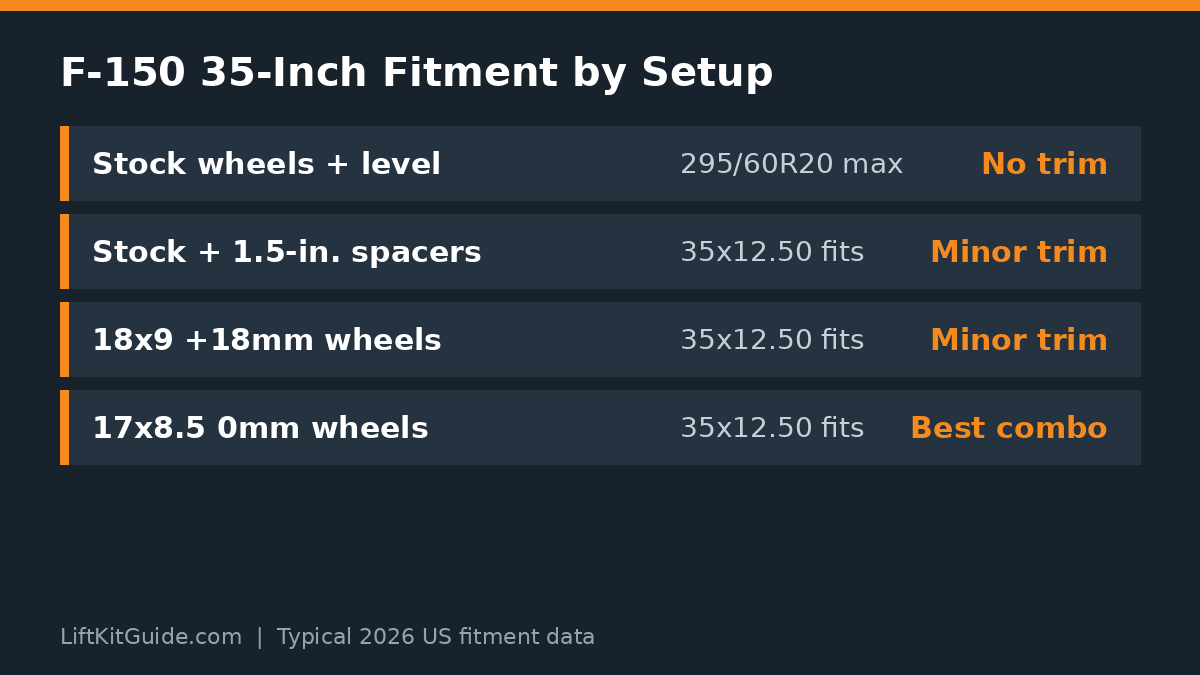
| Stock wheels (+44mm) | 295/60R20 (34.5×11.6) | Fits, no trimming |
| Stock wheels (+44mm) | 35×12.50R20 | Rubs UCA and crash bars |
| Stock + 1.5-in. spacers | 35×12.50R20 | Fits with minor trim |
| 18×9 +18mm wheels | 35×12.50R18 | Fits with minor trim |
| 17×8.5 0mm wheels | 35×12.50R17 | Fits; most popular combo |
What is the biggest tire you can fit on stock F-150 wheels with a level?
The 295/60R20 is the sweet spot: roughly 34.5 inches tall and 11.6 inches wide, it fills the wheel well like a 35 but stays narrow enough to clear everything on stock wheels with a leveling kit. Owners report zero rubbing and zero trimming with this size across 2015 to 2026 F-150s. It is the answer for anyone who loves the factory wheels and wants the biggest possible tire without touching anything else.
If you want a true 35-inch diameter on stock wheels, the 35×11.50R20 exists in a few tread patterns and splits the difference. It gives you the full height with less width drama, though selection is limited and prices run higher per tire. Either way, pair the new rubber with a look at what a leveling kit actually changes so the alignment shop sets caster correctly for the leveled stance. Can you fit 35×12.50s on stock f-150 wheels is the wrong question for stock-wheel loyalists; the right question is which 35 fits, and the 295/60R20 is it.
When owners ask can you fit 35×12.50s on stock f-150 wheels and hear no, the 35×11.50R20 is the compromise that keeps factory wheels in play. It delivers the full 35-inch height and ground clearance with roughly an inch less width to fight, and on stock +44mm wheels that inch is often the difference between clearing and rubbing. Expect to pay a premium per tire and wait longer for stock, since fewer manufacturers make the size, but the total project stays cheaper than buying new wheels.
Can you fit 35×12.50s on stock F-150 wheels using wheel spacers?
Can you fit 35×12.50s on stock f-150 wheels using wheel spacers? Yes, and it is the most popular budget solution. A 1.5-inch hub-centric spacer pushes the wheel outboard enough to convert the stock +44mm offset into roughly +6mm effective offset, which lands squarely in the proven clearance range for 35×12.50s on a leveled F-150. Owners run this setup for tens of thousands of miles without issues when the spacers are quality pieces installed correctly.
Spacers do demand respect during installation. Cheap cast spacers have failed, which is why the community standard is billet aluminum hub-centric spacers from established brands, torqued in a star pattern and rechecked after the first 500 miles. Treat them as a maintenance item at every tire rotation. Done right, spacers are the $200 answer to the can you fit 35×12.50s on stock f-150 wheels question; done wrong with ebay castings and an impact gun, they are a roadside disaster waiting to happen.
- Hub-centric only: lug-centric spacers can vibrate; hub-centric rings center the wheel properly.
- 1.5-inch thickness: converts +44mm to roughly +6mm effective offset, the proven range.
- Quality brands: Bora and SpiderTrax dominate owner recommendations for a reason.
- Torque discipline: torque to spec with a torque wrench, then retorque after 500 miles.
- Check stud length: the spacer must leave enough thread engagement for the lug nuts.
What aftermarket wheel specs clear 35s on a leveled F-150?
Two specs dominate the proven list: 18×9 with +18mm offset and 17×8.5 with 0mm offset. The 18×9 +18 setup keeps the tire close to the body for a clean, near-factory look with just a hint of stance, and it usually needs only minor plastic trimming at full lock. The 17×8.5 0-offset setup is the enthusiast favorite: cheaper 17-inch tires, taller sidewalls for off-road, and a slightly more aggressive stance that most owners prefer.
Avoid going more negative than -12mm unless you enjoy trimming. At -24mm and beyond, the 35s swing wide enough to catch the crash bars and bumper valance even with the level, turning a bolt-on project into a cutting project. When you are shopping, remember that the leveling kit versus lift kit decision does not change these wheel specs; the offset math is the same whether the two inches come from a level or a full lift.
Twenty-inch wheels deserve a note because so many F-150s come with them stock. A 20×9 aftermarket wheel at 0 to +20mm offset works fine with 35×12.50s, but the tires cost $50 to $100 more per tire than 17-inch equivalents and the shorter sidewall rides harsher. If you are buying wheels anyway, dropping to 17 or 18 inches saves money twice: cheaper wheels and cheaper tires. The answer to can you fit 35×12.50s on stock f-150 wheels does not change with diameter, but your wallet will notice the difference.
| Wheel spec | Stance | Trimming with 35×12.50s |
|---|---|---|
| 18×9 +18mm | Near stock, clean | Minor plastic at full lock |
| 17×8.5 0mm | Slightly aggressive | Minor plastic at full lock |
| 17×9 -12mm | Aggressive | Plastic trim likely |
| 20×9 0mm | Aggressive | Plastic trim likely |
| Anything -24mm or more | Very aggressive | Metal trimming expected |
How much trimming do 35s need on a leveled F-150?
With the right wheels or spacers, trimming is minor: usually just the front plastic valance and a corner of the fender liner where the tread kisses at full lock in reverse. It is a 20-minute job with a razor knife or Dremel, and the cuts hide behind the bumper where nobody sees them. This is the normal, expected outcome for 35×12.50s on a leveled F-150, and it is why so many owners consider the setup effectively bolt-on.
Metal trimming enters the picture only with very negative offset or when running 35s with no lift at all. The crash bars behind the front bumper are the structural rub point, and some owners trim their ends or install aftermarket replacements. If you find yourself cutting metal, recheck your offset choice first, because the need for rubbing fixes usually signals the wheels are too aggressive rather than the tires too big. The right spec trims plastic; the wrong spec trims steel.
The right tools make trimming a non-event. A sharp utility knife handles plastic liners, a Dremel with a cutoff wheel manages the valance, and a heat gun lets you reform liners instead of cutting them. Work slowly, test-fit between cuts, and remember you can always remove more plastic but never add it back. Most owners finish both sides in under an hour, and the result is invisible once the truck is back on the ground.
Do 35s on stock wheels affect your speedometer and gearing?
Yes, noticeably. Moving from stock 33s to 35s throws the speedometer off by 6 to 7 percent, so 65 mph indicated is really about 69 mph, and your odometer under-reports miles by the same percentage. That skews your MPG math, your maintenance intervals, and potentially your warranty mileage. A $150 to $250 plug-in calibrator fixes the speedometer, odometer, and shift points in about 15 minutes, and it is money well spent.
Gearing is the longer-term question. F-150s with 3.55 or 3.73 gears handle 35s acceptably with the 10-speed automatic, losing some snap off the line but remaining perfectly livable. Trucks with 3.31 gears feel the 35s more, with frequent downshifting on grades and a bigger MPG hit. Read up on tuning for bigger tires before deciding; most owners find the calibrator sufficient and skip the $2,000 regear. Can you fit 35×12.50s on stock f-150 wheels may be a fitment question, but living with 35s is a calibration question.
What does it cost to properly fit 35s on an F-150?
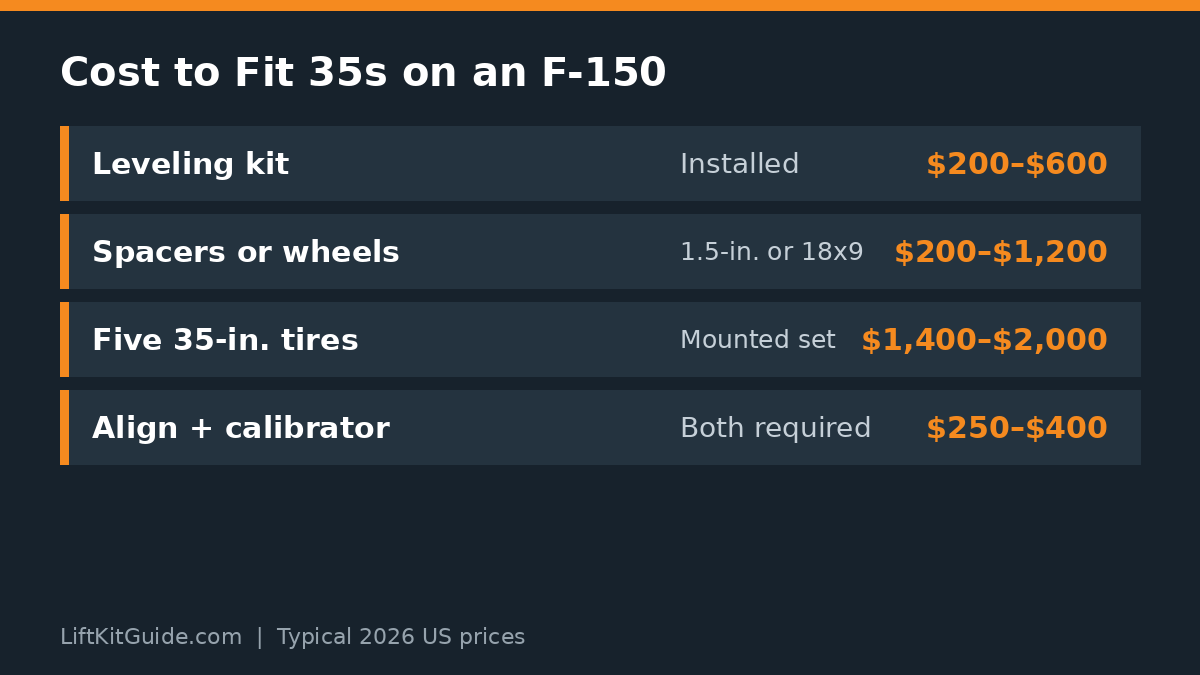
The full budget for 35s on a leveled F-150 typically lands between $1,800 and $3,000. The leveling kit itself is $200 to $600 installed, five 35-inch tires run $1,400 to $2,000, spacers or wheels add $200 to $1,200, alignment is $100 to $150, and the speedometer calibrator is $150 to $250. Buying the tires during a rebate season can save $200 or more on a set of five, which is worth timing if you are not in a hurry.
Where owners overspend is buying twice: cheap spacers now and wheels later, or 35s mounted before discovering the rub. The MPG penalty of bigger tires is also a real ownership cost, roughly 1 to 3 MPG depending on tire weight and driving mix. Plan the wheel solution, the trimming, and the calibration as one project, and the F-150 becomes one of the easiest, most rewarding trucks to run 35s on. Do it piecemeal and every step costs more than it should.
One final tip: buy the speedometer calibrator before the tires go on, not after. Driving a week on uncorrected 35s racks up odometer error and confuses the transmission’s shift logic, and the fix takes fifteen minutes with the truck parked. It is the cheapest part of the project and the most commonly forgotten.
Frequently asked questions
Will 35×12.50 tires rub on stock F-150 wheels with a level?
Not reliably. The stock +44mm offset positions a 12.50-wide tire too far inward, causing contact with the upper control arm and crash bars at full lock. A leveling kit adds height but does not change this horizontal clearance problem.
What is the biggest tire for stock F-150 wheels with a leveling kit?
A 295/60R20 (about 34.5 inches tall and 11.6 inches wide) is the biggest tire that fits stock F-150 wheels with a leveling kit and no trimming. True 35×12.50s need wheel changes or spacers.
Do wheel spacers let you run 35s on stock F-150 wheels?
Yes, 1.5-inch hub-centric spacers effectively convert the stock +44mm offset to about +6mm, which clears 35×12.50s on most leveled F-150s. Buy quality spacers, torque them properly, and retorque after 500 miles.
What aftermarket wheels fit 35s on a leveled F-150?
An 18×9 wheel with +18mm offset or a 17×8.5 with 0mm offset are the proven specs. Both position the 35×12.50 correctly in the wheel well, usually needing only minor plastic trimming at full lock on a leveled truck.
How far off is the speedometer with 35s on an F-150?
About 6 to 7 percent slow, meaning 65 mph indicated is really 69 mph. Recalibrate with a $150 to $250 programmer to fix the speedometer, odometer, and shift points. Trucks with 3.31 gears will feel the 35s more than those with 3.55 or 3.73 gears.
How much does it cost to put 35s on an F-150?
Expect $1,800 to $3,000 including the leveling kit, wheels or spacers, five 35-inch tires, alignment, and speedometer recalibration. The tires alone run $1,400 to $2,000 for a set of five.
The bottom line
Fitting 35×12.50s on stock F-150 wheels with only a leveling kit is the one combination where the honest answer is usually no. The stock +44mm offset tucks the wide tire into the control arms and crash bars, and no leveling kit changes that geometry. Accept a narrower 35, add quality spacers, or buy proper wheels, and the same truck clears 35s happily.
Do not let the leveled look fool you into skipping the details: test-fit before you buy, budget for minor trimming, and recalibrate the speedometer. The F-150 is one of the easiest trucks to fit 35s on once the wheel offset is right, and getting that one spec correct is the difference between a clean setup and a rubbing mess.



Leave a comment