



Last updated: October 2026 Written by the LiftKitGuide Team, truck suspension installers and editors
Old Man Emu vs Dobinsons 4Runner: Dobinsons usually wins for tunability and modern monotube performance, while Old Man Emu wins for proven reliability and weight-matched simplicity. Complete Dobinsons kits run about $2,100 and OME kits about $2,200 including install and alignment, according to owner-reported 4Runner forum pricing. Dobinsons IMS monotube struts feel firmer and more controlled with less nose dive; OME’s twin-tube Nitrocharger setup rides slightly softer and has three decades of global expedition pedigree.
Key takeaways
- Complete kits cost about the same: roughly $2,100 for Dobinsons and $2,200 for OME including install and alignment (owner-reported 4Runner pricing).
- Dobinsons IMS series uses monotube struts; OME Nitrocharger/Nitrocharger Plus uses twin-tube — monotube resists fade better on rough roads.
- Owners describe Dobinsons as firmer but comfortable with notably less brake dive; OME feels a touch softer and more forgiving when unloaded.
- OME offers weight-matched rear springs (0, 330, or 660 lbs added weight); Dobinsons offers similar load tuning plus more height options.
- Both are bolt-on 2-3 inch lifts needing no cutting; add UCAs past 2.5 inches and budget an alignment after settling.

On this page
What are Old Man Emu and Dobinsons lift kits?
Old Man Emu (OME), made by ARB in Australia, has been building integrated 4×4 suspension systems for more than 30 years and is the default recommendation at expedition outfitters worldwide. An OME 4Runner kit pairs Nitrocharger or Nitrocharger Plus twin-tube struts and shocks with coil springs engineered in matched sets — you choose front springs by bumper weight and rear springs by constant cargo load, with common rear options covering 0, 330, or 660 pounds of added weight. The philosophy is simple: tell them your weight, get the right springs, bolt it on.
Dobinsons, also Australian, is the challenger that won over the Toyota community with its IMS (Internal Monotube Shock) series and an enormous catalog of spring rates and heights. Where OME gives you a curated menu, Dobinsons gives you a spreadsheet: dozens of front and rear coil options let you dial exact lift heights from 1 to 3.5 inches for your precise load. In the old man emu vs dobinsons 4runner debate, this is the fundamental philosophical split — OME curates, Dobinsons customizes — and your personality as a buyer probably already tells you which appeals more.
It helps to understand where each brand comes from. ARB built OME for the Australian outback, where a suspension failure a thousand miles from help is not an inconvenience but an emergency — that heritage explains the conservative engineering and obsession with matched systems. Dobinsons grew up in the same market but took the tuner’s path, building its reputation one spring rate at a time among enthusiasts who wanted exactly the right coil. In the old man emu vs dobinsons 4runner story, both companies are serious engineers; they just answer different buyer questions.
Old Man Emu vs Dobinsons 4Runner: which rides better?
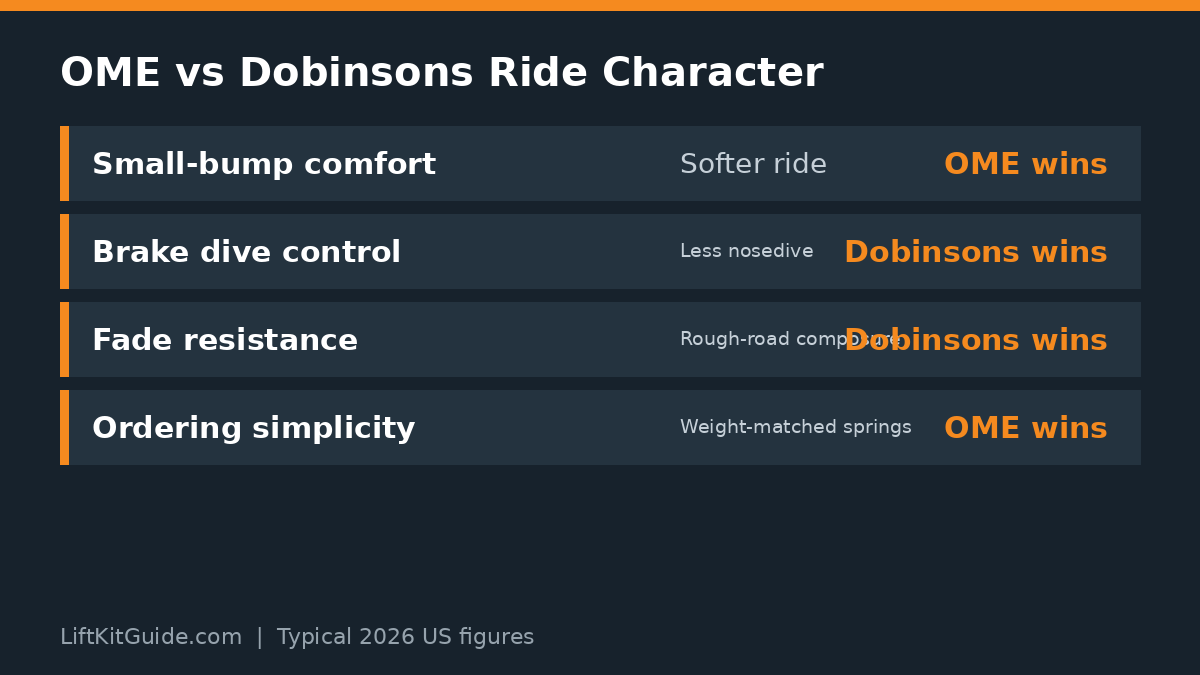
Ride quality is where owners draw the sharpest lines. Dobinsons IMS monotube owners consistently report a firmer, more controlled ride with dramatically reduced brake dive and body roll — one 4Runner owner described the truck as feeling ‘stuck to the road’ after switching, with the floating, wallowy stock behavior gone. The monotube design keeps damping consistent over rough sections where twin-tubes start to fade, which matters on long washboard forest roads.
OME counters with a ride more owners call forgiving. The twin-tube Nitrochargers absorb small chatter with a softness the Dobinsons does not quite match, and when the truck is unloaded, OME’s lighter spring options ride closer to stock comfort. The old man emu vs dobinsons 4runner ride verdict usually lands here: Dobinsons feels more modern and controlled, OME feels more traditional and plush. Neither is harsh — both are leagues better than worn factory suspension — but drivers who prioritize comfort over control tend to prefer OME, and vice versa.
A useful real-world test is the fire-road commute many 4Runner owners actually drive: miles of corrugated dirt at 35 mph with camping gear aboard. This is where Dobinsons’ monotube advantage is most obvious — the truck tracks straight and composed while a twin-tube setup starts to feel busy. Around town, though, the difference shrinks to nearly nothing; both ride well over speed bumps and potholes. Judge the old man emu vs dobinsons 4runner ride debate by your worst regular road, not your best.
| Ride trait | Old Man Emu | Dobinsons IMS |
|---|---|---|
| Small-bump comfort | Softer, more forgiving | Firmer, more controlled |
| Brake dive | Moderate | Noticeably less |
| Body roll | Slightly more | Slightly less |
| Fade resistance | Good (twin-tube) | Better (monotube) |
| Unloaded ride | Closer to stock | Firmer than stock |
| Loaded ride | Excellent (matched springs) | Excellent (tuned rates) |
How much do OME and Dobinsons 4Runner kits cost?
Pricing is closer than the internet suggests. Owner-reported numbers from 4Runners.com put complete Dobinsons kits around $2,100 and complete OME kits around $2,200, both including professional install and alignment — essentially a wash. At the parts level, an OME Nitro Plus 1-2 inch kit lists near $1,150 before options, while Dobinsons IMS-based kits land in a similar band depending on spring and shock choices. The real price variable is not the brand but the options: UCAs, top hats, and spring upgrades move either kit several hundred dollars.
Where costs diverge is in the upgrade paths. OME’s premium BP-51 bypass kit jumps deep into race-shock territory at several thousand dollars, while Dobinsons’ MRA (remote reservoir adjustable) series offers a middle step between IMS and full race gear. For the standard 2-inch daily-driver build most 4Runner owners buy, budget $2,000 to $2,500 all-in for either brand installed. See our cost to lift a truck guide for how these fit total build budgets, and parts versus labor splits for where shops charge most.
Do not forget the small costs that surround either kit. An alignment after settling runs $100 to $150, extended brake lines if you go taller add $80 to $150, and most shops recommend an alignment check, not a full alignment, at the 500-mile retorque. Neither brand requires special tools beyond a good spring compressor or pre-assembled struts, which many vendors offer. These incidentals are identical between brands, so they should not sway the old man emu vs dobinsons 4runner decision — focus on the dampers and springs instead.
Monotube vs twin-tube: does the shock design matter?
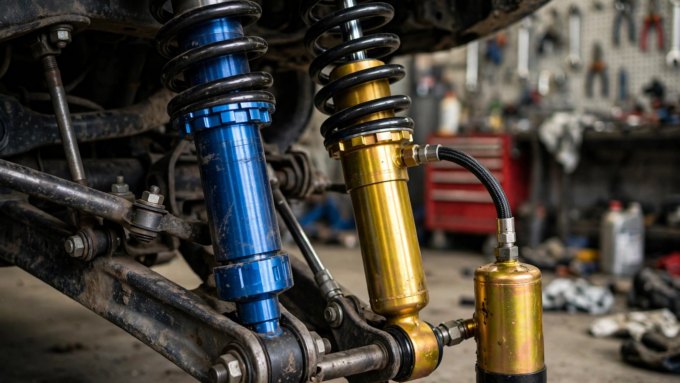
Yes, and it is the single biggest technical difference between the two brands’ mainstream kits. Dobinsons IMS struts are monotube: a single tube with a floating piston separating oil and nitrogen gas, which resists aeration and fade when the shock works hard. OME Nitrocharger and Nitrocharger Plus are twin-tube: an inner working tube inside an outer reservoir, a design that is more forgiving of small imperfections and generally cheaper to manufacture, but more prone to fade on sustained rough roads.
In daily driving the difference is subtle — both ride well around town. It shows up on the tenth mile of washboard or a long mountain descent, where the monotube keeps its composure and the twin-tube starts to feel soft. That said, OME’s twin-tubes have crossed continents for decades without complaint; fade resistance matters most to drivers who actually punish their suspension. For the old man emu vs dobinsons 4runner buyer who mostly commutes with weekend dirt, either design is more than adequate.
For readers new to shock terminology: a monotube shock puts the piston, oil, and a nitrogen charge in a single tube separated by a floating piston, giving a larger piston area and better heat dissipation. A twin-tube nests the working cylinder inside an outer tube that acts as a reservoir, which tolerates minor dents and costs less to build. Neither design is obsolete — both win races — but monotube has become the default for performance applications, which is why Dobinsons’ IMS line gets so much attention.
Which kit is better for a loaded overland 4Runner?
This is OME’s home turf. The brand’s entire system is built around constant load: you specify your bumper, winch, roof rack, and cargo weight, and OME matches springs accordingly, with rear coils explicitly rated for 0, 330, or 660 pounds of added weight. Owners running heavy overland builds consistently praise how OME maintains ride height and composure fully loaded — the truck sits level and controlled where generic springs would sag. Three decades of expedition use is not marketing; it is thousands of loaded trucks in the Australian outback.
Dobinsons answers with granularity rather than curation. Its vast spring catalog lets you spec exact rates for your exact load, and owners report excellent loaded behavior when the rates are chosen correctly — the catch being that you must choose correctly, which rewards research or a knowledgeable vendor. For the old man emu vs dobinsons 4runner overland decision, OME is the safer recommendation for buyers who want the vendor to decide, while Dobinsons rewards buyers who enjoy dialing in their own specs. Check Toyota Tacoma lift kits for how the same brands compare on the pickup side.
One more consideration for the loaded build: spring rate affects unloaded ride more than most buyers expect. Heavy-duty rear coils chosen for a roof-top tent will ride stiff on the daily commute when the tent is in the garage, which is why some owners keep two sets of rear springs or accept the compromise. Both OME and Dobinsons make this trade-off visible in their ordering guides — a honesty you will not get from generic lift kits. Match springs to your most common load, not your heaviest fantasy trip.
- OME weight matching: front springs by bumper weight, rear springs in 0/330/660-lb constant-load ratings — simple to order correctly.
- Dobinsons spring catalog: dozens of rates and heights from 1 to 3.5 inches — maximum tunability, demands more research.
- Heavy bumper + winch: both brands offer heavy-duty front coils; do not run stock-rate springs with 150+ lbs on the nose.
- Roof-top tents: add the tent’s weight to your constant rear load when choosing rear springs, or the truck will sag.
- Settling: both settle slightly after install; get the alignment after 500 miles, not day one.
Old Man Emu vs Dobinsons 4Runner reliability and warranty?
Both brands enjoy excellent reliability reputations, with different strengths. OME’s simplicity is its armor: twin-tube shocks with modest pressures and conservative valving simply last, and ARB’s global dealer network means replacement parts are available on nearly every continent — a genuine consideration for overlanders. Warranty support through ARB’s established channels is straightforward and well-documented.
Dobinsons counters with modern construction and a strong enthusiast-community presence, with US vendors providing knowledgeable support. IMS monotubes run higher gas pressures and tighter tolerances, which delivers the performance edge but leaves slightly less margin for neglect — keep them clean and they last as long as anything. In the old man emu vs dobinsons 4runner longevity debate, neither brand generates the failure threads that plague cheap kits; both are buy-once purchases when installed correctly.
Parts availability on the trail is worth a thought for remote travelers. OME’s global ARB dealer network means a replacement shock is findable in more places worldwide than almost any competitor — a real asset on international overland routes. Dobinsons’ US distribution is strong and growing, with excellent vendor support stateside, but the global footprint is smaller. For North American travel the difference is negligible; for a Pan-American highway trip, it might tip the scales.
Do you need upper control arms with OME or Dobinsons?
At 2 inches of lift or less, most 4Runners align fine on stock upper control arms with either brand, though an alignment shop should verify caster numbers. Past 2.5 inches, aftermarket UCAs become strongly recommended regardless of brand — the ball-joint angle and alignment range simply run out, and no spring choice fixes geometry. Both OME and Dobinsons vendors sell UCA bundles (OME, Dobinsons, or SPC arms in the $650 to $875 range), and buying them with the kit saves a second alignment.
This is also where honest self-assessment pays off. If you know you will eventually want 3 inches and 33s, buy the UCAs with the initial install rather than paying for alignment twice. Our suspension lift kits explained guide covers the geometry, and best lift kit brands ranks where OME and Dobinsons sit among premium options. Either way, the UCA question is about lift height, not brand.
A final note on UCAs: not all aftermarket arms are equal. Tubular arms with standard ball joints suit most drivers and cost less; billet or uniball arms offer more alignment range and strength for hard use at higher prices. Whichever brand’s lift you choose, match the UCA to your use — a daily driver does not need race-grade uniballs that demand regular service. Buy the arm for the truck you drive, not the truck you post.
| Setup | Typical price | Notes |
|---|---|---|
| Dobinsons IMS kit, installed | ~$2,100 | Owner-reported, incl. alignment |
| OME Nitro Plus kit, installed | ~$2,200 | Owner-reported, incl. alignment |
| UCAs (OME/Dobinsons/SPC) | $650-$875 | Recommended past 2.5 in. |
| OME BP-51 bypass kit | $4,000+ | Race-grade upgrade path |
| Dobinsons MRA adjustable | $3,000+ | Remote-reservoir middle step |
Which should you buy for your 4Runner?
Buy Dobinsons IMS if you want the most modern damper technology, the least brake dive, and the ability to fine-tune heights and rates to your exact build — and you enjoy (or have a vendor for) the research. It is the enthusiast’s choice and the better performer on rough roads, at essentially the same money as OME.
Buy Old Man Emu if you want the simplest correct answer: decades of expedition pedigree, weight-matched springs chosen for you, a slightly softer unloaded ride, and global parts availability. For the old man emu vs dobinsons 4runner buyer who wants to order once and never think about suspension again, OME remains the gold standard. See leveling kit versus lift kit if you are still deciding how much lift you actually need.
Whichever you choose, give the new suspension a proper break-in before judging it. Fresh coils settle up to a quarter inch over the first 500 miles, bushings need heat cycles to find their happy place, and your own calibration to the new ride takes a week. Too many owners declare a verdict on day two. Drive it loaded, drive it empty, then decide — and remember the alignment shop visit that both brands require after settling.
Frequently asked questions
How much does an Old Man Emu lift cost for a 4Runner?
An OME Nitro Plus 1-2 inch kit lists near $1,150 for parts; owner-reported complete installs run about $2,200 including labor and alignment. Adding UCAs ($650-$875) or stepping up to the BP-51 bypass kit ($4,000+) increases the total.
How much does a Dobinsons lift cost for a 4Runner?
Owner-reported complete Dobinsons IMS installs run about $2,100 including labor and alignment — essentially the same as OME. Spring and shock choices move the parts price, and the adjustable MRA series costs $3,000 or more.
Is Dobinsons better than Old Man Emu?
Neither is universally better. Dobinsons IMS offers monotube performance, less brake dive, and more tuning options; OME offers twin-tube forgiveness, simpler weight-matched ordering, and unmatched expedition pedigree. Choose Dobinsons for tunability, OME for simplicity.
Are Dobinsons shocks monotube?
Yes — the Dobinsons IMS (Internal Monotube Shock) series uses a monotube design with an internal floating piston, which resists fade better than twin-tube designs on sustained rough roads. Dobinsons also offers twin-tube options in its entry-level lines.
Do I need UCAs with a 2-inch 4Runner lift?
Usually not at 2 inches — most 4Runners align within spec on stock UCAs with either OME or Dobinsons. Past 2.5 inches, aftermarket UCAs are strongly recommended to restore ball-joint angle and caster regardless of brand.
Which 4Runner lift is best for overlanding?
For heavy overland builds, OME's weight-matched spring system is the simplest correct answer — specify your constant load and the springs are chosen for you. Dobinsons matches it when spring rates are selected carefully, with an edge in damper performance on rough tracks.
The bottom line
Old Man Emu vs Dobinsons on a 4Runner is a choice between two excellent philosophies, not a choice between good and bad. Dobinsons IMS brings modern monotube performance, less dive, and deep tunability; OME brings twin-tube forgiveness, foolproof weight matching, and thirty years of expedition trust — at essentially identical money.
Pick Dobinsons if you enjoy dialing in your setup and want the sharpest damper performance. Pick OME if you want to answer three questions about your truck’s weight and never think about suspension again. Either way, you are buying once.




Leave a comment