



Last updated: October 2026 Written by the LiftKitGuide Team, truck suspension installers and editors
So, what is a leveling kit? It is a small suspension kit that raises only the front of a truck by 1 to 3 inches, bringing the front up level with the rear. Trucks leave the factory nose-down, a stance called rake, and a leveling kit removes most of it. You gain a level stance, room for a tire about one size larger, and more front clearance. Understanding what is a leveling kit does not do matters too: no rear lift, no extra towing capacity, no real off-road clearance.
Key takeaways
- A leveling kit raises only the front of the truck, by 1 to 3 inches, to match the rear and remove the factory nose-down rake.
- It fits a tire about one size larger – 33-inch tires on most half-ton trucks – and adds a small amount of front bumper clearance.
- It does not lift the rear, increase payload or towing capacity, or add real off-road ground clearance under the frame.
- Parts cost $50 to $900 and a shop installs most kits in 1.5 to 3 hours; an alignment afterwards is mandatory, not optional.
- Frequent heavy towers should think twice: with the rake gone, a heavy trailer makes the truck squat nose-up.
On this page
What is a leveling kit, in plain terms?
The simplest answer to what is a leveling kit is a front-only lift. Where a suspension lift kit raises the whole truck and replaces major components, a leveling kit works only on the front suspension and adds just enough height to match the rear. On most half-tons the rear sits 1 to 2 inches higher from the factory, so a 2-inch kit closes exactly that gap. Nothing at the rear axle changes: the leaf springs, shocks and ride height out back stay completely stock, which is why leveling is the cheapest way to change a truck’s stance.
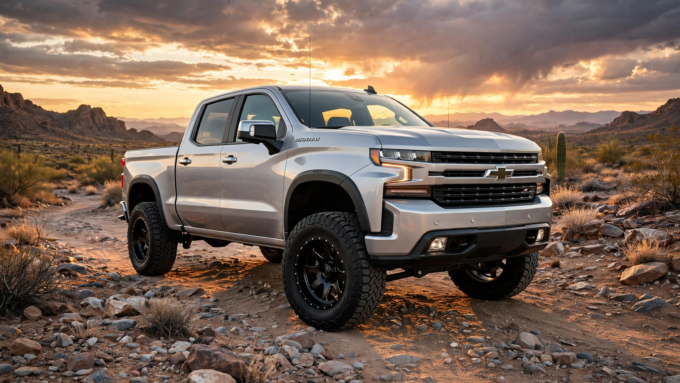
That small change has three practical effects. First, the truck sits flat instead of pointing its nose at the pavement, which most owners simply prefer the look of. Second, the raised front fenders clear a tire roughly one size larger than stock – typically a 33-inch tire on a half-ton that shipped with 31s or 32s. Third, the front bumper gains a little clearance over curbs, snow and ruts. What does not change is just as important: frame height mid-truck, payload, towing ratings and rear suspension travel all stay exactly as the factory built them.
Why do trucks have a factory rake in the first place?
Rake is deliberate, not a styling accident. Engineers build pickups nose-down for two reasons. The first is load carrying: when you drop a heavy load in the bed or hitch up a trailer, the rear suspension compresses and the truck settles level instead of pointing its nose at the sky. A truck that starts out level would squat rear-down under the same load, which hurts steering, braking and headlight aim. The second reason is aerodynamics – a slightly nose-down stance helps highway fuel economy, which matters to manufacturers chasing fleet efficiency targets.
This is the exact trade-off behind what is a leveling kit designed to fix. If your truck spends its life empty – commuting, light hauling, the occasional hardware store run – the built-in rake never gets used for its intended purpose, and you are left with the nose-down look full time. Removing it costs you nothing in daily driving. But if you regularly tow or haul near the truck’s limits, that rake is functional suspension travel you may want to keep. Deciding which kind of owner you are is the real first step, before choosing any kit.
What are the different types of leveling kits?
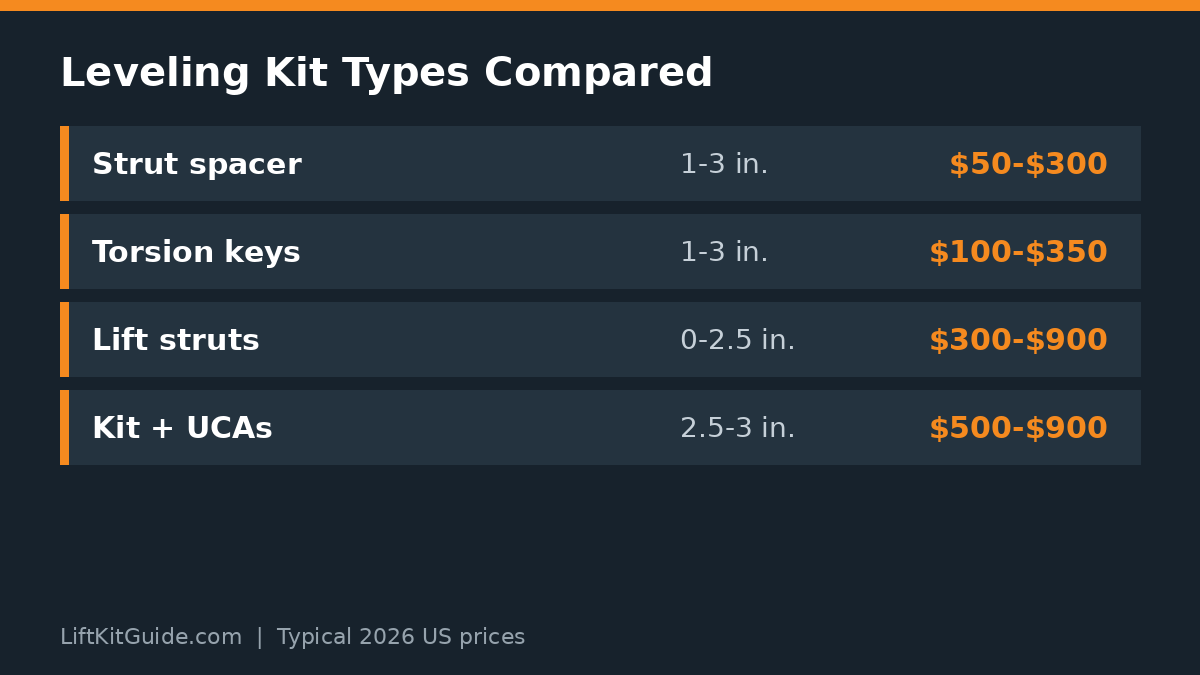
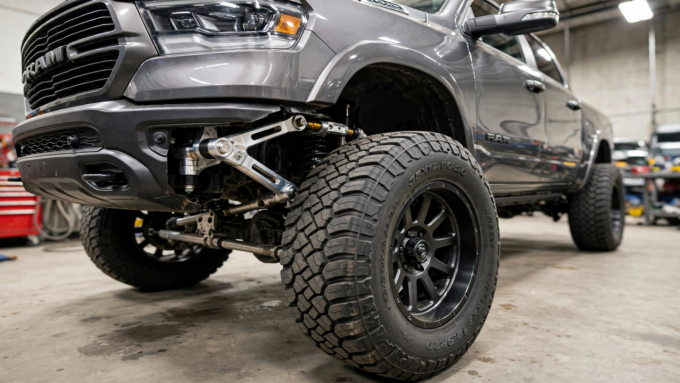
Now the hardware: once the definition is clear – what is a leveling kit made of? There are five main approaches, and they differ in price, ride quality and how much height they can safely add. Strut spacers are the most common: a metal or polyurethane block that bolts on top of the front strut. Coil and preload spacers work similarly inside or above the coil spring. Older torsion-bar trucks use replacement torsion keys instead. At the top end, adjustable lift struts replace the factory units entirely, and taller kits add upper control arms to keep alignment in range.
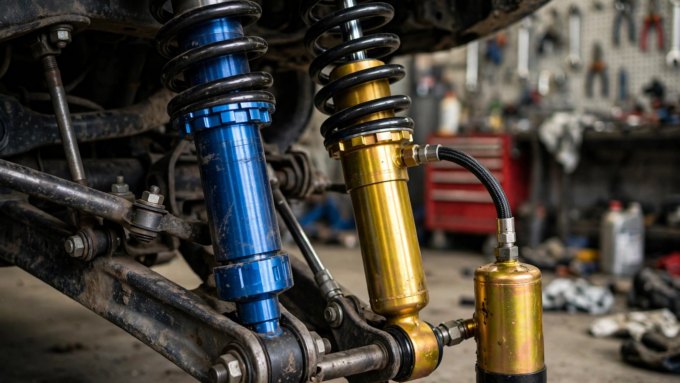
Strut spacers preserve the factory ride because the stock strut and spring rates are untouched, which is why they dominate the budget end of the market. Torsion keys crank the front up by re-indexing the torsion bars; they are cheap but can stiffen the ride if cranked to their limit. Adjustable lift struts, in the Bilstein 5100 style, use a snap-ring groove to set ride height on a longer, better-damped strut – the best ride of the group. Above about 2.5 inches, upper control arms stop being optional: the factory arms run out of ball-joint angle and alignment range.
| Kit type | How it lifts | Lift range | Parts price | Ride effect |
|---|---|---|---|---|
| Strut spacer | Block bolts on top of the front strut | 1-3 in. | $50-$300 | Near stock |
| Coil / preload spacer | Spacer above or inside the coil spring | 1-2.5 in. | $60-$350 | Near stock, slightly firmer |
| Torsion keys | Re-indexed keys crank the torsion bars | 1-3 in. | $100-$350 | Can stiffen at max crank |
| Adjustable lift struts | Replacement struts with height settings | 0-2.5 in. | $300-$900 | Best control and damping |
| Kit with upper control arms | Spacers or struts plus replacement arms | 2.5-3 in. | $500-$900 | Near stock, alignment stays in range |
What does a leveling kit actually change on your truck?
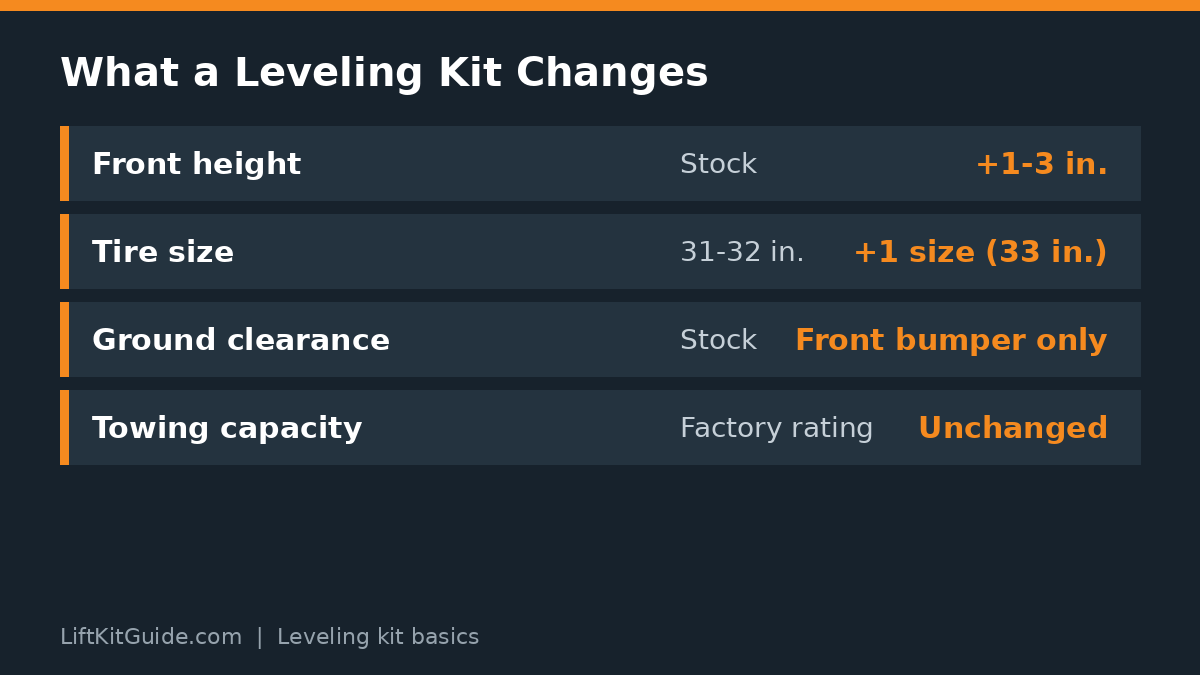
The honest spec sheet for what is a leveling kit is short. Front ride height rises by the kit’s rating, usually 1.5 to 2.5 inches on a modern half-ton. Rear height does not move at all. That front lift opens the front wheel wells enough for about one tire size: most half-tons go from a 31- or 32-inch stock tire to a 33 with no trimming, and some fit a 34 with minor plastic trimming. Ground clearance improves only at the very front – approach angle and bumper clearance – while clearance under the frame and differentials stays stock.
Everything structural stays stock too, and the table below shows the split. Payload and towing ratings are set by the frame, axles, springs and cooling, none of which a leveling kit touches, so the factory numbers still apply in full. Speedometer error follows the tire change, running roughly 3 to 4 percent slow with a one-size increase unless you recalibrate it, and fuel economy dips slightly with the bigger tires. In short, what is a leveling kit changes is stance and tire room – nothing structural.
| Measurement | Stock | With a leveling kit |
|---|---|---|
| Front ride height | 1-2 in. below rear (rake) | Level with rear, +1-3 in. |
| Rear ride height | Factory height | Unchanged |
| Max tire, typical half-ton | 31-32 in. | 33 in. (some 34 in. with trimming) |
| Front bumper clearance | Stock approach angle | Slightly improved |
| Payload and towing ratings | Factory ratings | Unchanged |
How does a leveling kit affect ride quality and towing?
Ride quality is where what is a leveling kit gets misunderstood. A spacer kit changes ride height without changing spring rate or damping, so on the road it feels almost identical to stock – the most common owner report is no difference at all. Lift struts can genuinely improve control, especially on a truck whose factory shocks are worn. The catch with every type is alignment: lifting the front changes caster and camber, so a professional alignment immediately after installation is required, not optional. Skip it and the truck will wander and chew its front tires.
Towing is the leveling kit’s real trade-off. With the factory rake gone, the truck starts level, so a heavy trailer’s tongue weight pushes the rear down and the nose up. A nose-high truck has lighter steering, reduced front braking grip and headlights aimed at the sky – unpleasant and, at the limit, unsafe. Occasional light towing changes nothing meaningful. But if you tow heavy or often, either keep some rake, choose a smaller 1.5-inch kit, or plan on rear air helper springs that restore level under load – a setup covered in our 2022 Ram 2500 leveling kit guide for heavy-duty trucks
Who actually needs a leveling kit?
The owners who benefit most are those who understand what is a leveling kit can and cannot do. If your goal is a level stance and a slightly larger tire for a daily-driven truck, a leveling kit delivers exactly that for a few hundred dollars – no other modification comes close on value. It is also the right answer for working trucks that carry constant front weight: a snow plow, a heavy steel bumper or a winch can sag a stock front end by an inch or more, and a leveling kit restores the factory ride height.
A few more profiles fit the pattern. Hunters and rural drivers gain useful bumper clearance on rutted tracks without paying for a full lift. Owners upsizing to all-terrain tires for winter or gravel use get the clearance those tires need. And anyone who simply dislikes the factory nose-down look can fix it in an afternoon with basic parts. None of these owners needs more suspension than a leveling kit provides, and all of them would be overspending on a full lift kit. If you recognise your truck in this list, you are the target buyer:
- Daily drivers who want a level stance and 33-inch tires without changing how the truck drives
- Working trucks carrying a snow plow, steel bumper or winch that sags the front end
- Owners upsizing tires to all-terrains for winter, gravel or mild trail use
- Budget fixers who simply want the factory nose-down rake gone for a few hundred dollars
- Nearly-new trucks whose owners want a reversible change that keeps warranty friction low
Who should skip a leveling kit?
Knowing what is a leveling kit cannot do points straight at who should not buy one. Heavy towers and haulers come first: if your truck regularly pulls a travel trailer, a loaded equipment trailer or a bed full of material, the factory rake is working for you every mile, and removing it makes the truck worse at its job. Keep the rake, or level only after adding rear air helpers. The second group is serious off-roaders: a leveling kit adds almost no usable clearance or suspension travel, so it will not get you down a harder trail.
The third group is owners of trucks with tired front suspensions. A leveling kit amplifies worn ball joints, tired struts and loose tie rods – lifting a worn front end usually turns small clunks and vague steering into obvious problems, and the alignment shop may refuse to align it until parts are replaced. Fix the wear first, then level. Finally, if what you really want is 35-inch tires or a visibly lifted truck, skip the leveling kit entirely and save toward a proper suspension lift; stacking a tall spacer on top of other parts helps no one.
How much does a leveling kit cost to buy and install?
Cost is usually the deciding factor, and it is where what is a leveling kit involves gets refreshingly simple. Parts run from about $50 for a basic spacer set to $900 for adjustable lift struts or a kit with upper control arms. Professional installation takes 1.5 to 3 hours, and with the mandatory alignment the installed total typically lands between $300 and $1,000. Our full breakdown in the leveling kit cost guide walks through prices by kit type and truck, so you can price your exact setup before calling a shop for a quote.
That is a fraction of a full lift, which is why leveling is usually the first suspension modification owners make. For comparison, the total cost to lift a truck with a full suspension kit runs $1,500 to $5,000+ installed. One model-specific note: heavy-duty trucks cost a little more to level because the parts are bigger and alignments pricier – the 2024 Ram 2500 leveling kit guide and the F-250 leveling kit guide for 2017 trucks show the pattern. Published shop guides, such as Gresham 4 Wheel Drive’s lift kit installation cost guide, quote similar labor times for leveling installs.
Leveling kit or suspension lift: which one is right for you?
Choosing starts with the basics: what is a leveling kit is a stance and tire-fitment tool, while a suspension lift is a capability tool. Our leveling kit vs lift kit comparison lays the two side by side, but the short version is simple. If you want level looks, 33-inch tires and stock manners for daily driving, the leveling kit wins on price, ride and warranty-friendliness. If you want 35s, real ground clearance and suspension travel for trails, only a lift kit delivers it – at several times the price and with far more parts changed.
There is also a third option owners ask about – a body lift – which raises the body on spacers for tire room without touching the suspension at all; our body lift vs suspension lift guide explains where it fits. For most owners reading this page, though, the decision is already made by how the truck is used: daily driving and light duty point to a leveling kit, heavy towing and hard trails point away from one. Buy for the truck you actually drive every day, not the one you might build someday.
Frequently asked questions
What is a leveling kit used for?
A leveling kit is used to raise the front of a truck 1 to 3 inches so it sits level with the rear, removing the factory nose-down rake. That levels the stance, makes room for a tire about one size larger than stock – typically 33s on a half-ton – and restores front ride height on trucks carrying a plow, steel bumper or winch. It is a stance and fitment tool, not an off-road or towing upgrade.
Does a leveling kit affect ride quality?
Barely, with a spacer kit. Because the factory struts, springs and damping are unchanged, ride quality stays close to stock – most owners notice no difference at all. Adjustable lift struts can actually improve body control over worn factory shocks. What does change ride and tire wear is skipping the alignment: lifting the front alters caster and camber, so budget for a professional alignment right after installation.
Can you tow with a leveling kit?
Yes, but with a caveat that matters. The kit does not change your truck's rated towing or payload capacity – the factory numbers stand. The issue is stance under load: with the rake removed, a heavy trailer's tongue weight makes the rear squat and the nose rise, which lightens the steering and aims the headlights high. Light, occasional towing is fine; frequent heavy towing is better with some rake kept, or with rear air helper springs added.
How long does it take to install a leveling kit?
A shop typically installs a strut-spacer leveling kit in 1.5 to 3 hours, plus alignment time. Torsion-key kits on older trucks are similarly quick, while kits that replace the struts or add upper control arms run longer. Experienced DIYers with a spring compressor, torque wrench and jack stands can do a spacer kit in an afternoon, but the alignment still has to happen at a shop before regular driving.
Do I need an alignment after installing a leveling kit?
Yes, always. Raising the front suspension changes the caster, camber and toe settings the tires rely on, and driving on the old settings will make the truck wander and wear the front tires out within a few thousand miles. This is where understanding what is a leveling kit job really includes matters: parts, labor and an alignment are one package, and any quote that leaves the alignment out is incomplete.
Will a leveling kit void my truck's warranty?
No, not the whole warranty. A leveling kit can only affect coverage for parts it directly stresses – a dealer could question a ball joint or CV axle claim on a leveled truck, for example – but under the Magnuson-Moss Warranty Act they must show the kit caused the failure, and unrelated systems stay covered. Keep your receipts and alignment sheet; sensible heights rarely cause warranty friction.
The bottom line
So, what is a leveling kit? A small, inexpensive front lift that levels your truck’s stance, fits a tire about one size larger, and changes almost nothing else. For a daily-driven truck that tows light or not at all, it is one of the best-value modifications you can make – a few hundred dollars, a few hours in the shop, and a truck that finally sits the way it looks in the brochure. The key is going in with clear eyes about the trade-offs involved.
If you tow heavy, haul at the limit, or want real off-road capability, a leveling kit is the wrong tool and a suspension lift – or simply leaving the truck stock – is the smarter buy. Decide that first, choose the kit type that fits your budget, get the alignment done, and a leveling kit will do its one job quietly for the life of the truck.



2 Comments