


Last updated: October 2026 Written by the LiftKitGuide Team, truck suspension installers and editors
Do I need an alignment after a 2 inch level? Yes — a 2-inch front lift moves toe by roughly a degree per side and shifts camber and caster enough to matter. The change is invisible to the eye but brutal on tires: uncorrected toe will feather a set of all-terrains in 10,000 to 15,000 miles. A professional alignment costs $75 to $150 and should be done immediately after the install. The only partial exception is solid-axle trucks, which usually just need the steering wheel recentered.
Key takeaways
- Yes — a 2-inch level moves toe roughly 1 degree per side, enough to ruin front tires in 10,000–15,000 miles.
- Toe wears tires fastest; camber wears edges; caster affects steering feel and straight-line stability.
- A standard alignment costs $75 to $150 and should happen immediately after the install.
- If factory adjustment runs out, aftermarket cam bolts ($50–$150) restore the range.
- Solid-axle trucks are the partial exception: usually just recenter the steering wheel.
On this page
Do I Need an Alignment After a 2 Inch Level?
Do I need an alignment after a 2 inch level? Absolutely — two inches of front lift is well past the point where alignment becomes optional. At this height, toe typically shifts close to a full degree per side, camber tilts outward, and caster drops enough to change steering feel. Your eyes cannot see these changes, but a $1,200 set of all-terrain tires will feel them within the first few thousand miles through feathered, noisy tread. The printout is your proof — a good shop hands it over without being asked and walks you through every number.
The 2-inch mark matters because it is where geometry changes stop being theoretical. A 1-inch spacer might sneak by within factory tolerances on some trucks, but 2 inches moves the suspension far enough through its arc that every angle needs resetting. This is why leveling kit manufacturers specify 2 to 2.5 inches as their standard height and simultaneously print alignment-required warnings in the instructions — the two facts are directly connected. That direct connection is why reputable shops treat the alignment as part of the leveling job, not an optional add-on.
Budget the alignment as part of the project, not as an afterthought. At $75 to $150, it is a fraction of the leveling kit install cost and a tiny fraction of premature tire replacement. Our leveling kit explainer details what the kit changes mechanically, while the leveling kit cost guide shows the full budget picture including this mandatory final step. Skipping it to save money is false economy, and do I need an alignment after a 2 inch level is really a question about how soon you want to buy tires.
| Angle | Typical shift from 2-in. level | Consequence if ignored |
|---|---|---|
| Toe | ~1° per side | Feathered tread in 10,000–15,000 miles |
| Camber | Positive shift, outer tilt | Outer-edge wear, reduced contact patch |
| Caster | Slight reduction | Lighter steering, less return-to-center |
What Is Toe, Camber, and Caster on a Truck?
Toe, camber, and caster are the three angles that define how each wheel sits, and understanding them turns the alignment from a mysterious upsell into plain maintenance. Toe is viewed from above: it describes whether the fronts of the tires point slightly toward each other (toe-in) or away from each other (toe-out). Even a quarter-degree of unwanted toe scrubs rubber sideways on every revolution, which is why toe errors destroy tires faster than any other misalignment. Get the toe wrong and nothing else you do for tire life matters very much.
Camber is viewed from the front: it is the inward or outward tilt of the top of the tire. Factory trucks run a touch of negative camber for cornering grip, but a 2-inch level pushes the top of the tire outward into positive camber, loading the outer tread edge. You might notice the truck looks slightly pigeon-toed from the front after a level — that visible tilt is camber you can actually see. That visible tilt after a fresh level is normal — what matters is whether the alignment brings it back into specification.
Caster is viewed from the side: it is the forward or backward tilt of the steering axis, and it is what makes the steering wheel return to center after a turn. Think of a shopping cart caster trailing behind its pivot — that trail is what stabilizes the wheel. Leveling reduces positive caster slightly, so the steering can feel lighter and less eager to track straight. The alignment restores all three angles to work together at the new ride height.
Do I Need an Alignment After a 2 Inch Level If It Drives Straight?
Do I need an alignment after a 2 inch level if the truck feels perfectly fine? Yes — this is the most expensive misconception in leveling. A truck can track straight and feel normal while running nearly a degree of excess toe, because toe wear is silent and the steering can compensate. By the time you notice feathered edges or a highway hum, the damage to the tread is already done and cannot be reversed by a later alignment. Trust the rack, not your seat-of-the-pants feel: only measured numbers tell the true story.
The “drives straight” test only catches gross problems like a badly off-center steering wheel or a strong pull. It tells you nothing about the slow, even scrub that toe error inflicts across the whole tread face. Technicians see this constantly: owners who skipped the alignment bring in trucks that drive acceptably but need front tires at 20,000 miles instead of 50,000. The alignment printout would have shown the problem on day one. A proper alignment on day one is dramatically cheaper than early tire replacement in month eight.
There is one honest exception worth naming. If your truck has a solid front axle, do I need an alignment after a 2 inch level gets a softer answer — camber and toe barely move on a rigid beam axle, and recentering the steering wheel via the drag link is often sufficient. But for the independent-front-suspension trucks that make up the vast majority of leveled half-tons and midsize pickups, feeling fine proves nothing. Get the alignment and get the printout.
| What you feel | What it actually means | Action |
|---|---|---|
| Drives straight | Toe may still be off — wear is silent | Align anyway; check the printout |
| Steering wheel centered | Geometry likely okay, but verify | Quick alignment check |
| Slight pull | Something is definitely out | Align immediately |
| Feathered tread | Toe has been wrong for thousands of miles | Align now; tires may already be damaged |
How Much Do Alignment Angles Shift With a 2-Inch Lift?
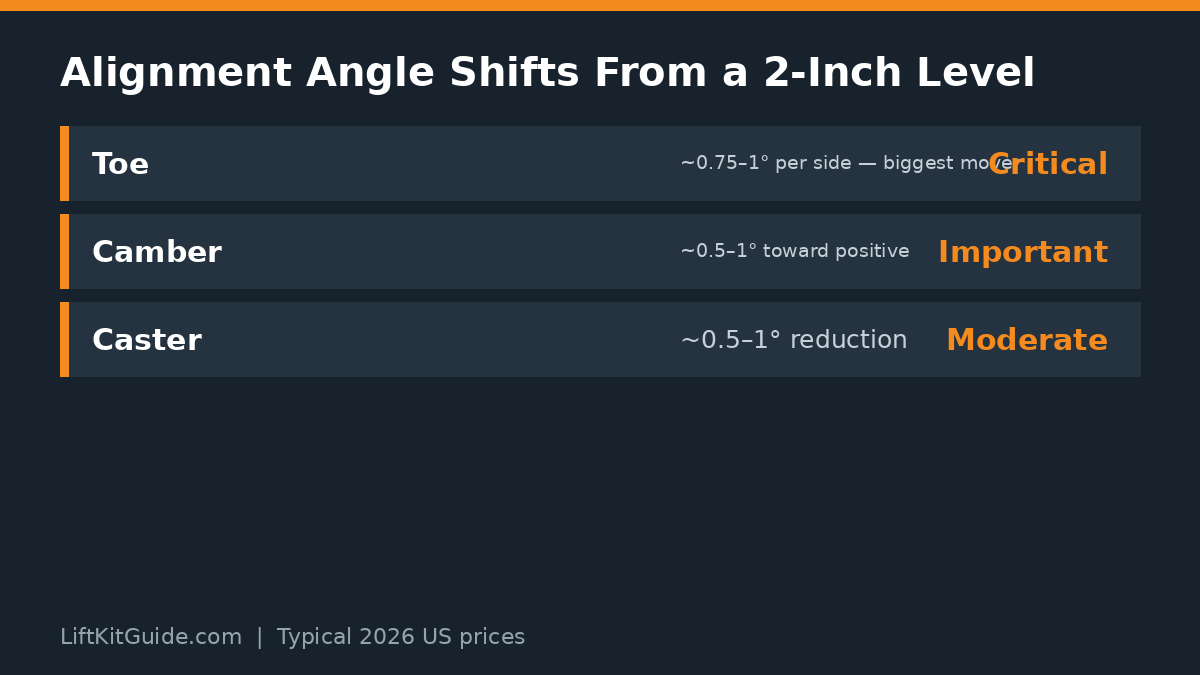
With a 2-inch front lift, toe is the big mover at roughly 0.75 to 1 degree per side on most independent-front-suspension trucks. That sounds small until you translate it: total toe error of 1.5 to 2 degrees means each front tire is being dragged sideways a fraction of an inch with every single rotation. Over 10,000 miles, that sideways scrub adds up to the equivalent of dragging the tires sideways for miles — which is exactly what feathering is. Think of a degree of toe as the tires arguing with each other about which way is straight.
Camber typically shifts 0.5 to 1 degree toward positive, pushing the top of the tire outward. On trucks that started near zero camber from the factory, that is enough to put visible load on the outer tread edge. Caster usually drops 0.5 to 1 degree, which most drivers feel as slightly lighter steering and a lazier return to center after turns. None of these numbers sound dramatic, and that is precisely why owners underestimate them. Small numbers, big consequences — that is the theme of every alignment conversation.
The exact shift varies by truck because suspension geometry differs — a Tacoma’s double-wishbone front end does not move exactly like an F-150’s. But the direction is universal: up goes the front, out goes the camber, in or out goes the toe, down goes the caster. This is why do I need an alignment after a 2 inch level has the same answer across every brand: the physics does not care about the badge on the tailgate. Physics does not negotiate, which is why do I need an alignment after a 2 inch level gets the same yes from every experienced technician.
Can a 2-Inch Level Max Out Your Factory Adjustment?
Sometimes, yes — and this surprises owners who assume any alignment shop can fix anything. Factory camber and caster adjustments work through slotted holes and eccentric bolts with limited travel. A 2-inch level moves the geometry near the edge of that range, and on some trucks the eccentrics hit their stops before the angles reach specification. The technician’s printout will show the angle stuck in the red no matter how the bolts are turned. The red zone on the printout is not a suggestion — it means the hardware physically cannot go further.
When that happens, the fix is aftermarket adjustment hardware, most commonly cam bolts or adjustable control arms. Cam bolts with a wider eccentric range cost $50 to $150 installed and restore the adjustment the factory slots lack. For trucks that will see more suspension changes down the road, aftermarket upper control arms with built-in caster correction are the premium answer — our upper control arm guide explains when arms become the right call. Ask about this before the truck goes on the rack, not after the first alignment attempt fails.
This is worth knowing before you book the alignment, not after. Ask the shop to check adjustment range first; a good technician will tell you upfront if the factory hardware cannot reach spec. Discovering it mid-alignment means a second appointment and a second alignment fee. Trucks leveled 2.5 inches are more likely to need the extra hardware than trucks leveled a true 2 inches — another reason to know your kit’s actual lift height. Knowing your true lift height matters, because do I need an alignment after a 2 inch level versus a 2.5-inch level can mean different hardware.
What Alignment Specs Should a Leveled Truck Target?
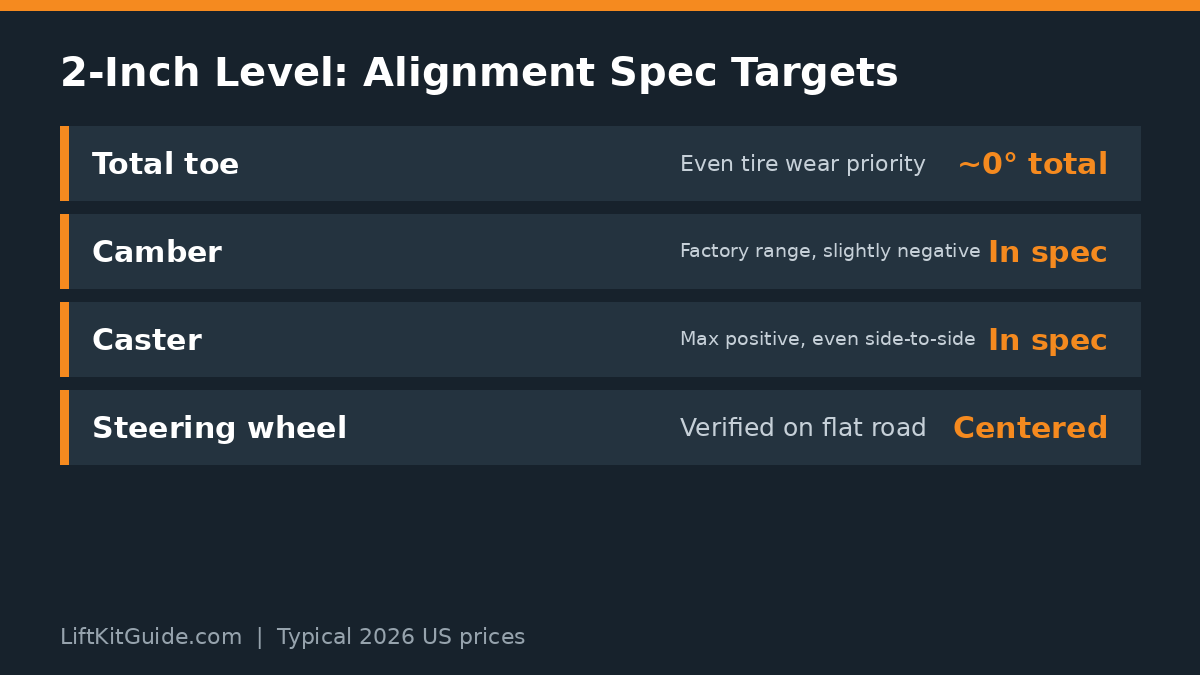
The target for a leveled truck is simple: factory specifications, achieved at the new ride height. Toe should be set at or near zero total — this is the single most important number on the printout, because any leftover toe error continues wearing tires from the moment you leave. Do not accept “within the green” if the green spans half a degree; ask for the actual number and push for as close to zero as the adjustments allow. Half a degree of leftover toe will still cost you thousands of miles of tire life.
Camber should land back inside the factory range, ideally with a whisper of negative camber rather than positive. Positive camber after a level is the classic sign the factory eccentrics ran out of travel. Caster wants as much positive as possible while keeping both sides even — uneven caster side to side is what causes a constant pull, and it is maddening to live with on long highway drives. Even caster deserves attention: lopsided caster is the classic cause of a mysterious highway pull.
The most important spec is not an angle at all: it is the before-and-after printout in your hand. A shop that aligns lifted trucks regularly will show you the numbers without being asked and explain what changed. If a shop waves off the printout or says the machine “doesn’t print,” that is your signal to pay elsewhere. The installation cost guide and lift cost overview both treat the alignment as a core project cost for exactly this reason.
- Toe: at or near zero total. This is the non-negotiable one — any residual toe error eats tires.
- Camber: within factory range, slightly negative preferred. Avoid positive camber that loads the outer edge.
- Caster: as much positive as the adjustment allows, even side to side. More caster means better straight-line stability.
- Steering wheel: perfectly centered. Verify on a flat road, not just on the rack.
- Printout: before and after. If the shop will not show numbers, find another shop.
How Do You Keep Tires From Wearing After a Level?
The alignment is step one, but tire longevity after a level is a system. Rotate your tires every 5,000 to 7,500 miles without fail — rotation evens out the minor wear differences that even a perfect alignment cannot fully erase, especially on heavier all-terrain tires. Keep pressures at the door-jamb specification, checked monthly; underinflation wears edges and overinflation wears centers, and both amplify any small alignment imperfection. This is the unglamorous maintenance that separates 60,000-mile tire life from 25,000-mile tire life.
Watch the tread like a hawk for the first few months. Run your hand across the tread face every couple of weeks feeling for the sawtooth feathering that signals toe trouble, and glance at the inner and outer edges for uneven wear that points to camber. Catching a problem at 2,000 miles costs an alignment recheck; catching it at 12,000 miles costs two tires. Early detection is the entire game. Owners asking do I need an alignment after a 2 inch level should start this habit the same week as the install.
Re-check the alignment itself on a schedule, not just when symptoms appear. Potholes, curb strikes, and off-road miles knock settings out over time, and a leveled truck running big tires punishes small errors faster than a stock truck. Many owners align yearly or tie the recheck to tire rotations at a shop with a lifetime alignment plan. The suspension lift kits guide covers how taller lifts multiply these same maintenance demands. Tie the recheck to something you already do, like oil changes, so it never gets forgotten.
When Should You Align Again After the First One?
The first alignment happens immediately after the install — that part is settled. The second one should happen sooner than most owners expect: after about 500 to 1,000 miles, once the new suspension components have settled into their final positions. Fresh struts, spacers, and bushings shift microscopically as they take a set, and a quick recheck confirms everything stayed where the technician put it. Many shops include this recheck free if you ask when booking. Fresh components settling is normal and expected — the recheck simply confirms they settled evenly.
After that, align on events rather than the calendar. Any hard pothole hit, curb strike, or serious off-road session justifies a recheck, because those are the moments settings actually move. Annual alignment checks are sensible for daily-driven leveled trucks, and mandatory before any long road trip on expensive tires. If you add more suspension parts later — control arms, bigger tires, a rear lift — the alignment clock resets to zero and you start over. When in doubt, check it out: an unnecessary recheck costs little, but a missed problem costs tires.
Do I need an alignment after a 2 inch level is therefore not a one-time question but the start of a maintenance habit. The owners with 60,000-mile tire life on leveled trucks are not lucky; they are aligned, rotated, and attentive. Build the recheck into your routine the same way you build in oil changes, and the 2-inch level becomes the trouble-free mod it was meant to be. So do I need an alignment after a 2 inch level? Once at install, once after settling, and on events after that — that is the whole formula.
Frequently asked questions
Do I really need an alignment after just a 2-inch level?
Yes. The forum consensus is overwhelming: 2 inches of front lift moves toe close to a degree per side, enough to feather tires within months. The alignment is not optional at this height.
What is toe on a truck alignment?
Toe is the angle of the tires pointing inward or outward viewed from above. Even small toe errors scrub tread sideways every rotation, causing the fastest tire wear.
What is camber on a truck alignment?
Camber is the inward/outward tilt of the tire top viewed from the front. A 2-inch level typically adds positive camber, wearing the outer edge faster — corrected during alignment.
What is caster on a truck alignment?
Caster is the forward/backward tilt of the steering axis viewed from the side. It helps steering return to center. Leveling slightly reduces it; the alignment restores it toward spec.
How much does the alignment cost after a 2-inch level?
Usually $75–$150 standard, $100–$180 for four-wheel alignment. If factory adjustment ran out, aftermarket cam bolts ($50–$150 installed) may be needed.
Will the alignment fix the angles without removing the level?
Yes. The technician measures angles on a calibrated rack and adjusts toe, camber, and caster to spec at the new ride height. The level stays on; only angles are corrected.
The bottom line
A 2-inch level sits right at the threshold where alignment goes from recommended to mandatory. The geometry change is modest compared to a full lift, but toe still moves roughly a degree per side — more than enough to destroy front tires in a single year of driving. The $75 to $150 alignment is simply part of the leveling project, not an optional extra.
Understanding toe, camber, and caster turns the alignment from a mysterious shop upsell into a straightforward maintenance step. Tell the tech about the 2-inch level, ask for the before-and-after printout, and drive home knowing your tires will wear evenly. It is the cheapest insurance in the entire truck-modification world.



Leave a comment