


Last updated: October 2026 Written by the LiftKitGuide Team, truck suspension installers and editors
Do you need an alignment after installing a lift kit? Yes — every lift changes suspension geometry, and the taller the lift, the more the alignment moves. A 2- to 3-inch lift shifts toe and camber enough to destroy tires in months; a 6-inch lift additionally demands steering and driveline correction before the alignment can even reach spec. Budget $75 to $250 for the alignment itself, plus possible correction parts. Solid-axle trucks are the partial exception, usually needing only steering-wheel centering.
Key takeaways
- Yes — every lift changes alignment; taller lifts change it more and may need correction parts first.
- A standard alignment costs $75–$150; tall lifts at specialty shops run $150–$250.
- Cam bolts ($50–$150) or control arms ($400–$1,000) may be needed when factory adjustment runs out.
- Solid-axle trucks are the partial exception: usually just steering-wheel centering and a caster check.
- Align immediately after install, recheck after 500–1,000 miles of settling, then align on events.
On this page
Do You Need an Alignment After Installing a Lift Kit?
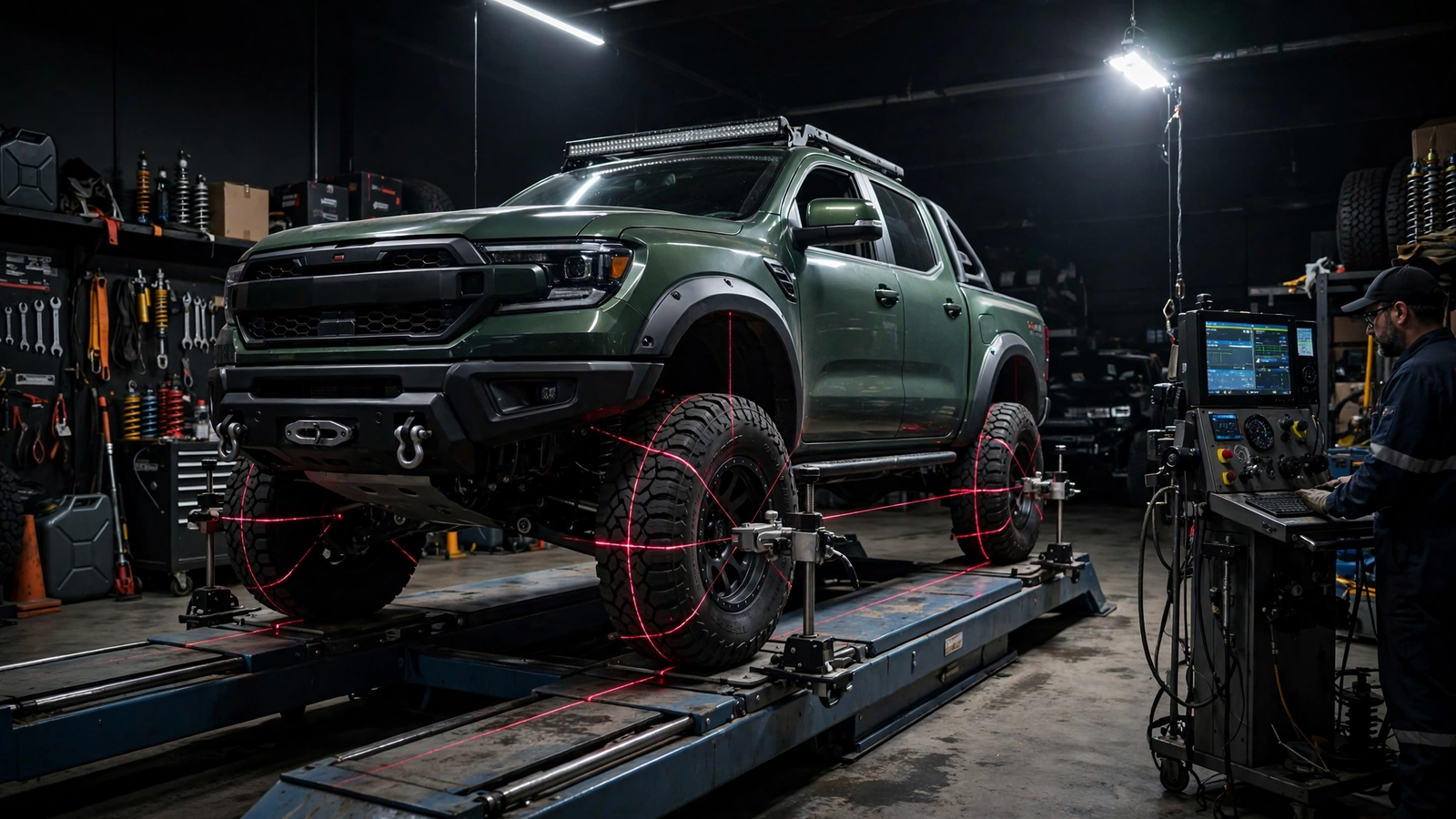
Do you need an alignment after installing a lift kit? Without exception on independent-front-suspension trucks: yes, immediately, before any real driving. Any change in ride height rotates the steering geometry — toe, camber, and caster all move — and the taller the lift, the further they move. A leveling kit shifts toe nearly a degree per side; a 6-inch lift can move things so far that the factory adjustments cannot even reach specification without aftermarket help. The tires always pay first, which is why the alignment belongs in the original project budget.
The reason is baked into suspension design. Control arms, tie rods, and steering links are all fixed-length components swinging through arcs, so changing where the suspension rests in its travel changes every angle at once. This is not a wear item that drifts out gradually; it is an instant, guaranteed geometry change the moment the truck comes off the jack stands at its new height. This instant change is the whole reason do you need an alignment after installing a lift kit is never really a question for IFS trucks.
That is why every reputable lift kit includes alignment-required language in the instructions, and why shops that install lifts daily treat the alignment as the final step of the job rather than an upsell. Our suspension lift kits guide explains the geometry each lift height creates, and the installation cost breakdown shows where the alignment sits in the total project budget. Skip it, and the most expensive parts of your build — the tires — pay the price first.
| Lift height | Alignment urgency | What it typically needs |
|---|---|---|
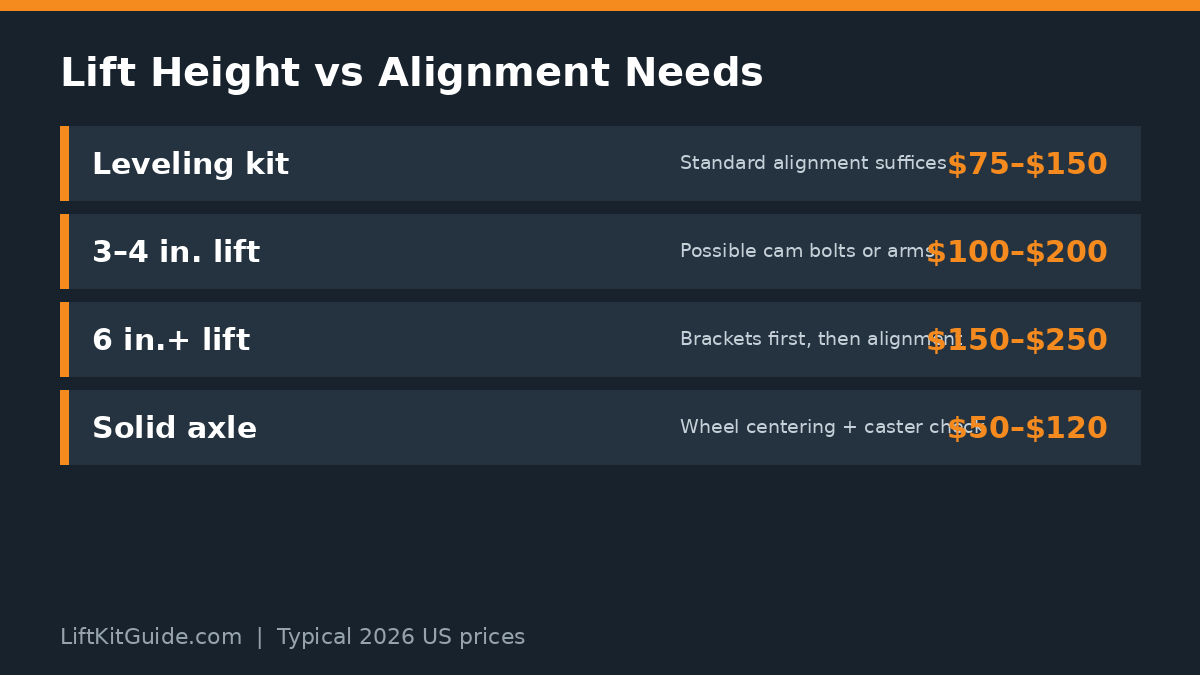
| Leveling kit (1.5–2.5 in.) | Immediate | Standard alignment; $75–$150 |
| Suspension lift (3–4 in.) | Immediate | Alignment + possible cam bolts or UCAs |
| Tall lift (6 in.+) | Immediate + correction first | Drop brackets, arms, then specialty alignment $150–$250 |
| Solid front axle | Check, often partial | Steering-wheel centering; caster check |
Why Does Lifting a Truck Change the Alignment?
Lifting changes alignment because alignment is measured relative to ride height, and a lift kit redefines ride height. At the factory setting, the control arms sit at a designed angle, the tie rods are level, and the steering axis has its intended tilt. Raise the chassis 4 inches and every one of those components now operates at a different point in its arc — the wheels tilt, the toe shifts, and the steering axis leans differently. The rack establishes the new baseline; nothing else in the garage can do that job.
Toe is always the headline casualty. As the suspension droops to its new resting position, the tie rods pull the front of the tires into a new toe angle — typically toe-in on most trucks — and even half a degree per side scrubs tread at an alarming rate. Camber follows the control-arm arc outward into positive territory, loading the outer tread edge. Caster, the angle that gives your steering its self-centering stability, usually decreases, which is why lifted trucks can feel darty until properly aligned.
The change is also permanent until corrected. Unlike tire pressure or a loose bolt, geometry does not settle back on its own — the truck will hold its new, wrong angles forever, wearing tires the entire time. This is the core answer to do you need an alignment after installing a lift kit: the lift did not knock something out of place, it moved the entire frame of reference, and only a calibrated alignment rack can establish the correct new baseline.
Do You Need an Alignment After Installing a Lift Kit on a Solid Front Axle?
Do you need an alignment after installing a lift kit on a solid front axle? Here the answer genuinely softens. Trucks like the Ford Super Duty and Ram 2500/3500 ride on a rigid front beam: the whole axle moves up as one piece, so camber and toe — the angles that depend on independent control arms — barely change. The beam does not know or care that it sits 4 inches higher. Recentering takes minutes with basic hand tools and immediately fixes the crooked-wheel complaint.
What does change is steering centering and sometimes caster. The drag link connecting the steering box to the axle shifts geometry with ride height, so the steering wheel typically sits off-center after the lift. The fix is a straightforward drag-link adjustment, not a full alignment. Caster can also drop enough to hurt highway manners, which is why many solid-axle lift kits include caster correction shims or adjustable control arms as standard equipment. Many kit makers include these shims in the box precisely because the issue is so predictable.
That said, “usually fine” is not “always fine.” After any solid-axle lift, verify the steering wheel centers properly, the truck tracks straight without constant correction, and tire wear stays even across the first few thousand miles. If anything feels off, get it on the rack — some solid-axle trucks need a proper alignment plus caster correction to behave. The leveling vs lift comparison breaks down which suspension designs respond which way. A quick check costs little and confirms whether your truck is one of the lucky ones.
What Parts Might the Alignment Shop Say You Need?
The most common surprise on the alignment rack is running out of factory adjustment. Camber and caster are set through slotted holes and eccentric bolts with limited travel, and taller lifts push the geometry past what those slots can correct. When the technician’s printout shows an angle stuck in the red at full adjustment, the truck needs aftermarket hardware — not a better technician. For anyone asking do you need an alignment after installing a lift kit on a tall lift, missing brackets are the first thing to rule out.
Cam bolts with a wider eccentric range are the entry-level fix at $50 to $150 installed, and they solve most 2- to 3-inch lift alignment shortfalls. For 4-inch and taller lifts, aftermarket upper control arms with corrected ball-joint angles and built-in caster are the proper answer at $400 to $1,000 — our upper control arm guide details exactly when arms become mandatory rather than optional. That is still cheaper than the tires you will buy if the angles stay wrong.
On 6-inch bracket lifts, the correction parts are usually in the kit already: differential drop brackets, track-bar relocation, and steering correction all exist to bring the geometry back into a range the alignment can finish. If your tall lift was installed without its correction brackets — a disturbingly common shortcut — the alignment shop cannot fix the angles, and the missing parts need to go on first. This is why do you need an alignment after installing a lift kit is really two questions: are the correction parts installed, and then are the angles set.
| Correction part | When it is needed | Typical cost |
|---|---|---|
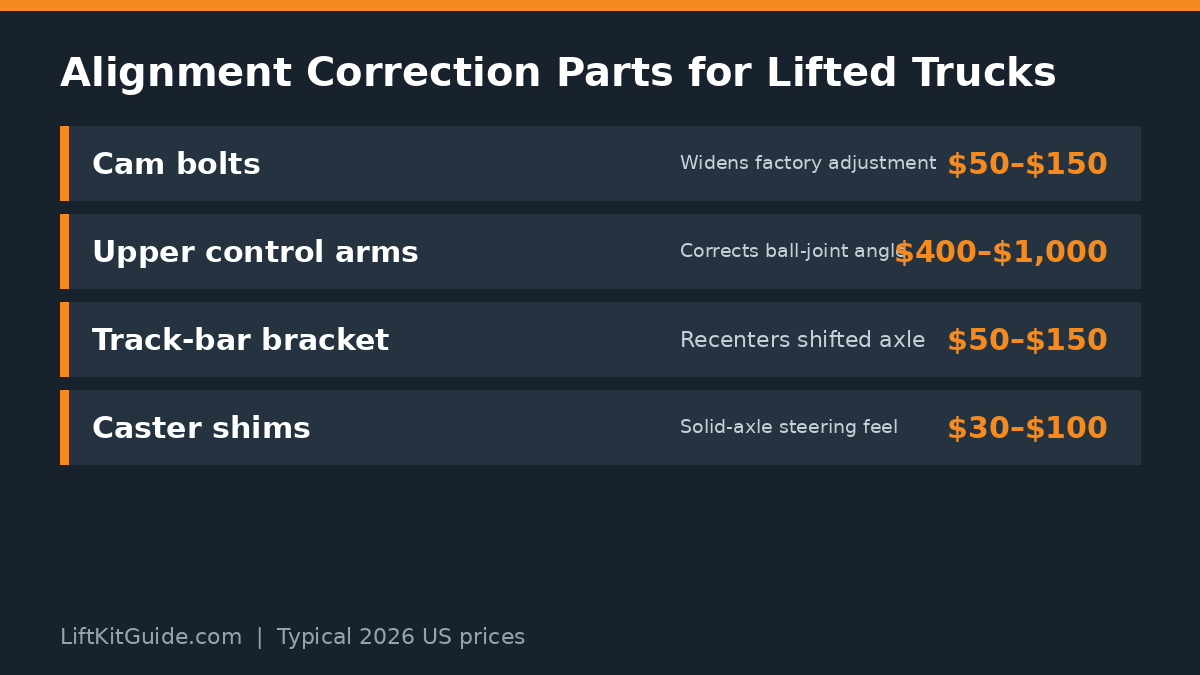
| Cam bolts | Factory eccentrics run out of range | $50–$150 installed |
| Upper control arms | 3 in.+ lifts; ball-joint angle maxed | $400–$1,000 installed |
| Track-bar bracket | Axle shifted sideways on tall lifts | $50–$150 |
| Caster shims | Solid-axle trucks with vague steering | $30–$100 |
How Is Aligning a Lifted Truck Different From Stock?
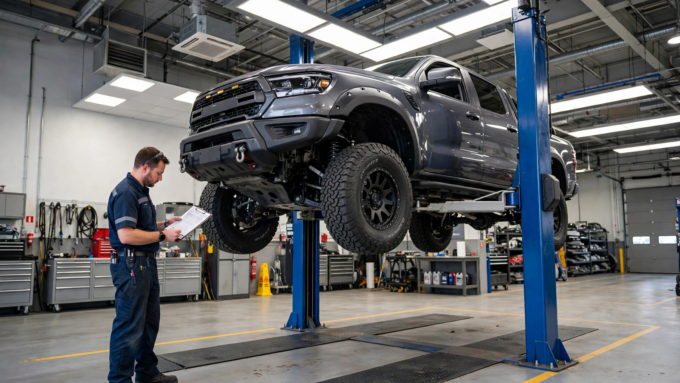
Aligning a lifted truck starts from a different baseline: the technician is not restoring factory geometry but establishing correct angles at a ride height the factory never designed for. Stock alignments follow the book — set everything to the middle of the factory range and move on. Lifted alignments require judgment about which end of the range serves the truck best, especially for caster, where more positive angle buys the highway stability that bigger tires try to take away. Book the specialty shop first and skip the disappointing detour.
Modified adjustment points are the second difference. A stock truck aligns through factory eccentrics; a lifted truck may align through aftermarket cam bolts, adjustable control arms, or slotted aftermarket brackets the technician has never seen before. This is why the shop matters enormously — a tech who aligns lifted trucks weekly knows these parts by sight, while a general-service tech may stare at an aftermarket arm wondering which bolt does what. Ask which aftermarket parts the tech sees most often — the answer reveals real experience.
The third difference is time and cost. A stock alignment is a 45-minute, $100 job. A lifted truck with correction parts can take twice as long as the tech iterates toward the best compromise the hardware allows, which is why specialty off-road shops charge $150 to $250. Paying for that expertise beats paying twice: once for a cheap alignment that could not reach spec, and again for the shop that fixes it properly. Paying for real expertise beats paying twice, which is why do you need an alignment after installing a lift kit should really ask where, not whether.
Should You Align Before or After Bigger Tires Go On?
The alignment should happen after the lift, but the tire question has a nuance: align on the tires the truck will actually run. Alignment angles do not change when you swap tires, but bigger, heavier tires amplify small alignment errors — a quarter-degree of toe that was harmless on stock rubber wears 35s visibly faster. If new tires are part of the project, the ideal sequence is lift, align, mount tires, then recheck. Get this sequence right and your expensive tires never see a single unaligned mile.
There is also a practical reason to align before the new rubber goes on: the old tires are already destined for replacement, so any microscopic wear during the short drive to the alignment shop costs nothing. Mount $1,500 worth of fresh all-terrains first and then drive to the shop unaligned, and you have spent the first miles of their life scrubbing. Sequence the project so the expensive tires never experience unaligned geometry. The few miles to the shop on old rubber are the cheapest miles of the whole project.
When you arrive, the five things above are what separate a good alignment visit from a wasted one. The printout deserves emphasis: it is the only objective record of what was done, and any shop that resists showing numbers is a shop to leave. Do you need an alignment after installing a lift kit is a yes — but whether the shop proves its work is the question that protects your wallet. A resistant shop is telling you everything about its standards — believe it and leave.
- Tell them the lift height: the exact inches change which specs the tech targets.
- Tell them the kit brand: some kits have known quirks the tech should expect.
- Tell them about correction parts: arms, bolts, and brackets change the adjustment procedure.
- Ask for the printout: before-and-after numbers are non-negotiable proof of the work.
- Ask about the recheck: confirm whether the settling recheck is included free.
What Does a Bad Alignment Feel Like on a Lifted Truck?
A bad alignment on a lifted truck announces itself first through the steering wheel. The wheel sits off-center when driving straight, the truck needs constant small corrections to hold a lane, and on the highway it may wander or feel darty over grooves and seams. Lifted trucks already ask more of the driver with bigger tires and higher centers of gravity, so alignment slop that would be a minor annoyance stock becomes genuinely tiring. Do you need an alignment after installing a lift kit if the truck already feels bad? Even more so — those symptoms are the geometry crying for help.
Tires tell the rest of the story, usually a few thousand miles later. Feathered edges you can feel with your palm, one shoulder wearing faster than the other, or a new humming drone at highway speed all point to angles that were never right or that moved after the install. By the time the wear is visible, the alignment has been wrong for a long time — which is why the recheck schedule matters as much as the initial alignment.
Sometimes the symptoms masquerade as other problems. A vibration that appears after a lift gets blamed on tire balance or driveshaft angles when the real culprit is toe scrub; vague steering gets blamed on the lift kit’s handling when it is actually insufficient caster. If your lifted truck developed a new behavior right after the install, suspect the alignment first — it is the cheapest thing to check and the most commonly skipped step. Our death wobble guide covers the scarier end of post-lift steering problems.
How Often Should a Lifted Truck Be Aligned?
Start with two alignments, not one: the immediate post-install alignment and a recheck after 500 to 1,000 miles once everything has settled. Fresh struts, bushings, and brackets shift microscopically as they take a set under the truck’s weight, and that settling can nudge angles just enough to matter on big tires. Many shops include the recheck free — ask when booking the first visit, because a surprising number of owners never know to ask. Put the recheck on the calendar when you book the first alignment so it does not slip.
After the settling recheck, switch to event-based scheduling. Pothole strikes, curb hits, and serious off-road sessions are the moments alignments actually move, so any of those justifies a trip to the rack. Annual checks are sensible for daily-driven lifted trucks, and a recheck before any long road trip on expensive tires is cheap insurance against discovering feathering 800 miles from home. Events move settings, so do you need an alignment after installing a lift kit becomes do you need a recheck after every hard hit.
Adding parts resets the clock entirely. New control arms, a different lift height, replacement steering components, or even significantly different tires all change the equation enough to warrant a fresh alignment. Think of alignment as part of the suspension system’s maintenance loop, alongside rotations and pressure checks. The lift cost guide and warranty guide round out the ownership picture — and the owners with the longest tire life are always the ones who treat alignment as routine, not reactive.
Frequently asked questions
Do you need an alignment after installing any lift kit?
Yes. Every lift height changes geometry. A 2-inch level needs a standard alignment; a 6-inch lift needs correction parts plus an alignment by an experienced technician.
How much does an alignment cost after a lift kit?
Usually $75–$150 standard, $100–$180 four-wheel, $150–$250 at specialty shops for tall lifts. Correction parts like cam bolts or control arms are extra if needed.
Do you need an alignment after lifting a solid-axle truck?
On a solid front axle the answer softens: camber and toe barely change on a rigid beam. Most just need steering-wheel recentering and a caster check. IFS trucks always need full alignment.
What are signs of bad alignment on a lifted truck?
Feathered tread edges, pulling to one side, a crooked steering wheel, vague highway handling, or new vibrations all point to alignment issues.
Do you need a second alignment after the lift settles?
Yes, plan on it. Fresh components settle over the first 500–1,000 miles. Many shops include a free recheck. After that, align on events like pothole hits or new parts.
Can you drive to the alignment shop after installing the lift?
Driving to the alignment shop is fine — go gently and directly. Avoid potholes and highway speeds. The short trip will not meaningfully wear tires.
The bottom line
Every lift changes alignment — the only variables are how much and what it takes to correct. A 2-inch level needs a prompt standard alignment; a 6-inch lift needs correction parts, an experienced technician, and sometimes a second visit after settling. The alignment is the final assembly step of the lift, not an optional extra tacked on afterward.
Build the alignment into your lift budget from day one: $75 to $250 for the service plus a contingency for cam bolts or control arms on taller kits. Choose a shop that aligns modified trucks weekly, demand the before-and-after printout, and recheck on events rather than the calendar. Do that, and the lifted truck drives as straight and true as it looks aggressive.



Leave a comment